









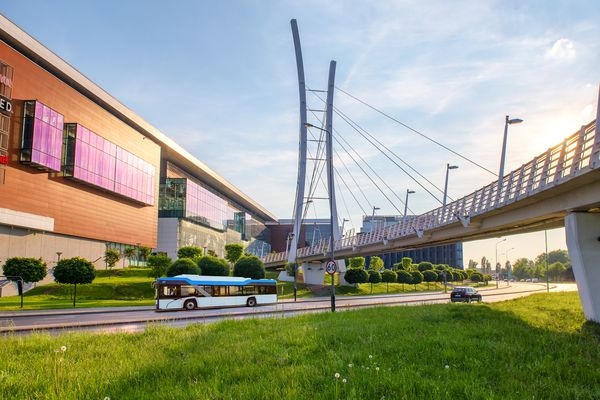
Thanks to three major orders from Berlin, Warsaw, and Milan, Solaris has taken the lead in terms of electric bus contracts won in Europe in 2019. The electric revolution in the bus sector coincides with the company’s long-term strategy, which assumes investments primarily in the development of alternative drives.
In the first months of 2019, Solaris won three huge orders for the delivery of electric buses to Berlin (BVG), Milan (ATM), and Warsaw (MZA). In total, up to 470 vehicles will leave the factory in Bolechowo for these three metropolises alone. Additionally, the manufacturer has contracted another 90 electric buses that will go to other European cities. As much as 25% of the orders for e-buses placed in 2019 by European carriers went to the Polish manufacturer. The company has thus taken the lead in terms of electric bus contracts won.
The European fleet currently numbers about 3,500 electric buses, but just 5 years ago this number was only 240 vehicles. This is an almost 15-fold increase. The European Union’s policy is certainly contributing to the growing demand for zero-emission vehicles. At the end of 2018, the European Parliament set a goal that by 2025, as many as 50% of new city buses should be e-buses, and by 2030 this share should increase to as much as 75%. The rapid pace of development in this sector is confirmation for Solaris that the direction it chose almost a decade ago, when building its first electric bus, is the right one.
Solaris offers carriers interested in transforming transport to zero-emission an electric bus fully tailored to their needs. Depending on the climate, the specifics of the line and its occupancy, and even the terrain, the electric Urbino is produced in various specifications. Solaris offers, among other things: options in terms of vehicle length, equipment, battery type, but also charging methods. The bus can be equipped with an asynchronous central motor or two motors integrated into the electric axle. Two types of batteries are available: Solaris High Energy and Solaris High Power. In the autumn, the manufacturer will present a new generation of battery storage – Solaris High Energy Plus with a maximum capacity increased by almost double. Energy storage in Solaris e-buses can be charged in two ways: quickly, i.e., in a few to a dozen minutes via a pantograph, or more slowly: via a plug-in socket. Interestingly, about 65% of Solaris electric bus customers have opted for pantograph charging. This battery charging solution is promoted by the Polish manufacturer. In the bus market, these proportions are distributed slightly differently, more or less half and half, but with a slight advantage for plug-in charging.
For many years, Solaris has been at the forefront of bus manufacturers investing heavily in the development of alternative drives. Less than a decade after its premiere in 2011, the Urbino electric carries thousands of passengers every day in 17 European countries, and the electric mileage counter has already exceeded 15 million. Solaris wants to maintain its position as a leader in electromobility, not only through the number of vehicles sold, but above all through their reliability and the increasingly better operability of the buses. Every kilometer of valuable experience allows Solaris to build better and better buses that serve the lines of large metropolises and small towns with the same efficiency as combustion vehicles, from the North to the South of the continent.