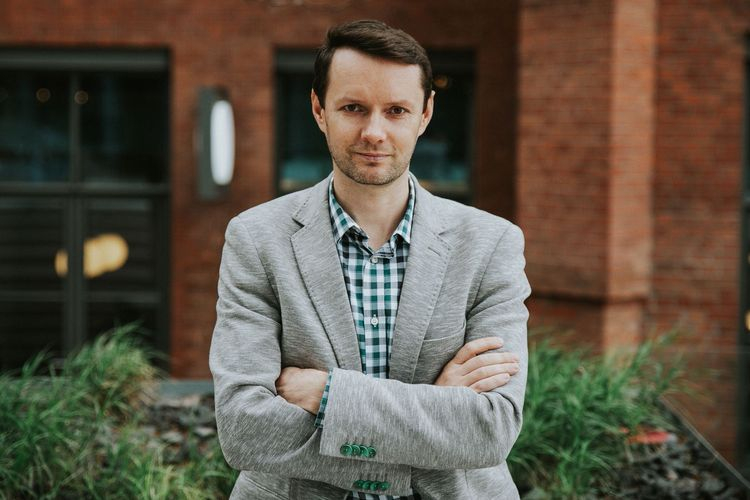
An interview with Marcin Gawroński, PhD, Eng., President of the Future Cities Foundation, Board Member of the Polish Green Building Council, and Director of the Green Building Department at Sweco Polska.
Janusz Mincewicz: The city of the future is…
Marcin Gawroński: …a city that is primarily managed effectively, with wise and empathetic leaders, which allows citizens to co-decide on its development. The city of the future should also be greener.
J.M.: Are Polish cities moving towards modernity, the expected exemplary future?
M.G.: Yes, they are, but it is more of a stroll than a brisk march. Especially if we look at the comprehensiveness of actions in all aspects of development. To the question often appearing in public discourse regarding the future of cities: “which city in Poland is the most modern”, experts rarely point to a specific local government, but focus on specific good practices in selected areas. There is no shortage of these, and fortunately, more and more are appearing. Proven ideas and implementations, in turn, are an inspiration for other cities and municipalities. Examples here include: traffic calming in Jaworzno, Gdańsk’s cycling policy, the approach to blue-green infrastructure in Bydgoszcz, or the development of standard cards along with a method for assessing the replacement value of trees in Białystok. The transformation of cities would happen faster if it were better supported by good and effective laws, rather than derailed by bad special acts, e.g., lex developer or lex szyszko.
J.M.: Before the pandemic, I was in Tokyo and Dubai, which surprised me with their modernity, especially Dubai. Are these already the cities of the future that are in our imagination?
M.G.: Thinking about the future of cities through the prism of modern technologies is already a historical approach from the smart city 1.0 era. After the evolution of this term, which in version 2.0 focused on city leaders, we are now, roughly since 2015, in the smart city 3.0 stage, i.e., a city where citizens come first. Recently, the term soft city – a friendly city – has been used. And the future of the metropolis definitely belongs to the residents and the social relationships functioning between them. The examples of cities mentioned in the question, which we know from Asia, among others, are indeed impressive. Due to their solutions or architecture, they remind us of cities from sci-fi movies, at least the non-apocalyptic ones. But there is also no shortage of examples of such bold assumptions that simply did not work out and are now abandoned or require special measures to attract people to them (e.g., Masdar in the UAE, Forest City in Malaysia, or earlier Kilamba in Angola).
J.M.: Should the cities of the future be green?
M.G.: Yes, definitely. The benefits of greenery and large trees should be reminded at every opportunity because cities still do not take good enough care of them. Trees mean lower ambient temperatures, and thus savings on energy for cooling, increased retention, absorption of CO2 and other toxic substances, higher values of neighboring properties, reduction of violence, improvement of health and stress reduction, and building bonds among residents of local communities. In a study recently conducted by the Urban Policy Observatory, greenery in cities with over 100,000 inhabitants was assessed based on satellite images. In this ranking, Koszalin took first place with a 70% share of greenery, followed by Zielona Góra, Kielce, Dąbrowa Górnicza, and Bielsko-Biała with values above 60%.
J.M.: What should good communication look like in a modern, future-oriented city?
M.G.: First of all, it should be sustainable communication, i.e., one in which the share of various forms of transport is represented relatively evenly. Examples from the Netherlands or Denmark show that this works. In Poland, however, solutions related to limiting car traffic in city centers are still perceived by the public as an attack on freedom. These changes are taking place in the fumes of a fight, not a common-sense and substantive discussion. Interchange hubs will be built, parking fees in the center will rise. This is already happening. We also hear about more and more interesting ideas related to, for example, the optimization of small freight traffic and “parcel locker mania”, namely cargo bikes and trams. An interesting report on this topic was prepared by the Miasto Jest Nasze (The City Is Ours) association.
J.M.: Polish cities have been investing in environmental protection for several years, buying zero-emission buses, eliminating coal stoves. Are these good directions for their future?
M.G.: These are, above all, necessary and fundamental directions. The air quality in Poland is one of the worst in Europe; we all suffer because of it. Changes towards its improvement are happening far too slowly. They are also more often local initiatives of local governments than effective national policy.
J.M.: Is the city of the future also a climate-neutral city?
M.G.: Of course. Bearing in mind the fact that, according to UN data, cities are responsible for nearly 80% of global energy consumption and 60% of greenhouse gas emissions, it is their duty to strive for climate neutrality. City leaders must inventory their emission sources as soon as possible, primarily buildings and transport, and then reduce emissions by all possible means, e.g., through energy modernization of buildings, investments in RES, introducing clean transport zones, and priority for zero- and low-emission means of transport: bicycles, public transport. Those emissions that cannot be avoided in the city should be compensated, e.g., by CO2 absorption by urban forests or offsetting.
J.M.: How much should resident participation be in creating urban projects dedicated to them?
M.G.: I think more than it is currently. This is an element definitely in need of improvement and development. In many cities, initiatives are appearing that give residents the opportunity to co-decide. We have all become accustomed to participatory budgets; in Gdynia or Rzeszów, urban labs have been created, in Kielce IdeaLab. I myself received an invitation from the city this year to the Poznań Citizens’ Panel on climate change, but in the end, I was not drawn into the working group. The voice of residents is important and valuable, but there are projects where it should not be dominant. Experts, scientists, urban organizations, and activists also play a large role. The topic of engaging residents was discussed during the last edition of our Future Cities conference, in an interesting conversation between Dr. Piotr Czyż and the Deputy Mayor of Ursynów, Bartek Dominiak, a recording of which will soon be available on the conference website. Speaking of citizen participation in urban projects, it is worth mentioning the private sector. Among developers, this phenomenon is still extremely rare and most often avoided. However, there are examples that include neighbors and local communities in the decision-making process, e.g., consultations regarding the implementation of Park Wilanów by the Ceetrus company, conducted by A2P2. You can also find examples of private participatory budgets, e.g., Olivia Business Center in Gdańsk.
J.M.: One of the well-known politicians told me that Poland and Polish cities are recently undergoing changes like those during the time of King Casimir the Great, who found the country wooden and left it brick. Isn’t he exaggerating?
M.G.: I don’t know which politician thinks so and what he meant, but I don’t think Polish cities are undergoing such changes. The reference to the case of Casimir the Great also appeared at our conference, on the occasion of a lecture on the tallest wooden building in the world in Norway’s Mjøstårnet, which has 18 floors and is over 85 m high. One of our participants joked that “Casimir the Great is turning in his grave”. The development of wooden construction in Poland, in the commercial real estate sector, is still a song of the future. In Scandinavia, it is already the dominant direction of development. Wooden or hybrid buildings have a much lower embodied carbon footprint, an aspect currently so important for many organizations. Polish cities have other challenges: “concrete-osis” (excessive paving), such as the freshly completed example of the market square in Kutno, runaway development, ubiquitous advertisements, lack of an idea for an effective housing policy, or, as mentioned earlier, the topics of smog and transport. Cities still need to be convinced to make the right decisions, even though they are obvious to scientists or urban associations. An example could be the presentation by Prof. Mariusz Lamentowicz from the Climate Change Ecology Laboratory at Adam Mickiewicz University in Poznań, who, during the Citizens’ Panel, explained why, instead of building retention reservoirs as elements intended to potentially protect us from floods and droughts, we should take care of wetlands and peatlands, which are a natural and far better means of protection.
The article comes from the magazine LOGISTYKA 3/2021.
The e-edition of the magazine is available in our offer!
Stay up to date, subscribe to the LOGISTYKA magazine!