









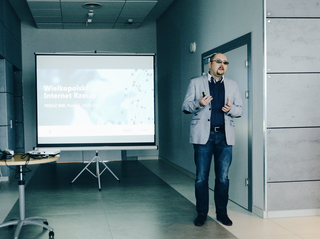
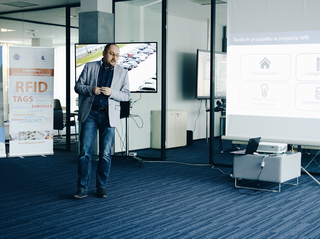
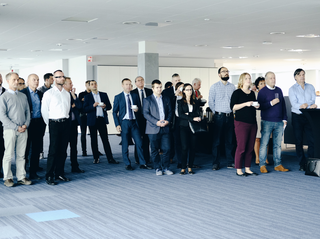
On October 20, a presentation of the innovative Greater Poland Internet of Things (WIR) project took place at the Talex headquarters. During the presentation, the capabilities of a long-range wireless sensor network were demonstrated in four potential applications: residential buildings, industrial solutions, urban environments, and agriculture.
The Greater Poland Internet of Things (WIR) is a project involving the construction of a multimodal sensor network in several cities across the Greater Poland region. WIR will utilize Internet of Things solutions developed by experts from the Institute of Logistics and Warehousing and project partners (Talex, PCSS, Inwebit, Sonalake, Zeto). These will include, among others, base stations and mobile devices known as beacons, which allow for sensory and identification functions. WIR network resources will be open to companies creating innovative services and products. Data from devices operating within the WIR network will be collected, processed, and shared in a unique, internationally scaled, event-based database operating in the cloud.
 |
 |
Representatives of the consortium prepared installations in a real-world environment. Participants of the showcase were invited, among other things, to a kitchen, where, using everyday appliances, solutions involving remote control and monitoring of devices were presented, which impact energy consumption reduction. Monitoring of electrical devices was also presented from an industrial perspective, based on smart attachments for electrical switchboards, allowing for real-time data transmission to users without interfering with the electrical grid. The showcase scenario also included moving outside the building to present a solution for managing open urban parking lots and intelligent monitoring of agricultural crops.
The WIR project aims to lead to the implementation of the Internet of Things concept first on a regional scale, and ultimately, it may also have a nationwide dimension.
 |
 |