








To ensure constant monitoring and optimal control of the entire process in short-distance transport, DACHSER has introduced new software in Europe – Short Distance Planning. Here is the story of the transition from a paper-based to a digital system.
At the DACHSER Augsburg logistics center in Gersthofen, peak hours begin at five in the morning. The scene of all the action is the entry gates, where a new truck parks every minute, and after efficient unloading and loading, the vehicles set off for their destination.
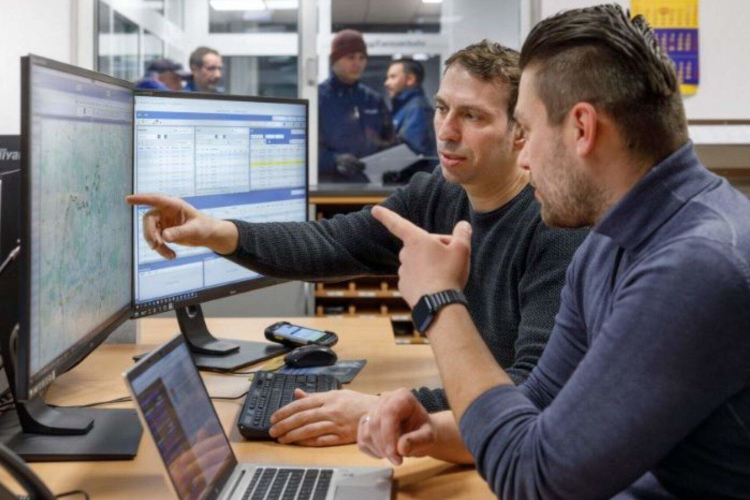
Dispatchers Markus Spanrunft and Muhammet Yilmaz are completely calm, claiming that everything is going according to plan just as it should. Although both have their workstations at some distance from all this hustle and bustle, each of them tracks the entire logistics process in real time on a large screen. There is no trace of papers, documents, or forms that usually pile up on a dispatcher’s desk.
– Welcome to a paperless world – says Markus Spanrunft with a smile – Short Distance Planning is the name of the program that DACHSER is using to completely reorganize and digitize short-distance transport planning. Its core is software that uses algorithms and artificial intelligence to optimize the shipping process and significantly increase supply chain visibility.
– Everything is very clear and user-friendly – says Carina Klaus from the Production Processes & Applications department at DACHSER. Together with her colleague Dennis Adler, she came to Gersthofen today from the headquarters in Kempten to see how the new software performs in daily use and to exchange ideas with dispatchers on its further optimization.
A new daily routine
– The decision for a completely new way of digitally recording and managing short-distance transport was born from a research project that DACHSER started a few years ago together with the Fraunhofer Institute for Transportation and Infrastructure Systems IVI. Over time, the program evolved into Idea2net – the company’s idea management program. Employees were asked to submit their own ideas – and in the end, we received 340 proposals – says Dominik Schnatterer, Department Head of Production Processes & Applications at DACHSER. Based on the collected concepts, DACHSER’s IT specialists developed the first graphical user interface and tested its usability and ease of operation during several interviews with employees. – The result is Short Distance Planning – an innovation in transport planning that was born from daily practice to bring benefits and facilitate work – says Dominik Schnatterer.
– Short Distance Planning provides us with a completely new control panel that we can use to trigger automated processes and easily view all shipment data. After an initial beta version and large-scale tests, ten pilot branches were equipped with the new software last year. The Europe-wide rollout began in the autumn. From the very beginning of the system’s development, we kept all European DACHSER Road Logistics branches in mind. Thus, creating a solution that would only function in individual countries was out of the question – says Dominik Schnatterer. The implementation of the system in Europe is a seven-stage process that has been ongoing for two years. It is planned that by 2024, as many as 142 branches will be using this software. Branches on the Iberian Peninsula will also be included as soon as the transport management system designed by DACHSER, Domino, is introduced there.
– We needed a strong, committed team to deliver new software that supports users, partners, and customers across the European network in such a short time – says Dominik Schnatterer. – Our core team consisted of about 20 people from the branches, IT department, requirements management, and my department, so we decided to combine many different skills and experiences.
Noticeably easier
– IT developers were particularly keen on feedback from users at the pilot branches. From the very beginning, it proved to be very positive. “In transport planning, we deal with a very heterogeneous environment involving various data sources and delivery conditions – says Carina Klaus – This meant that in the past, we dealt with many different forms and documents that caused a huge administrative burden for dispatchers and drivers but did not support the flow of information during the ongoing process”. In contrast, Short Distance Planning provides high harmonization and standardization of processes, and the interface used is intuitive for the user. “This makes everything much easier, and from the very beginning, because the system is simple to operate and you can start working on it immediately.
The goal is maximum supply chain visibility, and for the DACHSER team, this is also a clear message.
– At DACHSER, digitalization is never an end in itself; it serves people, not the other way around – emphasizes Dominik Schnatterer – That is why algorithms are not responsible for short-distance planning. Rather, they present suggestions that support the daily work of people responsible for planning and cooperation with drivers.
– For example, the use of the new software has already clearly improved communication between dispatchers and drivers. This is very visible in Gersthofen, where piles of paper no longer accumulate at the dispatcher’s station because Short Distance Planning transmits data wirelessly to mobile devices, which has increased work comfort. However, this does not mean the end of direct interaction between dispatchers and drivers. “During the delivery process, we can pass on information such as, for example, a route change as a result of traffic incidents – says Markus Spanrunft.
– Our goal is to deliver goods to customers always on time and to achieve a precise delivery window with the capabilities available at that time – says Christian Schnabel, Operations Manager at the DACHSER Logistics Center in Gersthofen. – This summarizes the users’ expectations of the new system, and the experience gained so far in logistics confirms his team’s forecasts. Short Distance Planning gives us a completely new control panel that we can use to trigger automated processes, such as notifying and retrieving all shipment data in real time – says Christian Schnabel with satisfaction – This means we can be proactive in route planning, not just reactive. It also ensures maximum process transparency. The fact that this also significantly increases delivery rates within selected time windows is something that our employees, drivers, and customers greatly appreciate. Because planning results are generated earlier and are more precise, short-distance organization also optimizes the flow of goods in our transit terminal. So everyone is a winner.
– It is already daytime in Gersthofen. By eight in the morning, the situation in the transit terminal has calmed down significantly – For Markus Spanrunft and Muhammet Yilmaz and their guests from Kempten, it was an opportunity to take another look at the processes – It is really great that using this system is so easy and understandable – says Muhammet Yilmaz.
Source: Dachser