








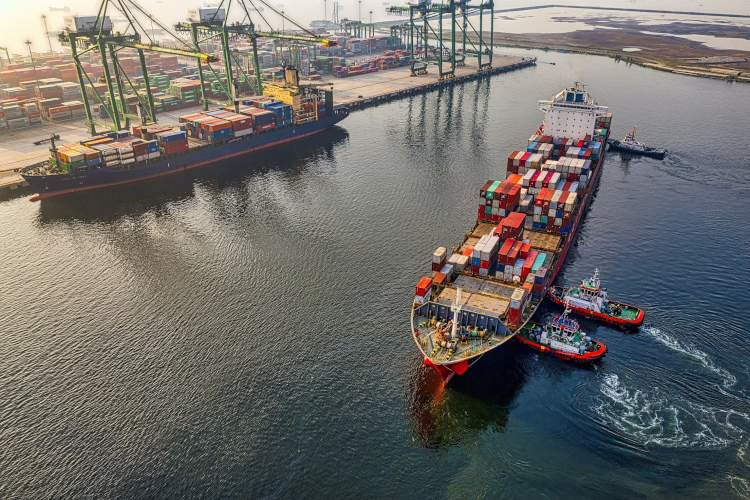
In global trade, maritime transport plays a key role (80% of global goods deliveries are carried out by sea). Deliveries take place along selected shipping lanes, which have specific routes that affect delivery times. Companies involved in the production of wine and alcoholic beverages, by knowing the maritime routes used for transporting goods, can better plan shipments and manage the supply chain, minimizing costs and delivery times. Hillebrand Gori, a logistics operator specializing in beverage handling, explains the current situation on the most important ocean routes for the industry.
Main shipping lanes in the world
Shipping traffic can be measured by the number of passing ships or the volume of cargo. The largest and most well-known include:
- The English Channel. Regardless of the measurement method used, the English Channel separating Great Britain and France is the busiest shipping route in the world. 500-600 ships pass through the Strait of Dover, its narrowest part, daily, and designated traffic lanes prevent collisions.
- The Strait of Malacca. This is a shipping lane running between Indonesia, Malaysia, and Thailand, which connects the Pacific and Indian Oceans. Every year, about one-third of the total volume of world trade passes through the strait.
- The Panama Canal. It is one of two, alongside the Suez Canal, most strategically important man-made waterways in the world. It is approx. 65 km long and stretches from the Caribbean Sea to the Pacific Ocean.
- The Suez Canal. Flowing through Egypt, the Suez Canal, which is over 160 km long, connects Asia with Europe. In 2019, 18,880 sea vessels passed through it, making it one of the busiest shipping lanes in the world.
- The Strait of Hormuz. The Strait of Hormuz, which separates Iran from the Arabian Peninsula, has global strategic and economic importance. In the first decade of the 2000s, one-third of all maritime trade passed through it.
Electronic shipping lane maps track maritime traffic
Even on the busiest shipping lanes, congestion and bottlenecks can form, which affects the decision on choosing a delivery route. Maps such as Marine Traffic, operating based on AIS (Automatic Identification Systems), are used to track global ship traffic live. Other shipping maps, such as the one prepared by Kiln based on data from the UCL Energy Institute, contain more detailed information on cargo ship movements.
The beginning of the year on the most important trade routes for Europe
Knowing the current situation on the routes is an important part of wine import and export. For deliveries to/from Europe, 3 directions are crucial – North America, Asia and the Middle East, and Asia – North America.
The beginning of the year on the Europe – North America route brought an improvement in the regularity of ship calls according to sailing schedules and a decrease in congestion at seaports. After a temporary increase in ocean freight rates in October 2022, they are expected to remain at a stable level in the near future. The waiting time for ships to enter ports has shortened, although delivery punctuality is still affected by delays in the schedules of rail trains transporting containers from/to seaports.
The second important direction is Asia and the Middle East. Despite the easing of China’s “zero Covid” strategy, demand for sea freight and cargo supply remain low. In response, shipowners are using so-called slow steaming (reducing ship speed), which reduces CO2 emissions and allows for fuel savings. Alternative shipping routes are also chosen more often, leading, for example, around the Cape of Good Hope instead of the faster connection through the Suez Canal. Shipowner spot rates are also falling, although more slowly. In the near future, the situation is expected to stabilize, although due to Ramadan, which began on March 22, the situation may reverse.
In turn, on the Asia-North America routes, a decrease in sea freight rates is observed; they will likely remain at a low but stable level over the coming months.
– The role of specialized freight forwarding companies, such as Hillebrand Gori, is to help plan supply chains using appropriate shipping lanes and efficient transport organization, while optimizing costs. We monitor what is happening on shipping lanes and in ports around the world on an ongoing basis. The punctuality, throughput, and speed of operations are affected by container availability, congestion, weather conditions, as well as construction work or strikes. Thanks to this, we can react quickly to changes and provide our clients with the highest quality of service – says Piotr Ulatowski, Commercial & Operations Manager, Hillebrand Gori.
Source: Hillebrand Gori