








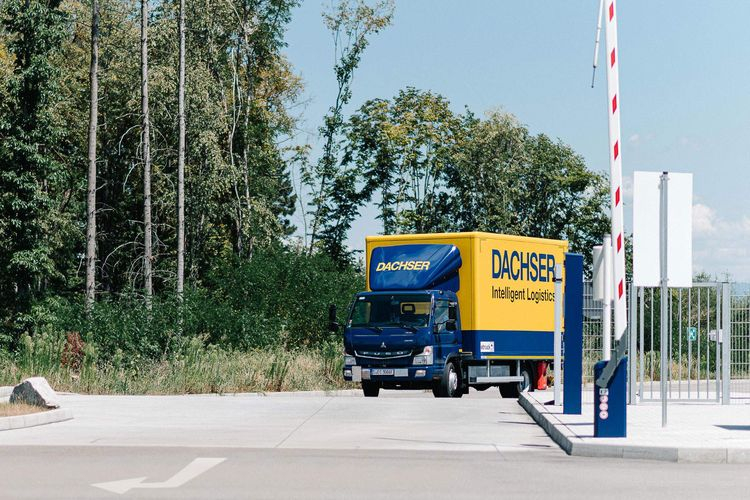
Andre Kranke, who has headed the Trends and Technology Research department at DACHSER’s Corporate Research & Development since 2019 and oversees the “Climate Protection” project, explains why there is no alternative to zero-emission transport.
Transport is currently dominated by fossil fuels. Has the transformation of logistics towards zero-emission already begun?
 Andre Kranke: Achieving climate neutrality requires drastic changes at a global level, which will encompass all sectors of the economy and extend into our private lives as well. Thus, the path for sustainable logistics has already been charted. Key technology decisions have been made, and only the details remain to be settled. A schedule has also been prepared.
Signs of these actions are already visible in many laws and regulations across Europe, which are either already in force or in the preparation phase…
A.K.: There are many regulations that we must comply with as representatives of the logistics industry, but three regulations require our special attention. One of them is the revised European Union Renewable Energy Directive 2018/2001, also known as RED 2. It sets targets for EU member states regarding the percentage share of energy from renewable sources – wind, solar, or biomass.
What impact does this have on the transport industry?
A.K.: Fossil fuels are becoming more expensive, as we can see every day when refueling our cars. The German Fuel Emissions Trading Act (BEHG), which came into force on January 1, 2021, caused the price of diesel to rise by approximately 8 euro cents gross per liter. And this is just the beginning. This national emissions trading system, which imposes a price of 25 euros for every ton of CO2e, will remain in effect until 2026. Costs are constantly rising and will reach a minimum of 55 euros per ton of CO2e; which means a price increase of more than 8 euro cents per liter of diesel. Incidentally, this also applies to other fossil fuels – transport and heating fuels, such as heating oil, gas, LNG, or CNG.
These regulations currently apply only in Germany. Is a similar concept planned across Europe?
A.K.: The European Union is planning to extend CO2 emissions trading to the transport sector as part of the Green Deal, modeled on the German BEHG. Although the details have not yet been precisely defined, I assume that the transport industry will be burdened with costs in the range of 70 to 100 euros per ton of CO2 emissions from 2025. However, I emphasize that these are only my personal assumptions.
What other challenges await the logistics industry?
A.K.: An important European directive has been in force since 2019. It sets extremely clear targets for commercial vehicle manufacturers: a significant reduction in CO2 emissions for new vehicles by 2025, and especially from 2030. However, optimizing diesel technology alone will not be enough to achieve a 30 percent reduction in CO2 emissions compared to a modern Euro 6 truck from 2019. Therefore, truck manufacturers are focusing on zero-emission vehicles, which in the EU directive is clearly defined as an absolute lack of CO2 emissions and air pollutants from the vehicle’s exhaust system.
This is a fascinating topic. At the beginning, you spoke about three legal regulations that are directives of great importance for the logistics industry; what is the third one?
A.K.: The EU Parliament, the Council of Ministers, and the EU Commission recently reached an agreement on the future revised Eurovignette Directive, which is an issue that is particularly relevant to the logistics industry as a cost factor. The directive will essentially establish a framework for all truck toll systems across the EU and define how such charges can be imposed and how high they can be. This system will likely be applied in Germany from 2023 and will include five new CO2 emission categories, in addition to the existing Euro 0 to Euro 6. These will play a key role in the future. According to my calculations, the difference in road tolls between a truck meeting the Euro 6 standard and a comparable zero-emission truck could be between 8 and 15 cents per kilometer for a 40-ton vehicle, in addition to standard toll charges. As a result, the growing cost benefits associated with zero-emission trucks will be an additional incentive for the development and market introduction of these vehicles by the middle of this decade at the latest.
Source: Dachser