









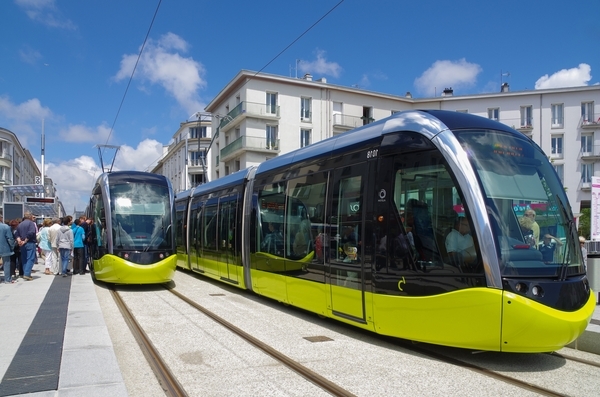
One of the main factors determining a potential passenger’s choice of transport mode for moving within an urban agglomeration is travel comfort, which is a complex issue covering visual, thermal, vibration, and acoustic aspects. In the process of moving by rail transport, a person is exposed to a number of influences that can, to some extent, determine their temporary psychophysiological state, influencing the choice of a given means of transport in the future, provided an alternative exists. Rail transport is one of the least environmentally burdensome branches of land transport. Analyzing individual types of adverse impacts of this transport on the environment, from a social perspective, the public most often complains about discomfort caused by noise and vibrations. Analysis of selected literature shows, among other things, that the effect of two or more burdensome factors on the body, such as vibration and noise, causes an increase in the total effect of their adverse impact compared to a situation where each of them occurred separately.
Rail transport in urban agglomerations and travel safety
Transport efficiency and ecological values mean that rail transport is increasingly used in urban public transport. The size, character, specificity, and the city’s transport policy determine the development of urban transport. As a result, transport as a whole constitutes an element of socio-economic infrastructure, understood as a distinct part of the system. The task of the infrastructure is to ensure the basic conditions for the development of the socio-economic system as a whole and the development of other subsystems.
The efficient functioning of urban public transport is characterized by a number of values that should be related to the users of this transport system. At the same time, the functioning of public transport can also affect entities that are not users of the system, such as people traveling in passenger cars, as part of the general local community. An important indicator of the effective use of rail transport in urban communication is the aspect of a positive image regarding the degree of travel safety. Safety in this context is understood as a very low probability of participating in a road accident, practically negligible threat from natural factors, and factors originating from the operation process. However, exposure to aggression from third parties on the way to and from stops, at stops, and in vehicles is currently of significant importance.
This dimension of safety is becoming increasingly important along with the expanding level of aggression in some social groups. Transport companies have been forced to establish close cooperation with bodies statutorily obliged to ensure order and safety in public places. Regardless of this, it is necessary to carry out other activities aimed at increasing the personal safety of passengers. These activities include, above all:
- hiring security agencies to patrol stops and vehicles,
- installing monitors allowing for the observation of stops and vehicles,
- ensuring communication between drivers and vehicle operators with services responsible for safety and order in public transport,
- accepting information from passengers about potential and currently occurring threats via a free 24-hour hotline.
All the mentioned activities are costly. As with other branches of transport, without them, it will be impossible to shape a positive image of public transport, which is so important from the point of view of competition with individual transport. Quality, reliability, and safety are the parameters by which the operation system of urban rail vehicles should be evaluated.
The article contains 21,000 characters.
Source: Logistyka Magazine