








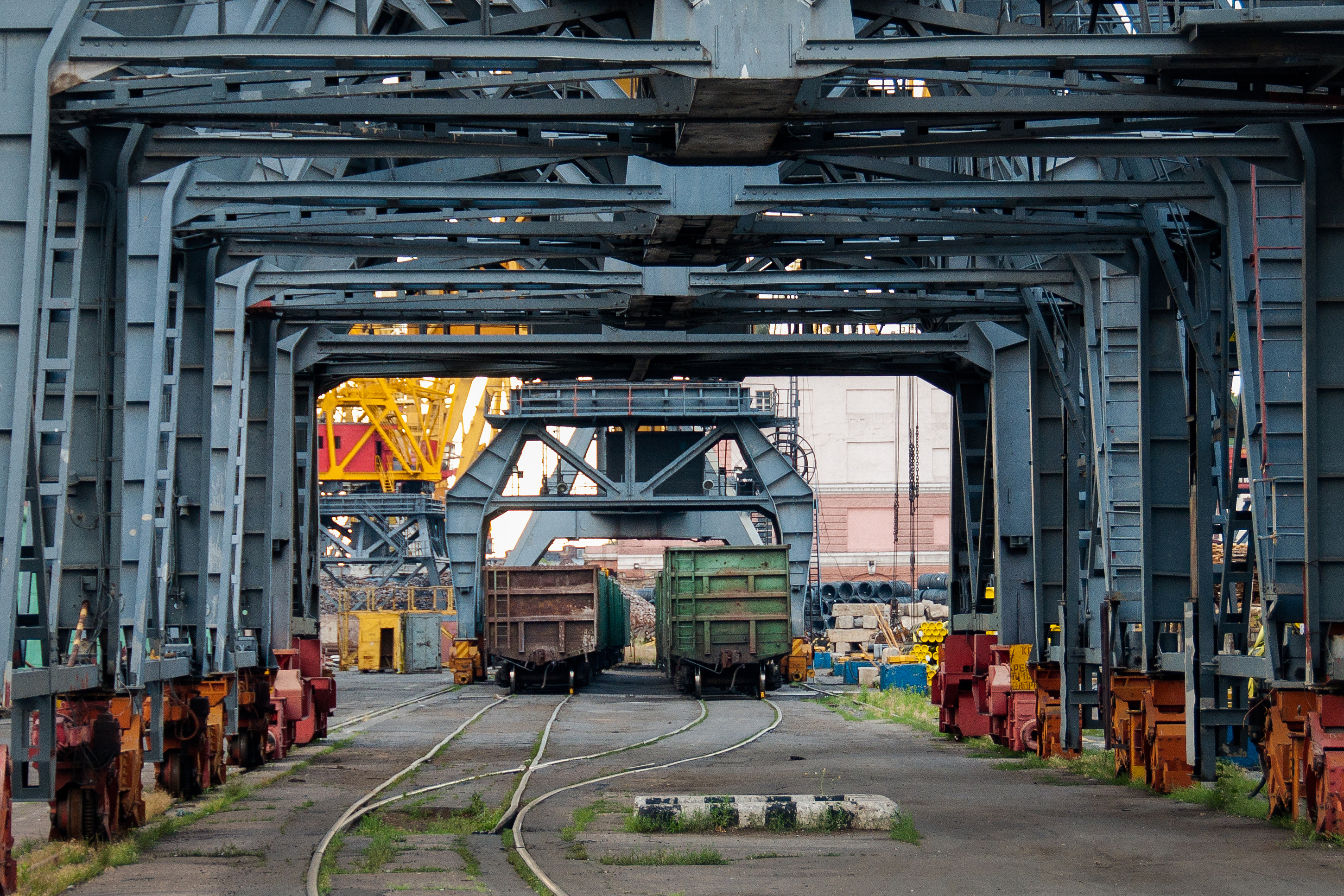
Known as Poland’s gateway to Scandinavia and serving as an important logistics hub between the south and north of Europe, the Szczecin–Świnoujście ports are developing dynamically. In April 2024, a location decision was issued for the container terminal in Świnoujście, which has a chance to be completed by the end of 2028. According to experts, a particularly important element of port development, as is the case with other ports in Poland, is rail transport, and investments in this area are especially needed. – This is our Achilles’ heel – admits Rafał Zahorski, plenipotentiary of the Szczecin and Świnoujście Seaports Authority for development.
Szczecin and Świnoujście are an important “duo” in Polish maritime transport. Both cities are the westernmost centers in our country, and their location on the Baltic Sea and in the immediate vicinity of the Oder estuary to the Szczecin Lagoon, as well as the border with Germany, is a powerful asset from a logistics point of view. Currently, in the case of Szczecin and Świnoujście, we are talking about one of the largest port complexes in the Baltic region, which lies on the route connecting Scandinavia with Central and Southern Europe. Their location is also particularly important for transport between the Baltic states and Germany. Partly for this reason, the entire complex needs investments that can influence dynamic development. Especially since ports all over the world are currently incurring expenditures on new infrastructure elements.
– All ports are investing very heavily at the moment. But they can only invest within their borders, not outside them. And unfortunately, the Achilles’ heel of our ports is rail transport, i.e., the route by which cargo arrives at the ports or leaves them. Without connecting the ports at an appropriate level, without regulating parameters to Western European standards – we are talking about train lengths of 750 m, their weight, axle load, and speed – it will be very difficult for us to compete as seaports. Hence these, and not other, results of the ports, which would be much better if our rail transport worked as it does in Western Europe – says Rafał Zahorski to the Newseria news agency.
According to the Actia Forum report, last year the ports in Gdańsk, Gdynia, Szczecin, and Świnoujście handled a total of over 145 million tons of cargo. The total result was 10 percent higher than the year before, however, growth was recorded in the Port of Gdańsk (+18.67 percent) and the Port of Gdynia (+5.25 percent), while the Szczecin–Świnoujście ports recorded a 4-percent decline. Among other things, container handling weakened, and this for the second year in a row. In the Szczecin–Świnoujście ports, the decline in this segment amounted to over 10 percent. On the other hand, the handling of grain and liquid fuels grew the most, which was influenced by the war in Ukraine.
The Szczecin and Świnoujście ports are talking about an investment “must-have” in the field of rail, which could affect their results in the coming years. Both cities are waiting for the modernization of a very important railway line running from Lower Silesia through the Lubusz Voivodeship to Western Pomerania. We are talking about line 273 connecting Wrocław with Szczecin and further line 401 Szczecin–Świnoujście.
– It has the international designation C59 and is called the “Nadodrzanka” due to its route. This is the main base cargo line for all of western Poland, not just for the Szczecin–Świnoujście port. It connects Scandinavia through maritime and ferry shipping, this cargo goes through all of Poland and to the south of Europe, e.g., to Switzerland, Austria, the Czech Republic, Slovakia, and other countries. This is a natural transport route, but for it to be competitive and efficient, it must be up to European standards. We are waiting for that. It can be seen slowly that the “Nadodrzanka” is waking up, maybe there will be modernization – assesses the expert.
On May 8, the Szczecin and Świnoujście Seaports Authority signed an agreement for the co-financing of a multimodal rail transshipment hub on the Ostrów Grabowski Peninsula in the Port of Szczecin. The total value of the project is 8.7 million euros, while the co-financing will amount to 4.3 million euros. The start of the project implementation is planned for June 2024, and its completion – for November 2026. As part of the investment, a rail transshipment station with an area of about 11,000 sqm will be built, and the ro-ro ramp will be rebuilt to allow the handling of large ships. The future multimodal rail transshipment hub, along with infrastructure for civilian and military needs, is to ensure efficient transshipment of intermodal units and military equipment onto the railway. It will be connected to the existing internal port railway system and internal port roads connected to the TEN-T core network. The project will adapt the port’s infrastructure to handle both civilian and military supplies without causing congestion in rail transport. This is one of the elements of increasing the security of EU borders and the eastern flank of NATO.
Investments in rail are also important for the West Pomeranian ports in the context of the expansion of the container terminal in Świnoujście. In April, the board received a location decision for this project from the voivode.
– We are in the preparatory period for the implementation of the first phase of the terminal, i.e., we are talking about a maximum amount of cargo passing through the terminal at the level of about 1 million TEU. This first phase is very advanced, and the location decision is actually one of the stages, of which there are still many. Today it looks like this terminal has a chance to start its operation in this first phase at the end of 2028, but that is said delicately for now, this date may change because some unforeseen issues can always appear, such as explosives, bombs at the investment site – says the plenipotentiary of the Szczecin–Świnoujście Seaports Authority for development.
Ultimately, the terminal will be able to handle up to 2 million TEU per year, simultaneously serving two ships, one 400 m long and one 200 m long. This is a strategic investment in both the area of the economy and state security.
Currently, the port in Świnoujście can accept ships with a draft of up to 13.5 m and a length of up to 270 m. In turn, the port in Szczecin, located nearly 70 km from the Baltic Sea, can accept units with a slightly smaller draft – up to 9.15 m and a maximum length of 215 m. Both ports are connected by a fairway through the Szczecin Lagoon, which takes about 4 hours to cross.
Source: Newseria