









The outstanding debt of entrepreneurs involved in road freight transport has just exceeded PLN 2 billion. It has grown by nearly 11 percent for another year, even though it was falling three years ago. Every ninth carrier fails to pay its contractors on time. According to analyses by the BIG InfoMonitor Debtors Register, one in four transport companies experienced financial liquidity problems last year, mainly due to the untimely receipt of payments for services rendered.
Transport is a key element of the entire economy. The availability of goods and their cost depend on it. Transport can account for as much as 80 percent of the final price of goods. Recent times have not been kind to carriers. Their difficult situation has been influenced by a drastic increase in fuel prices, high interest rates, rising labor costs, and finally everything related to the war in Ukraine: closed markets, the outflow of employees, competition from local companies, and protests at the border. All economic and geopolitical problems that have emerged in the country and Europe are reflected in transport. This can be seen in the BIG InfoMonitor Debtors Register and the BIK credit information database, where the total overdue debt of road freight transport increased by PLN 196 million (10.7 percent) over the year (from November 2022 to November 2023). During this time, the arrears of all companies increased by just under 8 percent. The situation was similar in 2022, and it was a significant change after the arrears of road freight transport were falling in 2021, even though overdue liabilities in the entire economy increased by 11 percent at that time.
Unpaid loan installments and invoices of companies with NACE code 49.4 (road transport) amounted to almost PLN 2.02 billion at the end of November last year. More than 25,000 active, suspended, and closed enterprises have arrears. On average, there is over PLN 80,000 per entity. The problems of road freight transport account for the vast majority of overdue liabilities of the entire transport and warehousing sector, which has over 34,000 unreliable debtors with a total amount of PLN 2.9 billion.
– The percentage of unreliable payers remains at a high level of nearly 11 percent, which means for suppliers in this industry that the risk of encountering a company in trouble is quite high. Almost every 9th transport company may not pay on time or at all. Therefore, it is worth checking future contractors for their payment reliability and monitoring the situation of regular partners – points out Sławomir Grzelczak, President of BIG InfoMonitor, and advises transport companies to do the same, because delayed payments from clients turned out to be one of the main causes of their financial liquidity problems last year, according to cyclical SME surveys conducted for BIG InfoMonitor.
Carriers from the Podkarpackie region have the fewest problems
When looking at the breakdown of unreliable payers by voivodeship, it is clear that carriers from the Podkarpackie region are doing the best. The share of companies with overdue liabilities there is 7 percent, compared to the national average of nearly 11 percent. At the other end of the spectrum are the Greater Poland, Silesian, Łódź, and Lower Silesian voivodeships, where 12 percent of carriers are in trouble.
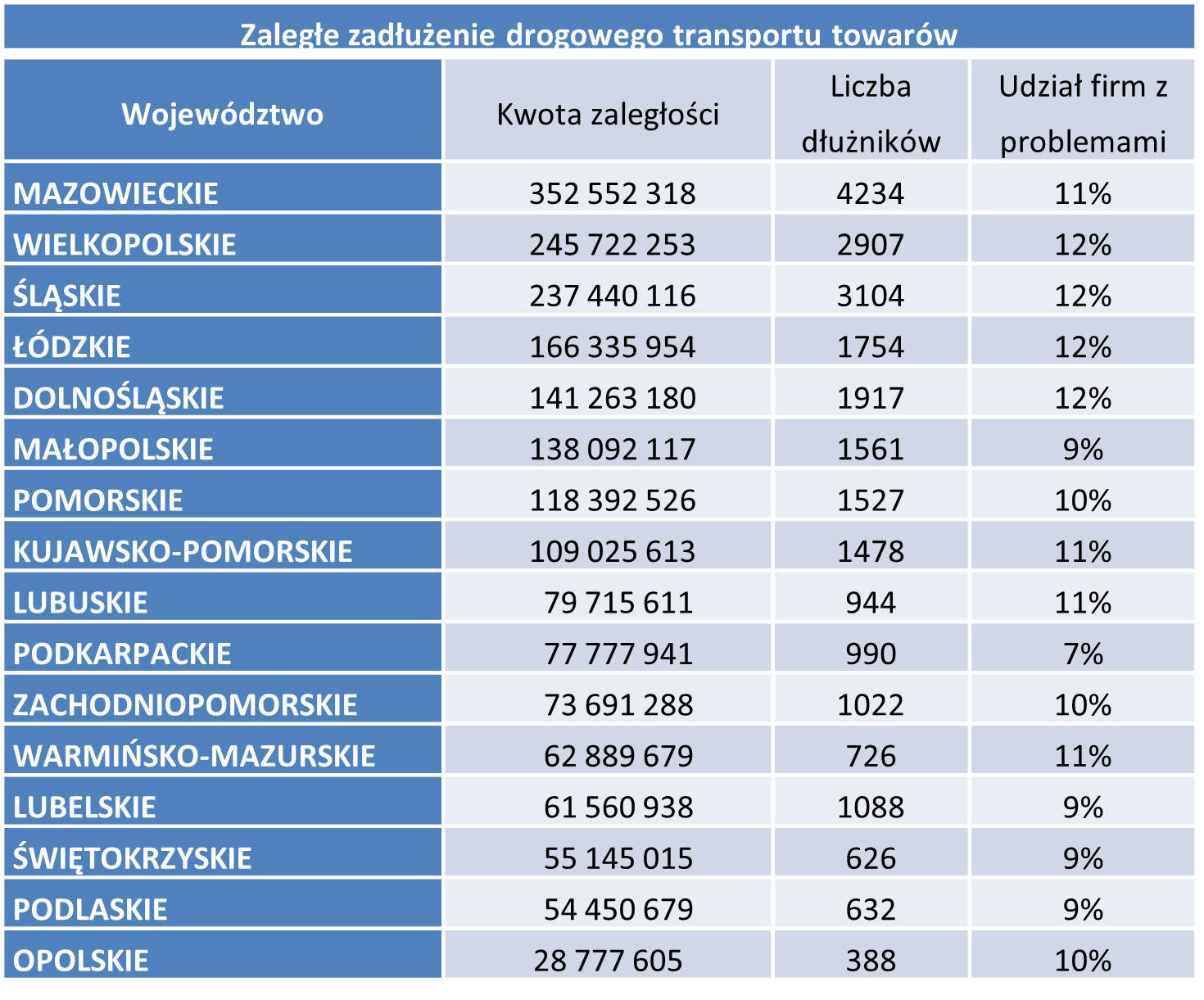 Source: BIG InfoMonitor Debtors Register and BIK database
Problems from across the eastern border
The high percentage of companies struggling to pay loan installments and invoices in the BIK and BIG InfoMonitor databases is not surprising; the transport business does not hide the fact that it is having a hard time. In the latest “SME Scanner” survey conducted for BIG InfoMonitor, the largest number of representatives of this industry stated that the company had financial liquidity problems last year; more than 1/4 of micro, small, and medium-sized transport companies admitted this. The reasons? First of all, delayed payments from contractors, or even their absence. Secondly, high inflation, which was followed by an increase in interest rates and thus the costs of servicing loan and leasing installments. Thirdly, an increase in practically all costs of running a business.
Additionally, European transport rates, which in some cases barely covered costs even before, have fallen drastically. This happened, among other things, as a result of unfair competition from Ukrainian companies, which began after June 2022, after the European Union decided to facilitate the export of agricultural products for the country attacked by Russia. With this in mind, the Union abolished the need to obtain permits for transport between Ukraine and individual EU countries. However, some Ukrainian carriers began to bend the rules and provide cabotage services within EU member states, and even between them. They can afford to offer attractive prices because they do not have to meet EU requirements regarding wages or working time. Polish carriers demanded changes for over two months by blocking border crossings with Ukraine. The change of government prompted them to end the protest at the border until March 1.
Not very optimistic prospects
At the end of 2023, 17 percent of transport companies declared that they were in poor financial condition, and another 5 percent described their situation as very poor – according to the “SME Scanner” survey. 35 percent of companies mentioned good condition, and the largest group, 42 percent of surveyed entrepreneurs, described it as neither good nor bad. Only 1.5 percent of respondents spoke of very good condition – this is the lowest percentage among the five analyzed industries.
The current year may be just as difficult. The conflict with carriers from across the eastern border remains unresolved, and due to the EU directive 2022/362, road tolls for trucks increased in some countries in December 2023, e.g., by 83 percent in Germany, and all EU countries will have to update them by March. Maximum CO2 emission standards are also being lowered every year, which will force some entrepreneurs to modernize their fleets at a high cost.
To improve their situation, 25 percent of the “SME Scanner” survey respondents from the transport industry assume that cutting expenses will be necessary. At the same time, to achieve a profit, every fifth surveyed carrier intends to maintain current margins, and every tenth intends to raise them. Only a dozen or so percent assume that they will be able to develop by improving efficiency (14 percent) and increasing sales (11 percent).
– Certainly, less tolerance for clients who do not pay on time is also necessary, because as the data from our databases and cyclical analyses prove, this is definitely not a way to deal with difficult times – advises Sławomir Grzelczak.
SME Scanner, omnibus, quantitative CATI survey among 500 micro, small, and medium-sized companies, conducted by the Keralla Research Institute in October 2023.
Source: BIG InfoMonitor