We talk to Aleksander Milon, Director of GXO Contract Logistics, about the development of e-commerce, the growing number of returns, and ways to limit them.
Michał Koralewski: A few weeks ago, GXO Logistics presented the results of a study on e-commerce trends. What are the conclusions from this study?
Aleksander Milon: The study we conducted presents trends in consumer shopping habits and retailer behavior, as well as the relationship between the development of e-commerce and the higher number of returns. The most important conclusions from this study are that as the share of online sales increases, so does the level of returns. Consequently, as many as 72% of retailers are investing in return management processes, and more than a quarter of them have recently invested in additional warehouse space. At the same time, 57% of consumers stated clearly that having a simple, free return process for ordered products is a very important factor in their online purchasing decisions.
M.K.: Do online store customers often use the option to return goods?
A.M.: Yes, and as many as 42% of online store customers return at least one item of their ordered goods. Analyses and experience from GXO show that as much as 35% of goods purchased via e-commerce are returned. Of course, depending on the country of the study, this level of returns looks different: it is usually lower in Poland than, for example, in Western European countries. The difference in individual product categories can reach as much as 20-25%.
M.K.: What is the reason for this difference? Why do Poles return fewer ordered products?
A.M.: In my opinion, this difference stems from a certain history of trade and the tradition of returns. Please note that, for example, in the German market, the return service stems directly from the model proposed by the Quelle company as early as 1927. Long before the era of computers and the Internet, Germans could buy products “remotely” thanks to Quelle product catalogs sent directly to their homes. Even then, the company had developed a very effective return management system. It seems to me that this century-long history of returns had a decisive influence on shaping consumer habits in Western countries. Today, a German customer is accustomed to ordering three pairs of the same jeans in different sizes or colors when shopping online, treating their home like a fitting room. Poles approach online shopping differently: one of the most important factors at this moment is savings, so we shop more carefully, choosing a specific product that, in theory, should not generate a return.
M.K.: Analyzing the results of the report, do you see a correlation between the development of e-commerce and the level of returns?
A.M.: Definitely yes. The number of returns in the countries where we conducted the study: the USA, Great Britain, France, and Spain, is growing year by year, analogously to the growth of the e-commerce share in the entire retail sector. This is primarily related to the growing expectations of customers. Consumers want cheap (free) and easy-to-use returns because it increases their sense of comfort and improves the shopping experience. Our research shows that many customers directly base their online shopping on whether the store offers an easy return process.
M.K.: There are companies that directly “encourage” returns by extending the return period to 100 days, offering a payment option 30 days after purchase, adding return labels to every package, extra packaging for returned products, etc.
A.M.: That is true, although in the long run, expanding return options becomes dangerous for sellers, generating constant movement of goods and incurring costs for handling the process, which does not always translate into financial profit. Additionally, making the return process too easy can lead to a situation where this option is abused. And yet, the benefit for all of us: sellers, logistics operators, but also consumers themselves, is to limit the level of returns.
M.K.: How, then, can the number of returns in online shopping be limited?
A.M.: Let’s start by answering what the main reasons for returning ordered products are. The wrong size, color, or material not meeting the consumer’s preferences, damage to the product – these are mainly the most important reasons why online store customers send back ordered products. Therefore, I believe that, first and foremost, we should place great emphasis on a very accurate product description to provide the customer with as much information as possible, answering questions that customers usually ask in brick-and-mortar stores: what is the size, what does the product look like from every side, what material was it made of, etc. I know of solutions that are based on recording each product in the form of a video presentation, where the seller shows and discusses every aspect of the product. A good solution is also the use of virtual reality, which allows, for example, placing a product (e.g., a piece of furniture) virtually directly in one’s apartment, which allows, among other things, checking the scale of the product in relation to the room. The second way related to returns due to damage to goods is the use of quality control in warehouses. In GXO warehouses, we often use such control at the entry of our clients’ products (inbound). Another control point is cameras that monitor the goods packing process. Since we are on the subject of packing, one must remember to properly adapt the packaging to the product: the more delicate and prone to damage it is, the more it should be protected in the packing process. The third way to limit the number of returns that is worth implementing is keeping accurate return statistics. The more we learn about why a customer returns a product, the better we will be able to counteract such returns in the long term. The more detailed the questions regarding product returns are, the harder it will be for the customer to abuse this process. Looking into the future, I think a good solution would be to introduce special IT security measures, consisting of identifying customers who abuse the return service (i.e., regularly ordering and returning goods without finalizing the purchase). For such customers, certain options could remain unavailable. For example, if you abuse the return service, the free returns option stops being active for you, or the next delivery is no longer free.
M.K.: Returns are not only costs for the manufacturer but also a significant burden on the environment. Excessive number of cardboard boxes or, even worse, plastic ones, increased courier traffic, etc. Can e-commerce be more ecological?
A.M.: Of course it can. Our experience shows that several immediate solutions can be easily applied: limiting the number of packages and better matching them to the product, optimizing cargo space in the truck so as not to transport air, actions aimed at increasing customer awareness that every return generates an additional carbon footprint, digitization of sales document circulation, or, for example, shifting the necessity of printing a return label to the customer. Do you realize that – referring to our research – about 35% of consumers return ordered goods, and there are companies that add a return label to every order? This means that 65% of these labels will end up in the trash. Another aspect increasing the ecological nature of e-commerce is the development of second-hand shops. This is an important trend that we see more and more often among the manufacturers themselves, who place a choice of first or second-hand products on their website, as well as thanks to the popularity of intermediary platforms like OLX. This increasingly chosen option on the Internet has become the equivalent of the old “flea market” and allows more consumers to benefit from products without the need to engage in additional production processes. Finally, this does not only apply to e-commerce but to the entire supply chain – choosing partners who will meet ISO 14001 requirements creates solutions that will be definitely more ecological.
M.K.: One of the most important global trends in e-commerce is the fulfillment of logistics processes – which can be seen in the example of China and the United States, and to a slightly lesser extent in Western European countries. In Poland, there are currently only a few dozen companies that professionally deal with the implementation of this type of service, and only 30% of online stores use fulfillment services for goods sold on the Internet – these are the conclusions from a study conducted by the Łukasiewicz – Institute of Logistics and Warehousing commissioned by GS1 Poland. Does the difference between Poland and Western countries result from a different business culture or simply from the early stage of e-commerce development in our country?
A.M.: Yes, I think we can talk about a slightly different approach to business. While in Western countries, as it becomes easier for us to sell, the entrepreneur wonders who will handle their logistics processes in a professional manner so that the saved time can be used to increase sales, in Poland, the “I will do it best myself” approach still dominates. Handling processes related to e-commerce is very complicated and time-consuming. To do it well, you need a lot of experience and appropriate warehouse infrastructure. By choosing to outsource these services, we free up time and resources that we can use precisely to increase sales or enter another, foreign market. I sell more, thanks to which I earn more than it costs me to outsource certain logistics processes. Therefore, I believe that scale also plays a significant role in the development of fulfillment; China or the United States offer a much larger base of customers who generate potentially much higher sales.
M.K.: One of your company’s flagship projects is the digital warehouse of the future, built in Leicestershire (Great Britain). The facility, packed with modern technology, supports Nestle’s logistics processes using, among other things, automatic sorters, robots, autonomous vehicles, as well as predictive data and intelligent machines. For what purpose was such a warehouse created?
A.M.: We introduce automation to respond to the demands of the market, which expects us to do in one working day what we used to do in a week. Automation in the aforementioned warehouse allows for a significant reduction in delivery times. Please also note that by shortening the delivery time and accelerating logistics processes sevenfold, it would be impossible to find the number of employees who could handle the aforementioned processes. Automation responds to labor shortages. The second aspect is the growing scale of the business. Markets have consolidated and become more accessible. Sales, moving in large volumes, generate very repetitive processes that are very costly. With a large scale of sales, these processes can be optimized by handing some of them over to machines. The third reason, very important for us, is the safety of our employees. In the aforementioned warehouse, heavy boxes are moved, and many repetitive activities are performed, which, through their monotony, can become a source of accidents or injuries. Therefore, we leave heavy and repetitive tasks to robots, and we direct our team to more varied tasks that have added value. Besides, the aforementioned distribution center, combining many innovations, acts as an incubator for testing new ways of meeting logistics needs.
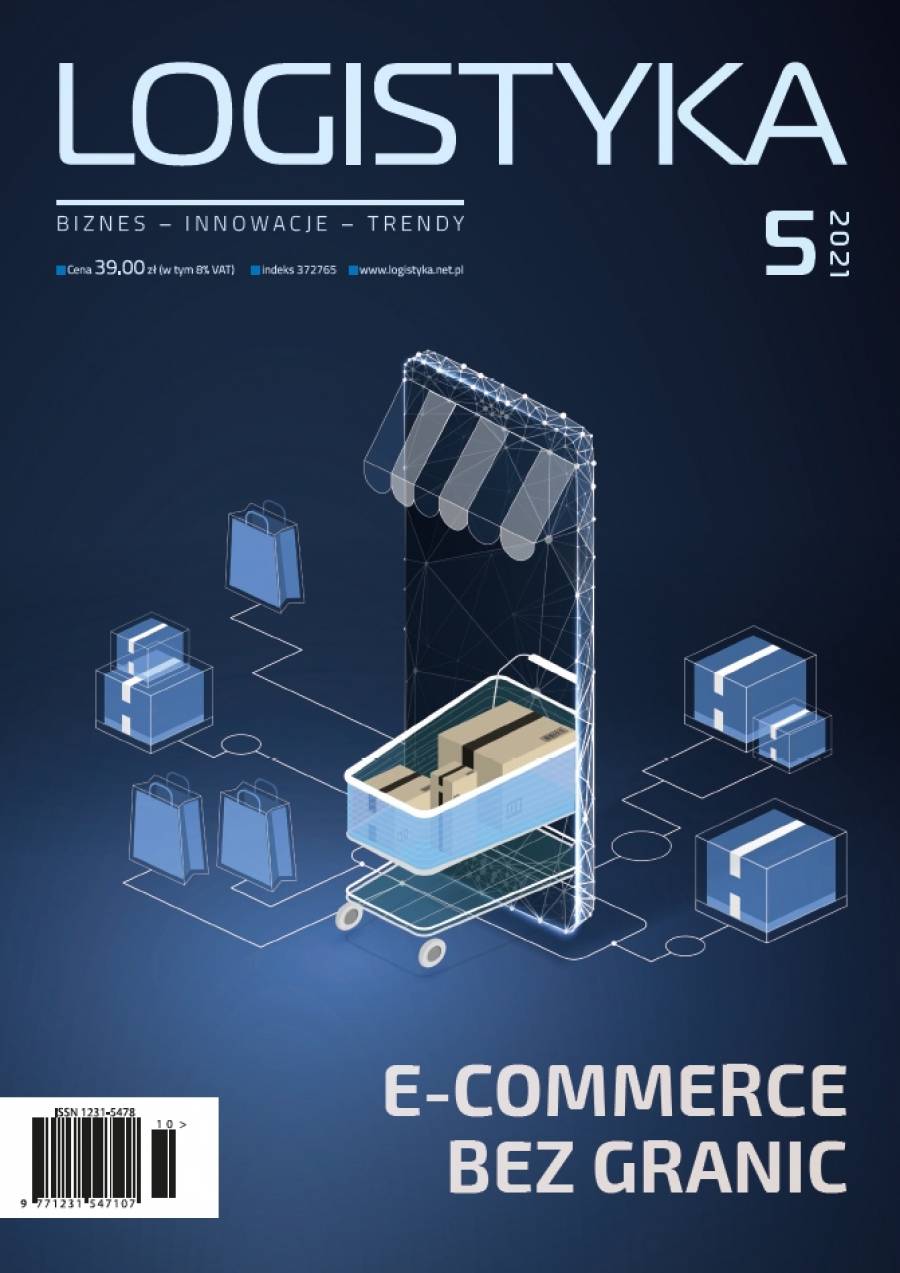
The article comes from the magazine LOGISTYKA 5/2021.
The e-edition of the magazine is available in our offer!
Stay up to date, order a subscription to the LOGISTYKA magazine!