








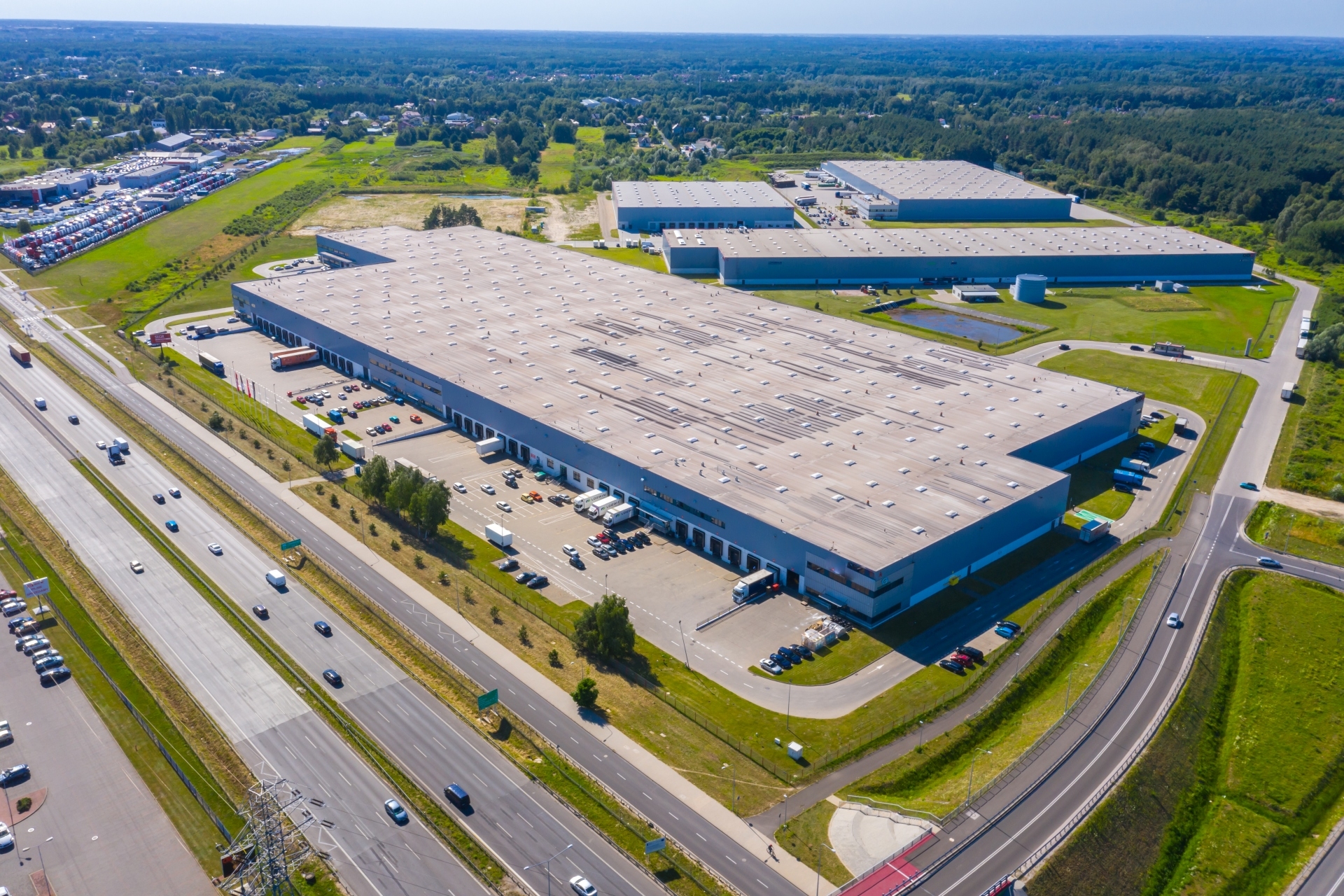
In towns around Warsaw, developers are reluctant to undertake warehouse construction on a purely speculative basis. Meanwhile, companies wanting to grow there need more options to choose from and flexibility in negotiations. Announced investments starting in the region offer hope for breaking the deadlock, according to Janusz Dudek, Senior Associate, and Katarzyna Adamska, Advisor in the Industrial and Warehouse Department at Newmark Polska.
Throughout last year, companies leased nearly 1.2 million sqm of modern warehouse space in the second Warsaw zone. This is historically the second-best result in this region (after 2023, which saw 1.277 million sqm), although to start construction on a larger scale, investors need more decisiveness from tenants, who are cautious about signing contracts for projects that exist only on paper.
The second Warsaw zone is the area from the borders of Warsaw up to 60 km from the city center. It contains modern warehouses with a total area of over 5.9 million sqm. In recent years, most of them were built in towns such as Błonie, Mszczonów, Pruszków, Nadarzyn, Janki, Raszyn, Nowy Konik, Piaseczno, Góra Kalwaria, Ożarów Mazowiecki, Grodzisk Mazowiecki, as well as Czosnów and Radzymin. As for tenants, the most interested sectors are FMCG, e-commerce, and logistics operators. The largest warehouses in towns near Warsaw leased since January last year include: H&M in CTPark Warsaw West in Wiskitki (63,000 sqm), PepsiCo in Logicor Mszczonów (58,300 sqm), Rohlig Suus in P3 Warsaw I – Lesznowola (50,200 sqm), Douglas in CTPark Warsaw South in Mszczonów (46,300 sqm), and Auchan in Logicor Mszczonów (46,200 sqm).
From the first zone to the second
The logistics development of towns near Warsaw was heavily influenced by the expansion of road infrastructure in the area, including the construction of the Warsaw bypass and new sections of the A2 motorway and the S8 expressway. Thanks to this, warehouses located in the second zone are now much better connected to the main markets in Poland and Central and Eastern Europe.
Janusz Dudek, Senior Associate, Newmark Polska
Katarzyna Adamska argues that the second zone is an excellent alternative to warehouses located in the capital – especially for tenants who do not need to be so close to the end customer and for whom efficient access to expressways and avoiding traffic jams on the city’s exit routes is more important.
Especially since the differences in rental rates between the first and second zones are really significant. For example, asking rates in Targówek range between 5.00-8.50 euros, while in Marki, Kobyłka, or Radzymin, base rents start from 4.00 euros. For medium and larger leases, these are huge differences, yet Marki and Targówek are less than a 15-minute drive apart. Hence, many companies start their operations in the first zone, e.g., as a start-up, and after a few years, they grow, develop, and relocate outside the city limits, where they can rent larger warehouses for the same rent.
Katarzyna Adamska, Advisor, Newmark Polska
In a deadlock between supply and demand
Despite the many advantages of the second Warsaw zone, new leases in the last year were not as numerous as developers wanting to start new investments in the area would have expected. Many companies whose lease contracts were expiring decided to stay in their current locations, and renegotiations accounted for as much as 41% of all leased space throughout last year, compared to 62% the year before, according to Newmark Polska data.
We see several reasons for the insufficient number of new contracts. Firstly, the low supply of new buildings does not give tenants enough choice. The difference in rents between the secondary and primary markets is also becoming increasingly visible. Base rates in the second zone in the last quarter of last year were at the level of 4 – 7.50 euros, and due to constant increases in construction materials, energy, and further increases in the minimum wage, leasing newly delivered space has become more expensive than in older warehouses. Most tenants currently operate in halls that are a few years old, which were built using similar technologies to the newest ones and also have green adjustments and environmental certificates. Therefore, tenants do not want to relocate, paying extra for rent in newer warehouses; they hold off on decisions, waiting for good offers and a wider selection.
Janusz Dudek, Senior Associate, Newmark Polska
According to market analysts, one of the reasons for the prolonged leasing processes in this region may also be a lack of flexibility in negotiations – this applies to both incentives in the form of rent-free periods and the technical adaptation of the spaces themselves.
It is primarily about the possibility of dividing halls that are available for rent. Even if the warehouse layout allows for it, such divisions require additional adjustments, e.g., running new installations, and generate additional costs, which property owners do not want to bear. They prefer to wait for a tenant who will rent the space in its entirety. Previously, carrying out such divisions was less of a problem.
Janusz Dudek, Senior Associate, Newmark Polska
Hiring an engineer and a warehouse worker
The dynamic development of logistics and warehouse centers on the outskirts of Warsaw (including the areas of Pruszków, Błonie, Grodzisk Mazowiecki) has significantly increased the demand for warehouse workers. Randstad’s analysis shows that the shortage of candidates for manual labor is primarily caused by their high turnover and wage pressure. To attract and retain employees, companies are increasingly raising wages, offering additional benefits (e.g., free transport), and reaching out to workers from Ukraine, Georgia, Moldova, and other countries.
The labor market in the region, which is seeing record-low unemployment, is a challenge.
The largest staff shortages concern warehouse workers, forklift operators, picking and packing staff, and drivers with B and C driving licenses. In response to these difficulties, companies are increasingly investing in automation and implementing logistics improvements to reduce the impact of staff shortages.
Małgorzata Mudyna, Regional Manager at Randstad.
At the same time, the proximity to Warsaw naturally attracts logistics companies and fosters the dynamic development of new technologies. Their implementation requires experienced experts who will be responsible for optimizing warehouse processes.
In this context, Warsaw’s technical universities, such as the Warsaw University of Technology, play a huge role, providing a valuable source of qualified graduates. Currently, the labor market absorbs them almost immediately after graduation because competencies in logistics automation are extremely valued. There is a high demand primarily for logistics process engineers, who play a key role in optimizing goods flows and implementing automation.
Małgorzata Mudyna, Regional Manager at Randstad
Contracts first, construction later
Warehouse resources in the second Warsaw zone at the end of the 4th quarter of last year amounted to over 5.9 million sqm of modern space.
Last year, we recorded significantly lower developer activity in towns near Warsaw. By the end of December, they had delivered only a little over 366,000 sqm of new warehouses. For comparison, in 2023, over 632,000 sqm of new space hit the market.
Katarzyna Adamska, Advisor, Newmark Polska
Among the largest investments delivered since January 2024, the expert mentions: CTPark Warsaw West in Wiskitki (over 110,000 sqm), CTPark Warsaw South in Mszczonów (67,400 sqm), P3 Warsaw I in Lesznowola (50,200 sqm), and MLP Pruszków II (33,200 sqm).
Meanwhile, half as many warehouse meters are under construction, as less than 182,000 sqm is currently being realized. In 2025, investments such as Hillwood Grodzisk Mazowiecki (51,400 sqm), GLP Warsaw VI Logistics Centre (37,400 sqm), Panattoni BTS Auchan (19,800 sqm), Panattoni Park Warsaw West in Błonie (16,500 sqm), and the expansion of the warehouse within the MLP Pruszków II park (15,700 sqm) should hit the market.
The falling number of new construction projects is still caused by more expensive investment financing, the uncertain geopolitical situation, and consequently, developers’ reluctance to take risks and start construction on a speculative basis. A few years ago, in towns like Janki or Ożarów, construction would start with the hall being 20-30% commercialized. Since the outbreak of the war in Ukraine, investors expect pre-leasing of at least half of the space being built.
Katarzyna Adamska, Advisor, Newmark Polska
First swallows near Warsaw
Despite the temporarily lower supply, the market of towns around Warsaw remains one of the most important locations on the logistics map of Poland.
The unique potential of this location is recognized by the developer CTP, which took a risk and announced the start of two investments not secured by pre-lease agreements. This spring, the construction of the first hall in Nowy Konik is to begin. The entire investment is planned as four warehouses with a total area of 76,300 sqm. In parallel, the developer has started earthworks for an investment in Janki, where it plans to build seven buildings with a total area of 45,500 sqm. Peakside also plans to deliver halls with SBU modules this year, where the minimum module is approx. 600 sqm. Other developers, although cautious about starting new investments, are also keeping their finger on the pulse all the time. There is more and more talk on the market about buying new land in the area.
Janusz Dudek.
Source: Newmark