








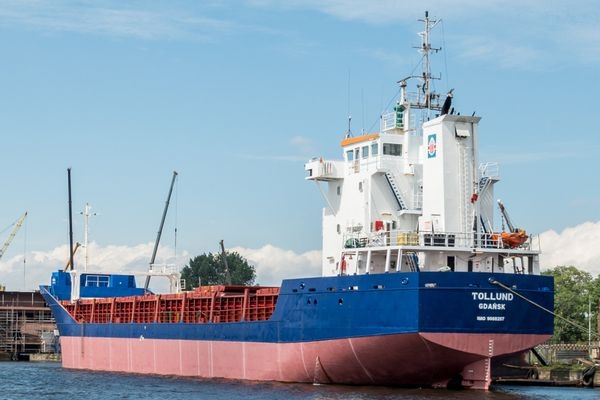
Over the last 28 years, the Polish merchant fleet in international shipping has shrunk from 247 ships sailing under the Polish flag to 96 vessels, of which only 6 currently sail in national colors. Seafarers have been discussing the reasons for this state of affairs for years, and from time to time this topic is raised in various types of legislative work, but so far without success. Why is it worth restoring the Polish flag?
– After so many lost years, it is time to take the problem seriously and regulate what is important for Polish shipowners and sailors. Restoring the Polish flag means hundreds of millions in additional revenue for our state budget, and Poland would have a chance to become the Singapore of the Baltic – says Ireneusz Kuligowski, President of the Polish Ship Managers’ Association.
Where have Polish ships docked?
In 1990, there were 247 deep-sea vessels registered under the Polish flag, but the time of economic transformation forgot about seafarers and the maritime economy, and ships had to sail and earn their keep. As a result of high fiscal and administrative burdens, shipowners began to register their vessels in countries with so-called flags of convenience (FOC), where there are simplified registration requirements and significantly lower costs of employing sailors. And so, year after year, the number of ships that remained in national colors decreased to 6 vessels.
– Worse still, unlike the European Union, where the problem was noticed as early as the 1990s (the first guidelines on this matter were issued within the EEC in 1991, subsequent ones in 2004, and amendments in 2009 and 2017), no separate social security system for sailors has been created in Poland – emphasizes the President of the Polish Ship Managers’ Association.
The above negligence has led to a situation where over 38,000 out of nearly 40,000 Polish sailors, high-class specialists (Poland has three universities educating maritime personnel), sail on ships under foreign flags.
– An additional problem is taxes. The exemption from personal income tax after working 183 days, introduced by Article 118 of the Act on Work at Sea of 2015, has not yet entered into force because the consent of the European Commission has not been obtained. Meanwhile, this is a global standard in shipping, not only in EU/EEA countries – explains Ireneusz Kuligowski. – The icing on the cake is the fact that Poland has also failed to fulfill its obligations regarding social security resulting from the Maritime Labour Convention of 2006, which provides for the creation of a comprehensive social security system for sailors.
Why are FOC countries so attractive to shipowners?
As pointed out by the President of the Polish Ship Managers’ Association, Ireneusz Kuligowski – it is a pure economic calculation. According to research by the World Maritime University in Malmö, 50 to 60 percent of a ship’s operating costs are crew costs. For example, data from the m/s Koszalin (38,000 DWT, with a crew of 18) shows that annual operating costs under the Bahamas flag amount to over 72,500 PLN, while under the Polish flag they are almost 668,000 PLN, of which over 620,000 PLN consists of social security contributions and fund contributions (FP, FGŚP, FEP, PFRON).
How to restore the Polish flag?
On the initiative of the Polish Ship Managers’ Association, a draft law has been prepared containing proposals for amendments to certain acts aimed at facilitating registration under the Polish flag. Among other things, the changes concern the creation of an insurance system for sailors, reducing the burden on shipowners in this respect, and tax changes.
– By introducing the proposed changes, assuming the reflagging of 20 ships per year, the state budget would incur costs of around 1.68 million PLN, while simultaneously gaining revenue for the Social Insurance Institution (ZUS) and the budget at the level of 6.1 million PLN, including 2.8 million PLN from health and social insurance contributions of sailors. In turn, the state treasury could achieve revenues of 247 million PLN (182 million PLN net income) over a decade, while expenditures would amount to 92 million PLN, assuming that we return to a level close to 1990, i.e., about 200 ships under the Polish flag – calculates Ireneusz Kuligowski.
For example, Norway, which is smaller than Poland and has a fleet of 1,900 vessels, generates an annual income of 16.5 billion euros from its flag. It is worth adding that maritime shipping generates about 40 percent of income within the entire maritime economy (according to the Menon & DNV GL report), and one job at sea generates up to four jobs on land.
– Knowing all this data, I dare say that Poland has every potential to become a unique center on a European scale for the management of ships of both Polish and foreign shipowners – concludes Ireneusz Kuligowski, President of the Polish Ship Managers’ Association.
Source: Polish Ship Managers’ Association