









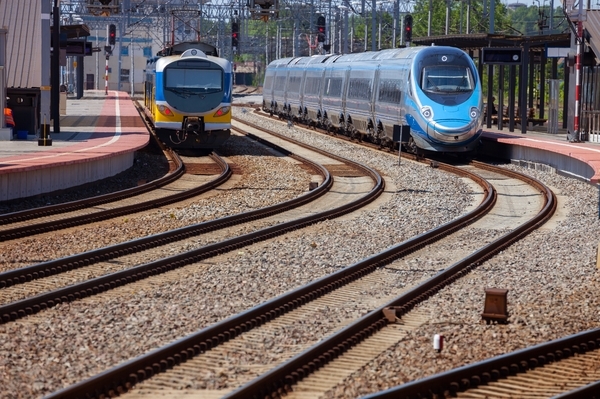
The transport system has a complex structure. This results from the tasks that are carried out within it. The activities undertaken in the system can be divided into two basic groups. The first group consists of activities related to transport. The second group consists of activities aimed at maintaining the system’s availability. It is therefore evident that numerous processes occur in the rail transport system, which are interconnected. The highest level of process integration and scheduling occurs in the case of the rail transport system.
The processes taking place in the rail transport system are extremely complex, as is the system itself. The maintenance process is linked to the transport process. The transport process is linked to the operation of transfer hubs and commercial points. Train traffic is associated with the need to secure junctions with pedestrians and cars. In this aspect, a reliable transport process is one in which the 5R rule is maintained – right place, right time, right quantity, right quality, and right goods. For the purposes of the conducted research, the focus was on the right time and the right place. Consequently, a number of problems arise related to the theoretical description of the actual system. The further part of the paper develops the most significant problems arising in the reliability research of railway systems and the motivation for modeling low-impact events.
The significance of events of seemingly minor importance
When inventorying research conducted on adverse events, it should be noted that 78% of events constitute an untapped treasure trove of knowledge. These are events resulting in delays. A train delay indicates the occurrence of some event, but also speaks of further deviations from the assumed plan. In order to prove the importance of events of seemingly minor significance (e.g., a train being 5 minutes late) and their possible influence on the occurrence of a railway disaster, a model of a railway accident occurrence was built. A fault tree analysis was used to model the process of this event occurring. Figure 1 shows a fragment of the developed fault tree. The top event of the analysis is a railway accident. A railway accident is understood here as a serious accident. For this reason, accidents with pedestrians, accidents with cars, and other events where the risk to people on board the train or significant damage to rolling stock is small were not included in the fault tree.
After drawing up the fault tree, an inventory was made of all basic events related to disrupted train traffic. These events are marked in gray. Due to limited space, it was not possible to show every branch that ends with the basic event “disrupted train traffic”. For this reason, tree interruption symbols were also marked in gray if “disrupted train traffic” was identified in the further part of that branch. As a result of the fault tree analysis, two areas were identified in which train traffic disruptions affect the possibility of a railway accident occurring. The first group is directly related to human error. Traffic disruptions can provoke employee behaviors that, in consequence, lead to an accident.
The article contains 29,230 characters.
Source: Logistyka Magazine