









After a weaker Q3 2024, the last three months of the year brought an increase in European transport rates. Unfortunately, this is not a signal of a market rebound. It is not higher demand and a growing number of orders that are responsible for the rise in rates.
Following a decline in both spot and contract rates in Q3 2024, the last three months of last year brought increases across Europe.
The contract price index was 2.8 points higher quarter-on-quarter, reaching 128.9 points.
In turn, the increase in the spot index was slight on a quarterly basis, improving by only 0.5 points to 123.9 points.
Both indices remain below the levels of the same period in 2023. In the case of contracts, it is 1.4 points lower, and on the spot market, it is 1 point lower.
It is worth noting that at the end of 2024, contract rates grew faster than spot rates and remain higher across Europe. This is the seventh consecutive quarter that we have seen such a situation. This illustrates Europe’s economic problems and low market demand – as the spot index is a kind of barometer of the current market situation. The difference between the two indices at the end of Q4 2024 was 5 points – slightly less than a year earlier, when the contract index was 5.4 points higher than the spot index.
Transport rate index in Europe at the end of Q4 2024 (Q1 2017 = 100)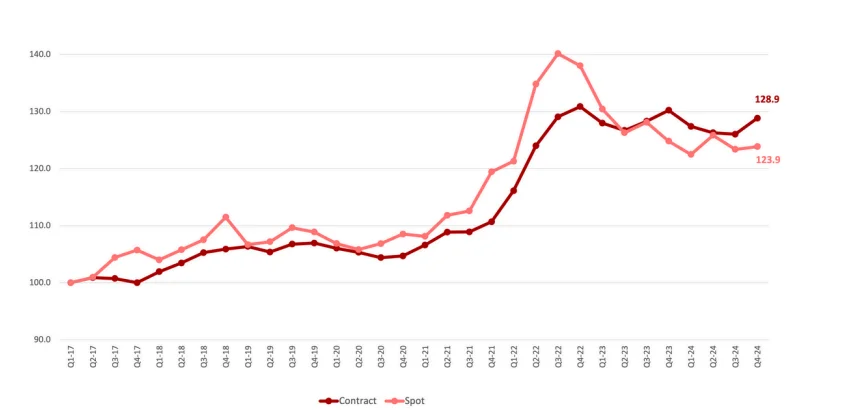
Demand is of little importance
The increase in rate indices is unfortunately not due to market demand. This, as well as the state of the European economy that influences it, still leaves much to be desired. GDP growth in the EU in Q3 2024 was a trace 0.3% quarter-on-quarter. Historically high inflation and high interest rates continue to suppress demand. However, it seems that it is slowly starting to emerge from the bottom. Inflation is constantly falling, as are interest rates, which is slowly translating into weak, but nevertheless, growth in consumption.
Importantly, households, whose spending in recent years has focused on services, unlike consumer goods that dominated during the pandemic, are slowly beginning to look favorably at durable goods again. European ports recorded clear increases in transshipments in Q3. And the level of inventories among European retailers, after years of full warehouses, is at a low or satisfactory level – which gives hope for the imminent need to replenish them.
On the other hand, these signals of a demand recovery are not visible in the industrial sector in Europe. In Q3 2024, industrial production fell by 0.8% year-on-year and 0.3% quarterly. In Europe’s two most important manufacturing markets – Germany and France – the industrial PMI index is scraping the proverbial bottom.
Costs are driving up rates
However, while demand has little impact on rates, the supply side exerts strong pressure. Firstly, the decline in new truck registrations in Europe in 2024 was double-digit. Secondly, cost pressure on entrepreneurs in the transport sector does not cease. According to Transport Intelligence, in Q4 2024, all costs, except for fuel, increased. Overall, labor costs in the EU rose by 5% year-on-year, and driver wages were the fastest growing of all sectors. In addition, the persistent problem of driver shortages will continue to drive this growth.
As various market experts have repeatedly emphasized, if we add low margins to rising fixed costs, carriers have very little room for maneuver to lower prices. This is largely the main factor pushing rates up.
Strong growth on the Polish route
We are most interested in the development of rates on the route between Poland and Germany – our country’s main economic partner. This route accounts for 40% of transport work in Polish international transport. On the analyzed Warsaw-Duisburg route, contract rates increased by 2.3% quarterly to 1,646 euros (1.52 euros/km), while spot rates increased by 3.3% compared to the previous quarter and amounted to 1,810 euros (1.68 euros/km). Year-on-year, contract transport was 8.4% more expensive, and on the spot market, one had to pay 9.4% more.
In the opposite direction (to Warsaw), contract transport cost an average of 1,235 euros (which gives 1.14 euros/km) – 7.4% more quarterly and 7.3% annually. The spot rate in Q4 was 1,447 euros (1.34 euros/km) – barely 1% more quarterly, although 10.1% year-on-year.
While across Europe the contract index has remained above the spot index since the end of 2023, the situation on the route between Poland and Germany is the opposite. To Duisburg, spot prices in Q4 were nearly 10% higher than contract prices. Moreover, the distance increased compared to the 8.9% difference a quarter earlier. In turn, on the direction to Poland, spot rates were as much as 17% higher than contract rates, although in this case the difference decreased, as it was nearly 25% a quarter earlier.
Road rates on the Warsaw-Duisburg route (C-contract, S-spot)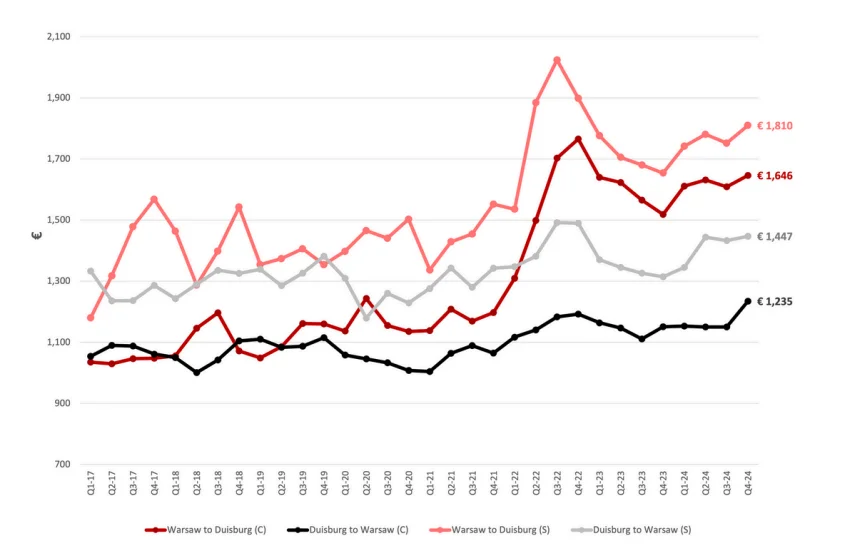
A festival of rising costs
The clear increase in rates in the recent period on routes between Poland and Germany is due to structural factors, not increased demand. In turn, the toll increases in our western neighbor’s country in December 2023, as well as the extension of charges to 3.5-7.5 t vehicles in July 2025, have raised operating costs for carriers operating on this route.
Additionally, as TI reports, in Q4 2024, the increase in labor costs in the transport sector in Poland amounted to 16% y/y and was the second highest in the EU. This creates powerful cost pressure on both the contract and spot markets. Analysts from TI expect further pressure throughout 2025. Rate cuts with low margins and rising costs are rather excluded.
Better to Italy than from Italy
The report also includes rates on another route related to our country – to and from Italy. According to calculations by TI analysts, on average, transport to the Apennine Peninsula cost 2,270 euros on contract and 2,379 euros on the spot market in Q4 2024. This means increases of 4.6% and 2.1%, respectively. Clearly larger increases are visible on contracts, which proves a greater influence of the cost side than the demand side. Year-on-year, the contract price was 2.9% higher, and the spot price was 2.4% higher.
In the direction to Poland, the average contract price was 1,709 euros, while on the spot market – 1,925 euros. Quarter-on-quarter, this is an increase of 1.3% and a decrease of 2.1%, respectively. Year-on-year, transport from Italy was 2% more expensive on contracts, but 2.1% cheaper on the spot market.
In the case of the discussed routes, the previously mentioned strong cost pressure on Polish carriers, related to rising wages and labor costs, is visible. It was this that contributed to higher increases in the direction from Poland.
Wounded powers
On the route connecting the two largest European economies, the economic stagnation of the Community and that prevailing in the transport sector are visible to the naked eye. From Duisburg to Lille, contract rates increased by 5.3% quarterly in Q4 to 680 euros (2.25 euros/km), while spot rates rose minimally by 0.8% to 694 euros (2.30 euros/km). Year-on-year, however, rates were lower – contract by 8.7%, spot by 5.2%.
In the direction to Germany, both the spot and contract markets recorded strong quarterly increases. Rates on the former increased by 6.8% (to 581 euros, 1.92 euros/km), and on the latter by 5% (to 507 euros, 1.68 euros/km). Unlike the direction to France, to Germany both rates grew year-on-year (on the spot by 8%, contract by 2.1%).
On both routes, spot rates are higher than contract rates. However, to Lille they are only 2% higher (and the difference has shrunk compared to Q3 2024), and to Duisburg by over 14%, with an upward trend.
As in the case of Polish-German routes, here too prices were mainly determined by rising costs rather than demand. The manufacturing sector in both these countries is at the bottom of the EU ranking. In turn, for example, vehicle insurance costs in Germany rose by as much as 33% year-on-year! Labor costs rose by 5% y/y in Germany and 4% y/y in France.
As on the Polish-German route, rate cuts should not be expected on the discussed route. Moreover, any increase in demand will be immediately translated into a jump in rates, as this will give carriers a rare opportunity to improve profitability.
Road rates on the Duisburg-Lille route (C-contract, S-spot)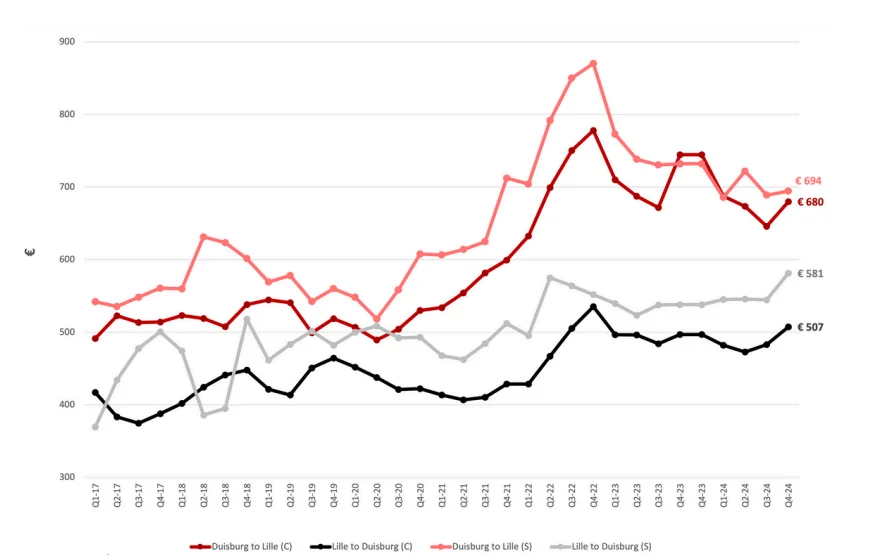
Spanish raisin in the European cake
A slightly different situation is visible on another important European route – across the Pyrenees. Unlike the countries discussed earlier, where industrial production is catching its breath, Spain is one of the few European countries characterized by an expansion of the manufacturing sector for nearly a year. This influenced the behavior of prices in this direction.
From Madrid to Paris, contract rates increased by 3.5% quarterly to 1,458 euros (1.15 euros/km), while spot rates increased by 4.5% to 1,484 euros (1.17 euros/km). Year-on-year, however, both categories fell by 5% and 2.1%.
In turn, to Madrid, contract prices increased by 3.1% compared to Q3 2024 (to 1,803 euros; 1.42 euros/km), but fell on the spot market by 5.1% (to 1,759 euros; 1.38 euros/km). Year-on-year, contracts grew by 6%, and spot rates fell by 2.3%.
Interestingly, while to Madrid contract rates were higher than spot rates (by 2.5%), in accordance with the pan-European trend, in the opposite direction they were on average 1.8% lower.
The expansion of Spanish industry is based mainly on strong demand from abroad. Hence the price increase on the route to France, which is a leading recipient of Spanish exports. Furthermore, the prospects for the Iberian economy are optimistic, which positively influences the conclusion of long-term contracts (hence the increase in rates in this category in both directions).
In turn, weaker growth on the spot market results from a slight breathlessness of industry in the last quarter of 2024 (to which the spot market reacts immediately) – here, the decline in production in the automotive sector was particularly painful. Lower consumption and a decline in economic activity due to the floods that affected wealthy regions of the country also had a significant impact.
According to TI analysts, based on analyses by the Spanish Caixa Bank, rates on routes across the Pyrenees in both directions should grow more strongly on contracts than on the spot market. This is due to fluctuations in demand in the short term, but also to optimistic medium- and long-term forecasts for the Spanish economy. It is interesting that while the increase in rates in the direction from France will be caused by the rising costs of carriers, from Spain the demand side will have a greater impact on prices.
Here rates are falling
An interesting case is the route between France and the British Isles, on which, contrary to the pan-European trend, rates… were falling. To the Isles in Q4, the contract rate was 8.2% lower quarterly and 7.8% annually. Also on the spot market, transport was cheaper than a quarter earlier (by 6.3%) and in the same period of 2023 (by 3.6%).
In the direction to the continent, the contract price was minimally higher on a quarterly basis (by 0.6%), but 3.9% lower on an annual scale. As for spot rates, they fell both compared to Q3 2024 (albeit minimally by 0.9%) and year-on-year – by 6.9%.
The level of rates to and from Great Britain is affected by the decline in trade between London and France, which is the United Kingdom’s main economic partner. Experts, however, expect an increase in rates throughout 2025. This is to be contributed to by the increase in entrepreneurs’ costs on both sides of the English Channel, as well as the introduction by Great Britain in January this year of phytosanitary controls at the border with the EU.
Source: PITD / Michał Pakulniewicz