








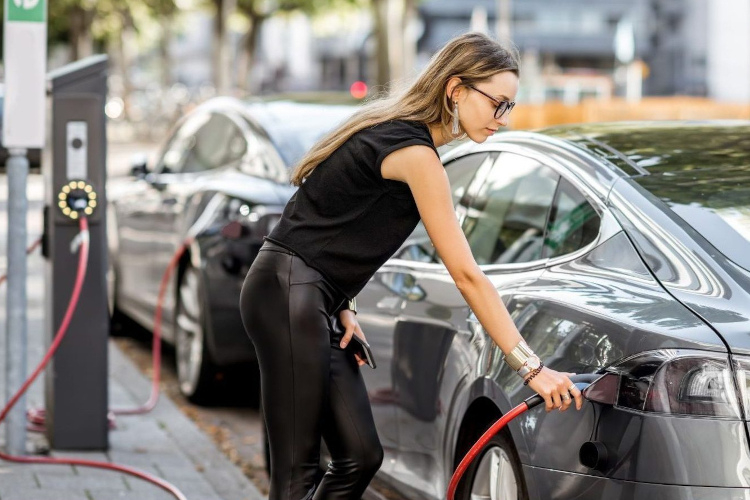
New analyses show that charging infrastructure will keep pace with the growth in the number of electric vehicles caused by the tightening of EU clean mobility regulations. A model developed by Transport & Environment suggests that by 2035, as many as 360,000 public charging stations could be built in Poland if CO2 emission targets for cars are raised in line with the commitments resulting from the European Green Deal. T&E believes that the Polish government and Polish MEPs can push for the adoption of even more ambitious CO2 emission regulations for cars than those proposed by the European Commission, without fearing a shortage of charging stations.
The analyses show that by 2030, up to 220,000 public charging stations could be built in Poland in connection with the proposed EU infrastructure regulations. These regulations require member states to expand charging infrastructure as the electric vehicle fleet grows. Currently, there are about 2,800 public charging stations in Poland. Both the Polish government and the European Commission admit that many more will be needed. T&E has developed a model for the expansion of the public charging station network, assuming that the EU will raise CO2 emission targets in 2025 and 2030 and establish a new interim target for 2027.
– The availability of a public charging station network is a major concern for drivers. Under the new regulations, member state governments will be required to address this by expanding national charging networks as the electric vehicle fleet grows. The Polish government and Polish MEPs do not need to give up on pushing for more ambitious CO2 emission targets for fear of a lack of sufficient charging stations. – comments Rafał Bajczuk, an analyst at the Electric Vehicles Promotion Foundation (FPPE).
Although a developed network of public charging stations may seem desirable, the vast majority of vehicle users will continue to charge them at private homes and workplaces. The European automotive lobby is demanding the installation of over a million public charging stations in Poland by 2035, which follows from an analysis of the lobby’s needs conducted by T&E. Under this scenario, drivers would use charging stations for less than an hour a day – well below the 3.6 hours required to achieve profitability (as established in the report prepared by the aforementioned lobby).
T&E believes that the automotive industry is setting unnecessarily high infrastructure targets, the implementation of which would require significant and continuous state budget subsidies to maintain the charging station network. The targets assumed by the industry are based on the unrealistic assumption that 60% of vehicle charging will take place at public stations and that in 2030 the average electric vehicle will be less efficient than currently available models.
As Rafał Bajczuk from FPPE adds: The “the more, the better” principle does not work for vehicle charging stations. Excessive network expansion, as demanded by some in the automotive industry, is an extravagance that will ultimately be paid for by taxpayers. In Poland, 360,000 public charging stations are sufficient to meet the needs of the growing electric vehicle fleet by 2035 while ensuring network profitability. An unrealistic assessment of infrastructure needs should not stand in the way of achieving the automotive industry’s ambitious climate goals.
MEPs and national government representatives are currently making decisions on the European Commission’s proposal regarding CO2 emission reduction targets for cars in the 2020s, which also assumes that all new cars introduced to the market from 2035 must be 100% zero-emission.
More information:
Report: ‘Charging’ for phase-out: Why public chargers won’t be a block on EU’s combustion car phase-out
Source: Electric Vehicles Promotion Foundation