








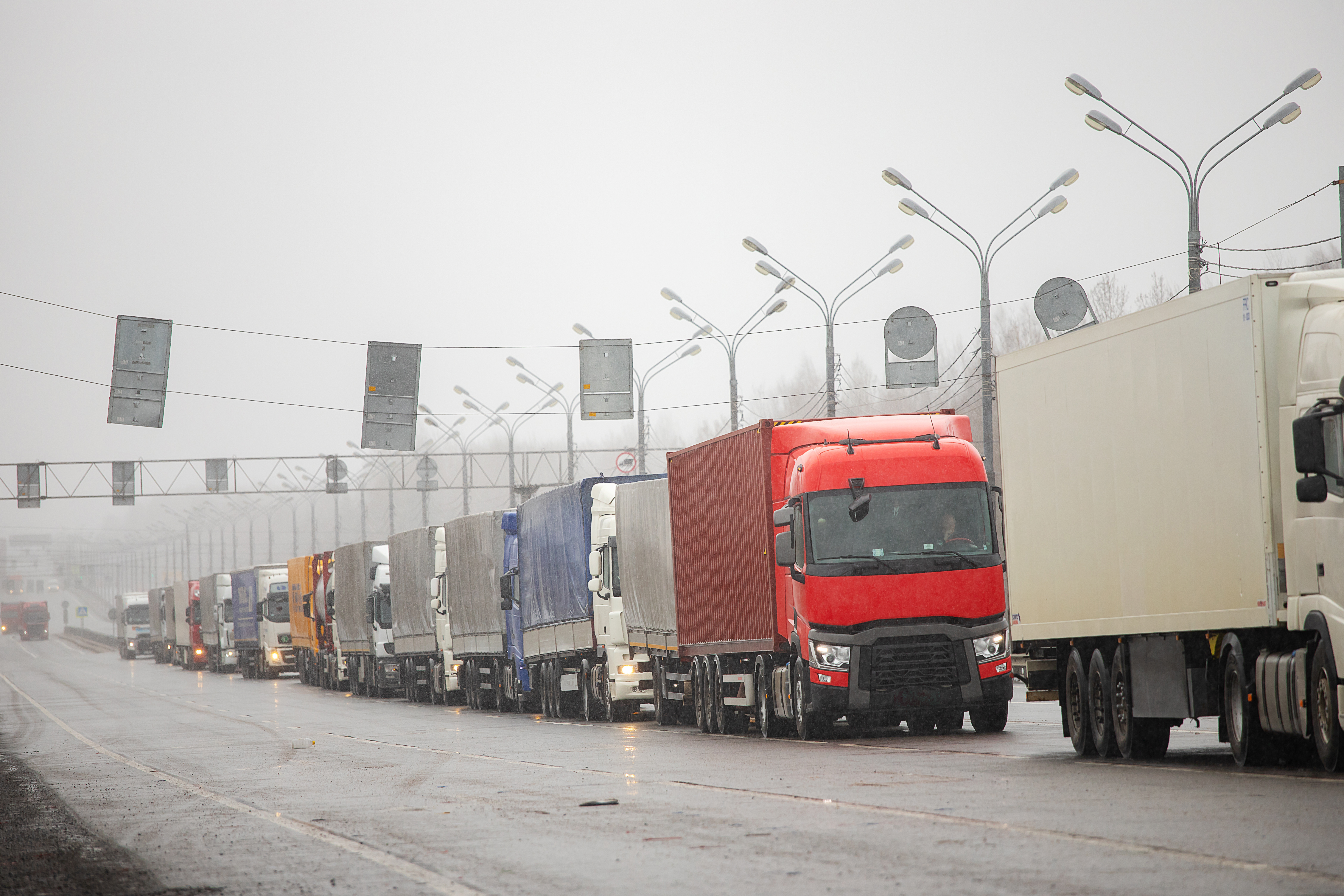
Every day, queues of trucks at border crossings with Ukraine are getting longer. Drivers have to wait up to 14 days for the opportunity to cross. However, protests on the roads are not uncommon. In such a situation, who is responsible for safety issues and delivery delays? How do employers account for the time drivers spend in queues?
According to Statistics Poland (GUS), national exports reached 351 billion euros last year. The largest increases were observed in transport to Central and Eastern European countries (an increase of 8.4 percent, to 18.2 billion euros). Polish companies placed goods worth 11.3 billion euros on this market, improving the 2022 result by 16.8 percent.
Increased traffic could be felt at all of the country’s borders. According to data from the Polish Economic Institute, it was Polish drivers who were responsible for the largest share of road transport in the European Union last year, covering as much as 380 billion tonne-kilometers. Next in the ranking, with a result 24 percent lower, are the Germans.
International transport, however, is often hindered by demonstrations that block key roads, city centers, and border crossings – currently especially in the east of the country. Ongoing protests raise many questions in the context of organizing drivers’ work, their remuneration, and delivery deadlines.
Tachographs and working time records
Changes introduced in the Mobility Package require all drivers who carry out international or intra-community transport to register every border crossing in the tachograph. This activity consists of entering the date, time, and symbol of the given country. Many doubts are raised by the method of calculating working hours while waiting at the border. As a rule, the driver’s working time also includes the time during which they remain on standby at their station.
– The driver’s working time includes a number of activities such as driving the vehicle, supervising loading, administrative formalities, taking care of the vehicle’s cleanliness, and many others. The legislator has set the daily driving time limit at 9 hours, although it can be extended to 10 hours twice a week. Subsequently, the driver should spend at least 11 hours resting. Resting can be done in the vehicle while parked, only if it is equipped with a sleeping area – comments Michał Rymut, Infrastructure and Operations Manager at Geis PL.
The regulations provide not only for rest periods between shifts but also for shorter breaks during work. According to the law, a driver must meet the requirement of a minimum 45-minute break for every 4.5 hours of driving. It is possible to divide this time into two smaller breaks – first a short 15-minute one, and then a longer 30-minute one, provided the sequence is maintained.
– If control authorities detect irregularities in the working time records, the carrier is responsible for all violations committed by the company’s drivers and persons not employed but performing road transport on its behalf. In the event that work standards are seriously violated, the employee may be punished with the revocation of the transport license or the authorization to practice the profession. These regulations also apply to entrepreneurs who do not employ external drivers and perform transport themselves – adds Michał Rymut from Geis PL.
The most difficult situation is for those drivers whose rest period falls exactly at the moment of crossing the border. They should then stop the vehicle, turn off the engine, and wait as long as the legislator requires. This matter should not be underestimated, not only because of possible penalties but also because driver fatigue is the main cause of nearly 20 percent of road accidents according to the European Road Safety Observatory.
Safety of waiting drivers and transported goods
Data from CEPiK shows that there are as many as 22 million people in Poland who have a driver’s license, of which 2.5 million hold category C, and 1.5 million hold C+E. The average age of a professional driver is over 50. In the case of professional drivers, there is no obligation to have third-party liability insurance. As a rule, insurance companies offer such a product only for a larger number of employees. It is the responsibility of the transport company to ensure appropriate working conditions, for example, by equipping the vehicle with safety-enhancing elements. Furthermore, the employer is obliged to provide employees with personal protective equipment (e.g., helmets, safety footwear, reflective clothing), as well as to conduct training in the field of safety during road transport.
Securing transported goods is also a problematic issue. Due to ongoing protests, carriers often do not deliver cargo on time, and even those transporting perishable products cannot count on special treatment from border services or the protesters themselves.
– According to the CMR Convention, the carrier is liable for the condition of the cargo and delays in transport from the moment of accepting the goods from the sender until their delivery to the recipient. They are also liable for any damage that reduces the value or functionality of products and arose as a result of negligence, failure to follow procedures, intentional actions, or the use of defective equipment. Among the factors that mean the carrier is not held liable for delays, we can mention so-called “force majeure,” i.e., protests. However, it should be remembered that it is the transport company’s duty to prove that the delay was caused by factors beyond its control – adds Michał Rymut.
Transport companies are looking for alternatives to congested border crossings to facilitate safe travel for drivers to their destination. A temporary solution is the transport of goods through other countries or rail transport. In this situation, logistics teams play a key role, focusing on the optimization of transport processes. Thanks to their expertise, companies can choose routes that are more efficient in terms of both time and cost and minimize the negative effects of congested border crossings. Currently, software that supports these activities is also being introduced more and more often.
Source: Geis PL