









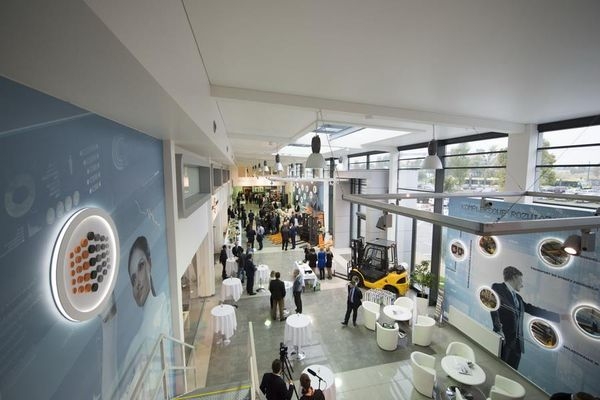
The Center inaugurated its operations in October 2015. To date, it has been visited by over 500 people, including representatives of many Polish companies interested in implementing modern intralogistics solutions, students of logistics universities, and high school students training to be logisticians. It is also a place where training sessions from the “Safe Warehouse” series are organized. The Center is and will continue to be a place for regular meetings, discussion panels, and industry conferences dedicated to Polish logistics.
In a two-story building covering 1,600 square meters, there are conference and training rooms as well as an exhibition area called THE WAREHOUSE OF THE FUTURE, which features innovative solutions in the field of intralogistics. The central part of the exhibition is a fully automated demonstration line for transport, palletizing, storage, and product identification, equipped with the latest solutions in automation, robotics, and product identification. THE WAREHOUSE OF THE FUTURE is currently the largest permanent exhibition of warehouse technology equipment in Poland. At the same time, it serves as a multimedia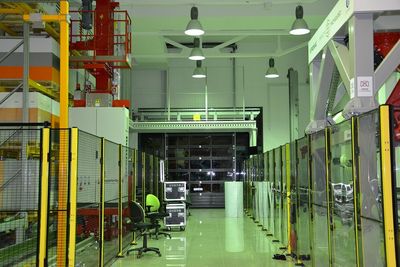 exhibition dedicated to trends and new technologies that have the potential to increase the efficiency of logistics processes in Polish companies in the coming years.
THE WAREHOUSE OF THE FUTURE in a nutshell:
1. Intralogistics equipment presentation station – this is a place where, at a touch table equipped with a special application, visitors can familiarize themselves with the full range of intralogistics equipment, learn about the elements of the logistics chain in an enterprise, and the 10 steps necessary for proper warehouse organization. Additionally, everyone can test their knowledge by solving a logistics quiz. To facilitate content browsing, the image displayed on the touch table is also visible on a large screen placed on the wall opposite.
2. Workshop designer station – here, using a touch monitor and appropriate, intuitive software, visitors can see what a company workshop, office, or locker room will look like after being equipped with metal furniture. This is also 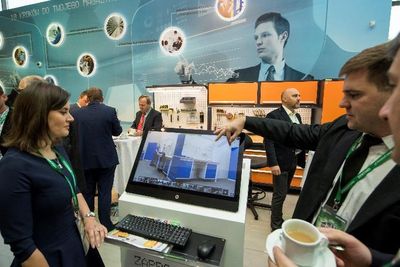 a zone where you can watch a film about the production of metal furniture, get acquainted with a wide range of furniture for workshops, locker rooms, and offices, and look at ready-made visualizations of these spaces, as well as take a virtual tour of a selected workshop or locker room.
3. Racking configuration station – this is a zone where, at another touch table and using easy-to-use software, anyone can enter their own warehouse data and design the layout of racks, as well as familiarize themselves with the full range of racking systems and their installations in various types of warehouses. This is also a place where you can see how racks are produced and learn about the current training offer for their safe operation. For a better visualization of the designed warehouse, you can take a virtual tour of the facility.
4. “Modern Logistician” Cinema – the cinema presents films showing work in modern warehouses, the production of internal logistics equipment, and new technologies used in warehouses. An additional advantage of this place is the ability to look at the project currently being worked on at the racking configuration station. The cinema is a place where, among other things, classes for logistics students are held.
5. Pick-by-light station – this is a station used for picking goods using a light system. The station consists of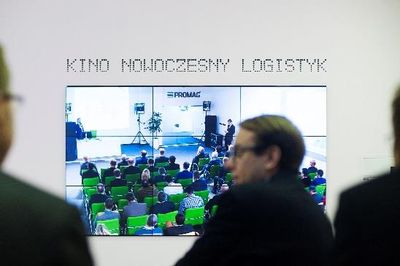 racks equipped with special displays and LED diodes, a conveyor from which goods are picked for completion, and a rack where goods ready for shipment are placed.
6. Racking solutions station – this is a place where the most common types of racks found in warehouses are presented. Worth noting are the racks with the radio-controlled AUTOMAG platform.
7. Other products, e.g., wrappers, forklifts, robots, etc.
8. Automatic line for transport, palletizing, storage, and product identification.
This is undoubtedly the most important part of the exhibition. It constitutes a comprehensive system of the latest solutions in the field of robotics, automation, and product identification. The presented layout is a combination of various types of technical and IT solutions, presenting a wide spectrum of automation possibilities in intralogistics processes.
Operating description
The system starts operating after a forklift loads a full pallet onto a roller conveyor, after which an automatic start occurs. The loaded pallet moves into the depalletizing zone. A suspended robot proceeds to depalletize upon receiving a readiness signal, i.e., the pallet reaching the correct position. Then, the goods are placed by the robot on three lines formed by modular conveyors. A vision control system mounted on the robot arm allows for identifying the moved element and placing it on the appropriate conveyor line according to the set program. After placing two subsequent loads on the modular conveyors, the system sends information to the robot about readiness for palletizing. The palletizing process takes place using another robot and a mechanical gripper. After placing the third, complete layer of loads on the pallet, the robot sends a signal to the system that the pallet is ready for the next process. If the next conveyor is not occupied, the pallet is transported to the wrapping zone. After the wrapping process is completed, the pallet begins to travel to a roller conveyor placed on a scissor lift. Here, a full identification process takes place by reading RFID tags located on 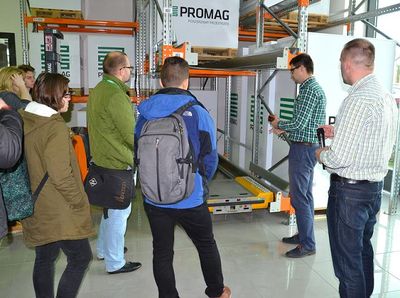 each load unit. The tags are read by antennas located on the RFID gate. The gate communicates with the WMS system, and based on its readings, the goods are accepted into warehouse stock. After reaching the appropriate height, the pallet is picked up by the vertical conveyor carriage and transported to the mezzanine (platform). The load unit covers a several-meter section of the platform placed in the system to bypass an obstacle, which is the hall entrance gate. This is a common technical solution aimed at bypassing communication routes. At the end of the chain conveyor, the pallet is transferred to a turntable, which changes the direction of transport without changing the orientation of the pallet. After performing a 90-degree turn, the pallet is transported to the stacker crane receiving point. After the pallet reaches the required position, signals are exchanged between the devices, and the warehouse stacker crane begins work. The pallet in the system is transported to a free rack space according to the set storage program. At the end of the system, a chain conveyor is placed. It acts as a receiving point for pallets delivered by the stacker crane. Here, re-identification takes place via antennas placed on the RFID gate of the tags located on the goods. The gate communicates with the WMS system, and based on its readings, a list of goods on the pallet is printed, e.g., in the form of a WZ document. Based on the readings from this gate, the goods are released from the warehouse.
The presented demonstration automatic line for transport, palletizing, storage, and product identification is a combination of many devices that can work in one integrated system or can also work independently. The use of such solutions increases the efficiency of processes taking place in companies, which translates into an increase in the competitiveness of companies on the market.
– PROMAG S.A. is a company that has been successfully combining two areas of activity for 35 years. On one hand, these are investments in expanding and developing the product offer, thanks to which we are currently the only company in Poland with such a rich and fully comprehensive offer of warehouse equipment. On the other hand, we place great emphasis on the continuous development of our own technical thought, know-how, and investments in employee knowledge. And this allows us to implement even the most complex and technologically advanced engineering projects in the field of intralogistics. We are an integrator of intralogistics solutions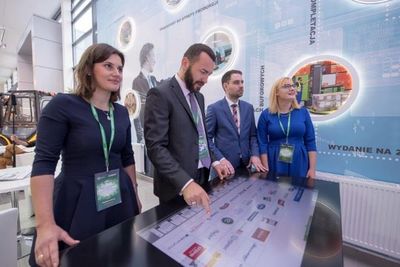 but we also want to be perceived as an integrator of the entire industry, the scientific community, and young logisticians. And this is, among other things, where the idea for establishing the PROMAG WAREHOUSE TECHNOLOGY CENTER came from. It is intended to emphasize, above all, our engineering activity, which perhaps was not always sufficiently noticed by customers, students, or part of the environment, and was not always clearly exposed by us. We already know that this was a step in a very good direction. The interest in our initiative has exceeded our expectations; there are so many visitors that we are organizing additional shows for them. That is why we are already planning further events that will promote modern intralogistics solutions and support the development of Polish warehouses. Although THE WAREHOUSE OF THE FUTURE is currently the largest permanent exhibition of warehouse technology equipment in Poland, for us, it is only a starting point and a challenge for further work. The solutions presented in the Center will therefore be continuously improved, and as technological thought develops, supplemented with subsequent modern products and services. We want to support the innovation of the Polish economy and provide Polish companies and students with constant access to the most modern solutions in the field of intralogistics – said Karolina Tokarz, Vice President of the Management Board, Director of Sales and Marketing at PROMAG S.A.