










The EAN barcode, seen every day on products, is present in 150 countries, and the sound of its scanning is heard over 6 billion times a day worldwide. It is a graphic representation of the GTIN number and is used for the unambiguous and unique identification of a product. This most commonly used GS1 identifier should be assigned according to globally established GS1 standards and guidelines. Every brand owner/manufacturer should follow them to ensure consistent product identification.
In the era of digitalization and the growth of online shopping, product data can be compared to the beating heart of every company. To keep it beating, data must be healthy and regularly checked. Outdated, incorrect, or incomplete data cause many problems for a company. From the consumer’s point of view, reliable and accurate data are becoming increasingly important and have a significant impact on purchasing decisions.
Labeling products with EAN barcodes seems easy, but practice shows that errors in this area occur quite often. At the turn of 2018 and 2019, GS1 Poland invited retail chains to participate in a study on the incorrect assignment of GTIN numbers (EAN codes) to products. The collected results, as well as the analysis of current reports flowing into GS1 Poland, allowed for the assessment of the scale of the problem.
The most common errors made by manufacturers/brand owners are:
- Assigning/duplicating the same GTIN number for different products, e.g., air freshener with three different scents, chocolates with peanut and strawberry filling,
- Significant changes in product composition, e.g., changing the oil version from rapeseed to sunflower, changing the flavor of yogurts from strawberry and raspberry to strawberry and blackberry, or vanilla cheese with jam to cream cheese with jam,
- Change in net weight, e.g., low-fat cottage cheese from 270 g to 250 g, milk bar from 50 g to 48 g, number of dishwasher capsules from 50 to 55, carbonated drink from 1.7 l to 1.5 l,
- Change in the declared quantity of products in a collective package, e.g., canned peas originally packed in a carton of 14 pieces, now 20 pieces.
For all the mentioned situations, new, unique GTIN numbers should be assigned.
A major challenge is the correct labeling of products available for sale on a specific day or at a specific time, for which there is a need for unambiguous identification and differentiation of promotional assortment in the supply chain at the collective packaging level. Most mistakes are related to adding freebies, e.g., a sample of hair conditioner to a bottle of shampoo. In a situation where the dimensions or gross weight of the packaging change by more than 20%, a new GTIN number must be assigned to such a product.
To the question: “In which category do the most frequent errors occur (e.g., dairy, beverages, cosmetics, etc.)”, retail chains indicated: dairy, spices, cake and baking additives, as well as sweets. This is reflected in the examples cited above. The entire process of handling a product in the distribution network can be automated and carried out in a short time, starting from the moment of order confirmation and punctual delivery to the correct invoice and quick payment for the product. The only condition is having current and high-quality data.
Adherence to standard GTIN management rules by all links in the supply chain is the key to ensuring effective, efficient, and consistent exchange of product information, thereby guaranteeing cost minimization and the smooth functioning of not only local but also global supply chains.
Current guidelines regarding the rules for the correct assignment of GTIN numbers are available at: https://www.gs1pl.org/uslugi-i-narzedzia/standardy-zarzadzania-numerami-gtin. They clearly indicate significant product modifications for which a change of the GTIN number is required.
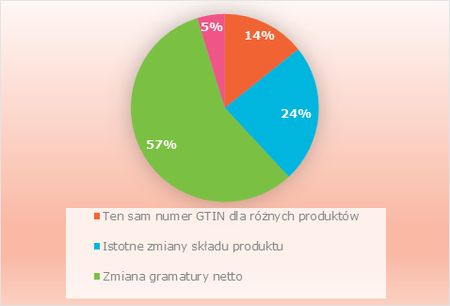
Source: own study based on internal GS1 sources.
Beata Bartol, Master Data Specialist at Chata Polska, notes: Lack of hygiene in product master data, including a unique GTIN number, compounds many problems at every level of the distribution channel, both in wholesale and retail. Correct product labeling leads to better sales, which translates into good business relations. Reporting sales data, as well as identification on orders, is a very important matter. Without consistent GTIN code data, this is impossible.
Beata Drag, Senior SAP Master Data Specialist at Żabka, adds: Manufacturers, and mostly the largest ones, often do not stick to good practice rules regarding the correct labeling of their products when changing the weight of their product. Unfortunately, it happens more and more often that the weight of products decreases, and its labeling with the GTIN number remains unchanged. Consequently, chains receive incorrect product data. Many manufacturers also incorrectly label their collective packaging, covering them with a label with the same GTIN number as the unit packaging, which makes correct verification of goods upon receipt at the warehouse difficult. Each unit of the logistics structure should contain its own separate, unique, and unrepeatable GTIN number.
Bartłomiej Kołodziej, Master Data Specialist at Eurocash S.A., comments: In our daily work with master data, where the GTIN number is, besides the name, the main identifier of goods in the system and further on the market, we also encounter many problems. Manufacturers from the dairy industry show the greatest lack of knowledge on the subject. Frequent weight changes, even small ones of 10 g, or labeling collective packaging of several flavors of yogurt or cheese with one EAN code within the same assortment, cause us quite a bit of confusion in working with data in the system and in the entire flow of goods from receipt at the warehouse to release to the store. Often, the manufacturer does not inform us about a change, e.g., in weight, and prints packaging with a code that has functioned so far for the old weight, releasing goods to the market while there are still warehouse stocks in distribution centers and stores. This prevents a smooth transition from the old weight to the new one. Wanting to keep the same system number in circulation, buyers must count on delays associated with introducing such an assortment into circulation. We try to inform our partners about the consequences of such actions and the failure to comply with the standards set by the GS1 organization, but our requests often remain unanswered.