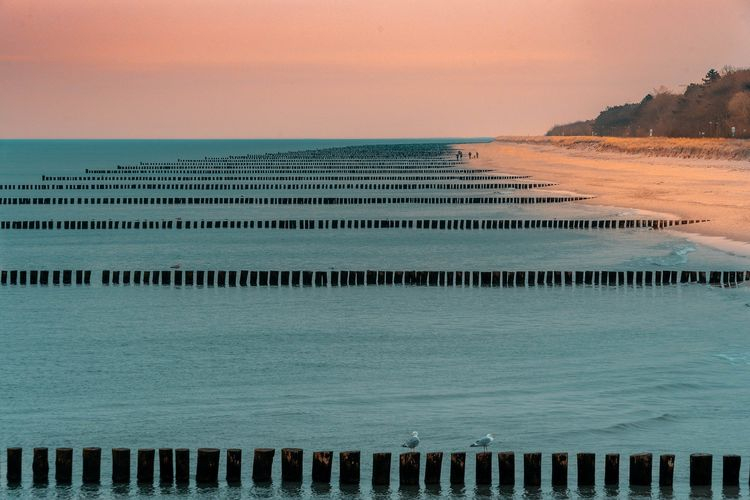
There is no doubt about the destructive impact of waste, especially plastic, on the marine environment. Every year, between 4.8 and 12.7 million tons of plastic enter the seas and oceans, poisoning marine ecosystems. This problem also affects the Baltic Sea. Its cleanliness can be improved by special PortBin devices installed in ports and river mouths, which catch waste floating in the water. One installation is capable of collecting up to 1.5 tons of waste per year.
Such a PortBin has just been installed in the port of Kołobrzeg by the Mare Foundation in cooperation with the Kołobrzeg Fish Producers Group as part of the pro-ecological project “Naturally Baltic” (Naturalnie Bałtyckie). This is the first installation of this type mounted in the West Pomeranian Voivodeship, which will protect this part of the coast from waste flowing into the sea via the Parsęta River.
The problem of plastic waste is a global issue that also strongly affects the Baltic Sea. The Baltic is a semi-enclosed basin where water exchange occurs only with the North Sea through the narrow and shallow Danish Straits. Therefore, a full water exchange takes up to 30 years, and any pollutants remain in it for years. According to Helsinki Commission (HELCOM) statistics, up to 70% of waste entering the Baltic consists of plastics. Plastic is also the most common waste found on its coasts.
What happens to the plastic that ends up in the sea?
Larger waste items act as deadly traps for marine animals – they are mistaken for food – poisoning their organisms, but also impairing their sense of hunger, thus condemning them to death. Moreover, plastic, under the influence of solar radiation, wave motion, and currents, breaks down into micro- and then nanoplastics. These particles are impossible to remove from the environment, and through water, they penetrate not only into marine organisms but also into farmed plants and animals, and consequently into us – humans. Microplastic particles are found in drinking water and food products, even such as salt or honey.
PortBin – how does it work?
PortBin is an excellent solution installed in ports or marinas that catches waste from the water surface. The device sucks in floating bottles and other waste before they reach the sea and break down into microplastics. PortBin is equipped with a 30-liter durable and weather-resistant bin that is easy for one person to empty. PortBin is made of PE-HD plastic, which is 100% recyclable. The first such bin in Western Pomerania was installed in the port of Kołobrzeg, at the Warzelnicze Quay 3, at the junction with the Solankowe Quay.
Polish fishermen working together to improve the quality of Baltic waters
The Kołobrzeg bin was installed as part of the cooperation between the MARE Foundation and the Kołobrzeg Fish Producers Group, the initiator of the educational project “Naturally Baltic,” which aims to promote the rational use of Baltic Sea resources, as well as to create conscious consumption of fish products.
– The Baltic Sea is a workplace and a source of livelihood for thousands of people associated with Polish fisheries. Therefore, fishermen care about protecting its waters and ensuring that future generations can also benefit from its resources. Hence, we willingly and actively join in activities that improve the state of our sea – says Marcin Radkowski, President of the Kołobrzeg Fish Producers Group – The PortBin in Kołobrzeg is not the only pro-ecological project implemented with the Mare Foundation. In previous years, with the hands of our fishermen, we collected lost fishing nets and other marine waste lying in the Baltic. The newly installed PortBin will allow for the capture of thousands of kilograms of waste before they get into the sea.
Naturally Baltic – education from an early age
Each of us must be aware that 99.7% of Poland’s area lies in the Baltic catchment area, so trash thrown on the ground in Krakow, Opole, or Wroclaw eventually ends up in the Baltic Sea through sewage or rivers, polluting it for years. Therefore, it is worth considering the consequences for the environment, and thus the consequences for us, before we throw a candy wrapper, a plastic bottle, or a cigarette butt, whose filter is made of plastic, on the ground instead of in the trash can.
The “Naturally Baltic” program raises awareness among Poles and promotes pro-ecological attitudes that can influence the improvement of the Baltic’s cleanliness or the condition of its resources. Educating the youngest is also important. For this purpose, the educational project “Treasures of the Baltic” (Skarby Bałtyku) was created, aimed at children and youth in primary schools, as part of which a modern e-learning platform was launched, through which teachers can conduct classes with students about the Baltic Sea – its features, salinity, inhabitants and resources, fish living in the Baltic, their nutritional and health properties, as well as ways to protect its waters.
Source: Newseria
Read also about other ecological initiatives:
– Pioneering flexible packaging recycling project launched
– Brambles achieves sustainability goals
– Polish industry to benefit from the development of offshore wind farms
– 4,000 photovoltaic panels on the roof of the LPP Distribution Center
– GLS focuses on renewable energy sources
– Kuehne+Nagel and IAG Cargo perform carbon-neutral charter flights
More articles on ecological solutions can be found in the magazine LOGISTYKA 4/2021.
The e-edition of the magazine is available in our offer!
Stay up to date, subscribe to the LOGISTYKA magazine!