









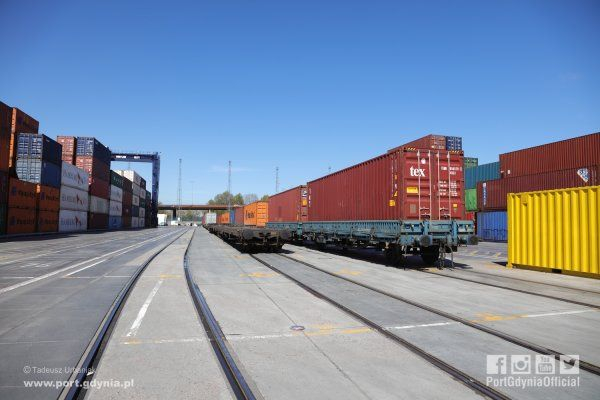
The increase in cargo handling at seaports is increasingly linked to the potential of intermodal transport, which in the coming years will become a priority branch of freight transport both in Poland and in Europe. The growing volume of cargo handling makes it necessary to build logistics facilities and modernize railway lines. A novelty will be the development of the “dry port” concept in Poland, i.e., a transshipment terminal that will serve as a land gateway for the Tri-City ports.
The development of intermodal transport is one of the priorities of the economic policy of Poland and the European Union. However, for seaports to be able to handle more containerized cargo, it is necessary to expand linear infrastructure and the network of intermodal terminals. Large Western European ports decided many years ago to move some logistics operations to transshipment terminals located inland, which serve as storage and logistics facilities relieving the maritime terminals. Moving some transshipment and storage tasks for intermodal units outside the seaport allows for increasing its operational capabilities. Maritime terminals can then handle more ships and focus on transshipments between sea and land transport.
– The main goal of building dry ports is to improve transport between seaports and the rest of the country. The construction of an intermodal terminal in Bydgoszcz Emilianowo is in line with the Port Development Strategy until 2027, which assumes an increase in the share of rail transport in handling goods serviced by the Port of Gdynia. This terminal will be located at the end of line no. 201, which, after modernization, will ensure fast and efficient transport of goods to our port. We hope that this will increase interest in using the transshipment services of the Port of Gdynia not only among Polish logistics operators but also among potential customers from other countries. This is particularly important for investments being implemented at the Port of Gdynia, such as the Outer Port – said Adam Meller, President of the Port of Gdynia Authority.
Dry port in Bydgoszcz
On July 28, a special-purpose vehicle, Terminal Intermodalny Bydgoszcz Emilianowo, was established. This is the implementation of an agreement concluded in 2019, the signatories of which were PKP SA, the Port of Gdynia Authority, PKP Cargo SA, the Bydgoszcz Industrial and Technological Park, the National Support Centre for Agriculture, the Nowa Wieś Wielka municipality, and the Kuyavian-Pomeranian Voivode. The special-purpose vehicle will prepare the design and documentation for the new logistics center.
– During the working meetings held as part of this initiative, the project assumptions were discussed and the actions to be taken to create conditions for the construction of the intermodal terminal in Emilianowo were defined. Work is underway to establish a special-purpose vehicle that will be responsible for the project implementation. Work is also ongoing on a conditional investment agreement related to the project implementation – informed Michał Stilger, spokesperson for PKP SA.
Modernization of the railway main line
To improve freight connections and prepare for the projected increase in the volume of intermodal connections in this direction, it was decided to launch the third branch of the Baltic-Adriatic corridor. Railway line no. 201 was built in 1938 and was, alongside the construction of the Port of Gdynia, the largest Polish investment in the interwar period. In 1922, the Polish Sejm decided to build the Port of Gdynia, and the construction of a new railway line was part of this investment. This main line provided a connection between the industrial region of Silesia and the Port of Gdynia, bypassing the Free City of Danzig. The Coal Main Line project was executed in the years 1926-1928.
PKP PLK’s investment plans regarding line 201 are a response to the increase in cargo handling at the Port of Gdynia (by 2.3% in Q1 2020). The modernization will include the addition of a second track on the Maksymilianowo – Gdańsk Osowa section and a third track on the Gdańsk Osowa – Gdynia Główna section. Furthermore, the line will be electrified and adapted to a speed of 140 km/h for passenger trains and 120 km/h for freight trains, which is currently the standard for intermodal rail.
The modernization of lines 131 and 201, as well as the creation of a network of transshipment terminals here, especially in Bydgoszcz and Zduńska Wola Karsznice, may increase interest in using the transshipment services of the Tri-City ports not only among Polish logistics operators but also among potential customers from countries located beyond our southern border. This will be a key factor for the success of investments being implemented in Gdynia, such as the Outer Port or the new Public Ferry Terminal. Intermodal transport requires the construction of an entire chain of various infrastructure elements. It is a complex undertaking in which success is determined by good cooperation and coordination between seaport authorities, the railway infrastructure manager, transshipment terminals, and logistics operators.
Source: ZMPG-a SA
Read also about seaports:
– Ports invest in ferry terminals
– Expansion of port infrastructure drives the Tri-City economy