








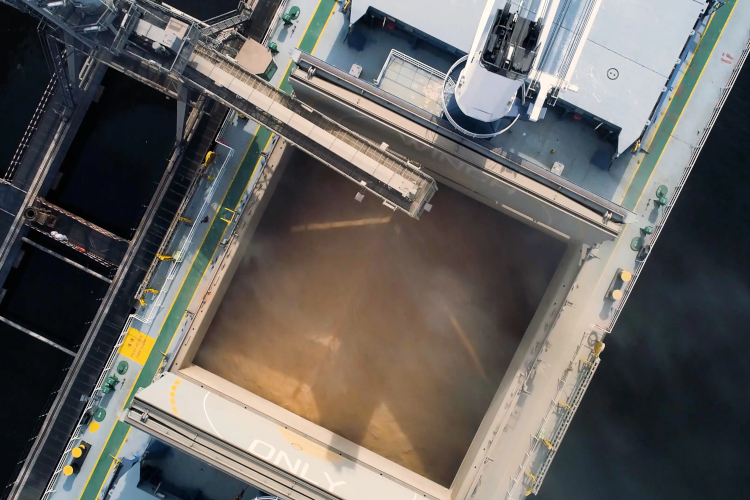
Although grain transshipments increased significantly last year in all Polish seaports, which is directly related to the blockade of Ukrainian ports on the Black Sea, they were overshadowed in the first months by the massive volumes of coal handled in the ports. In recent months, however, there has been more and more talk and writing about grain. Ports and operators already have their hands full and are preparing for further increases.
In 2022, grain transshipments at the Port of Gdańsk amounted to approximately 2 million tons, which was a record for this port. At the same time, it was 19 percent more than the year before. The first half of 2023 brought another colossal increase in agro transshipments.
– Polish ports, including the largest of them, the Port of Gdańsk, have been prepared to handle larger quantities of grain. Although it was a significant challenge, they rose to the task. This can be seen in the transshipment results for the first half of this year. Over six months, grain terminals exported approximately 1.4 million tons of grain through the Port of Gdańsk, especially corn, which is an increase of 52 percent compared to the same period last year. For comparison, throughout 2022, the Gdańsk port handled just over 1.9 million tons of grain – explains Marek Gróbarczyk, Deputy Minister of Infrastructure.
The port itself is preparing for increased grain shipments. Since about 70 percent of grain transport to the port takes place via trucks, it was necessary to increase the number of parking spaces – there are now 970 of them. They will allow for decongesting port arteries and access roads, as according to estimates, up to 1,500 grain trucks may enter the port during peak traffic. Grain sampling points operated by the J.S. Hamilton company are waiting in four parking lots. Without proper testing, the grain will not be loaded onto the ship. The tests are carried out 24 hours a day, regardless of the weather, which is possible thanks to the roofing of the so-called rakorafs, i.e., devices that take samples. In July, J.S. Hamilton opened additional stations at the Port of Gdańsk. Thanks to this, it is able to handle over 700 vehicles per day. Thus, the queues of waiting drivers have been reduced to practically zero.
Grain transshipments themselves are possible within the port area, at several different quays, including the Vistula (Wiślane), Grain (Zbożowe), Oliwa (Oliwskie), or Bytom (Bytomskie) quays. They are carried out by a total of six operators: GBT/Malteurop, Port Gdański Eksploatacja, Speed, Siark-Port, Gdańskie Młyny, and Magrol.
However, a significant increase in transshipment capacity is a process spread over years. According to plans, operators working at the Port of Gdańsk will develop their capabilities within the next 2 years so that the port’s throughput will increase to approximately 5.8 million tons per year.
– The current transshipment capabilities of the main grain terminals in the Gdańsk port are 300,000 tons per month, and storage capacity is 126,000 tons. Operators can handle 730 trucks and 80 railcars per day. But they are ready to increase their transshipment capabilities. They plan to build permanent and tent warehouses, and they also want to carry out railway investments. They estimate that building facilities for storing agricultural products will cost PLN 68 million. With such investments, the transshipment capacity of grain terminals in the Gdańsk port will increase to 485,000 tons per month (5.8 million tons per year). And the target storage capacity will increase by 65,000 tons to 191,000 tons. Of course, the Port of Gdańsk Authority is also open to new investors planning large-scale agro transshipments – explains Kamil Tarczewski, Vice President of the Port of Gdańsk.
Exporters are investing
The need for constant modernization of port infrastructure is also pointed out by Viterra, one of the leading grain exporters using sea routes.
– The processing capacity of Polish terminals is constantly increasing, which allows us to achieve further records in terms of the volume of exports from Poland. Nevertheless, compared to modern terminals in Western Europe and the Baltic countries, such as Lithuania and Latvia, there are still many areas where we can introduce improvements, even in terms of modernizing infrastructure and loading processes – informs Karolina Kucharska from Viterra Polska.
However, investments in infrastructure take time. Both warehouse halls, railway sidings, and, among other things, transshipment equipment are needed. Regarding the latter, the port company PG Eksploatacja is systematically developing its capabilities. Recently, the second of three new port cranes – the Liebherr LHM 550 – has started its work for the company. The first was delivered in winter, and the third is expected at the end of 2023. These universal machines have been equipped with grabs enabling the transshipment of various goods, including, of course, grain.
– New transshipment equipment means increased efficiency and maintaining transshipment stability in the long term. Currently, the company also uses the recently purchased mobile shiploader RIMO SL1400/M for agro transshipments, which has significantly improved transshipment efficiency, but also stabilized our operational activities in the loading process. After the renovation of the Vistula Quay, the conveyor belt will be used for direct loading of goods from the warehouse, which will create another ship loading station. The next step and challenge for the company will be to increase the storage area for agro goods – explains Szymon Mikołajczak, Commercial Director of PG Eksploatacja.
The current transshipment capacity of PG Eksploatacja is estimated at 150,000 tons per month.
– The maximum transshipment capacity was determined based on the assumptions of storing homogeneous goods in warehouses and full rotation of ships with loading capabilities of over 30,000 tons. Currently, we notice that agro goods from previous and current harvests in various commodity groups and of varying quality are reaching our warehouses, which means that our storage and transshipment potential is not fully utilized – adds Szymon Mikołajczak.
Relieve the market
Everyone wants transshipments to take place as quickly as possible – this will cause fewer traffic jams and truck downtime, as well as shorter ship stays at the quay. The GBT terminal, one of the six handling grain cargo in the Gdańsk port, is currently able to unload up to 7,000 tons of grain per day from trucks, and up to 1,800 tons from railcars. Moving on, in the same terminal, up to 10,000 tons of grain can be loaded onto a ship per day. However, these numbers will soon be outdated. Rafał Różański, President of the GBT Management Board, estimates that the terminal is currently using 90 percent of its transshipment capacity. The terminal is constantly working on increasing its capabilities.
– The modernization of the terminal is being carried out comprehensively and is aimed at streamlining and accelerating the transshipment process at every stage – says Rafał Różański.
According to President Różański, some of the investments have already been completed. Three new tent halls have been built, which allowed for increasing the storage base by 17,000 tons. In addition, an external parking lot with a roofed place for sampling and testing for 54 trucks is also available. Further investments are underway. Among them are: an additional line for unloading grain railcars, an additional track for railway maneuvers. Work is also underway to increase the ship loading speed to 600 tons per hour and reduce dust at the terminal. The company is also buying mobile equipment for unloading grain railcars.
– The bottleneck is receiving logistics, proper planning of deliveries so as not to lead to long waiting times for trucks and railcars for unloading. In agreement with the Port and the Hamilton inspection unit, we are working on an hourly notification system, which should distribute the burden of deliveries. The Port Authority has become very involved in supporting grain transshipment, acting as an initiator of many meetings and panels aimed at eliminating bottlenecks. In a short time, infrastructure was created that strongly supports the terminals both logistically and IT-wise. This is confirmed by both the volumes exported in the Port and the daily volumes delivered by rail and road – adds the president of the GBT terminal.
The actions of the Port of Gdańsk Authority are also positively assessed by Szymon Mikołajczak from PG Eksploatacja. As he says, the involvement of the Port of Gdańsk Authority, among other things, in the construction of new buffer parking lots has benefited both operators and the city’s residents.
– Key for operators and the Port of Gdańsk Authority was and will be to clear potential traffic jams caused by trucks bringing agro goods to the port. Causing congestion in the continuity of agro goods deliveries to the port means that the port operator does not use its operational capabilities. Residents felt the Port of Gdańsk Authority’s investment in everyday life through the lack of traffic jams, and PG Eksploatacja increased transshipment efficiency through the possibility of spreading agro goods deliveries over the entire 24-hour period – he explains.
Viterra Polska is also preparing for the season.
– It is worth noting that in the 2022/23 season, half of the grain exported by sea was sent to African countries, which confirms the high quality of Polish products and the trust we enjoy among international recipients. Nevertheless, due to the growing competitiveness of grain from other regions, we are constantly looking for new markets for Polish agricultural products. One of them is, for example, the United States market, which has been unusual for our business so far. Every year, we also invest in improving the entire process, starting from automatic sampling and ending with the use of modern laboratory equipment, which significantly shortens the time a Polish farmer must spend waiting for the acceptance of the goods they have produced. We are taking all possible actions to relieve the market of grain surpluses and increase export opportunities – adds Karolina Kucharska.
Source: Port of Gdańsk