








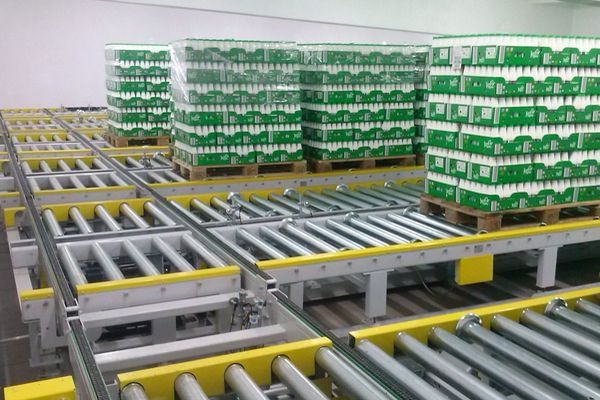
Automation, as a leading trend in the warehouse market, has been discussed for at least several years. However, while companies operating in Western Europe have long been successfully investing in such solutions, Polish enterprises are only just beginning to take a serious interest in them. This is a good sign, because without the automation and robotization of processes, it will be difficult for them to meet the requirements of increasing market competitiveness.
While it is true that one can find more or less spectacular examples of warehouse and production process automation in Poland, such investments have so far been decided upon primarily by large global companies with foreign capital. Among them, manufacturers and distribution centers of retail chains have dominated and continue to dominate. The reason for this state of affairs includes access to capital and financial resources. On the other hand, these are naturally companies organized along the lines of companies operating in the West – they therefore possess appropriate operating models and are thus more aware of the tangible benefits that automation brings.
It is difficult, of course, to expect that Polish warehouses will be able to catch up and fully automate within the next few years. However, the situation is improving year by year – interest in modern solutions is growing, the number of new investments is increasing, and managers are increasingly realizing that their implementation is not only necessary to achieve the efficiency required by demand, but also allows for significant cost reduction in the long term, which clearly translates into increasing the competitiveness of products and services. Importantly, this applies not only to the largest enterprises with huge warehouse areas, but also to smaller ones, with several to a dozen thousand pallet spaces.
Competitiveness requires investment
Among the main barriers hindering Polish companies from investing in warehouse automation, one should primarily mention the conviction about the high initial outlays of such an operation and the associated fear, which boils down to the simple question: “can we even afford it?”. Added to this is the uncertainty regarding the return on investment time and the final costs of the entire project, and whether it will be profitable in the final analysis. Beyond purely financial barriers, the Polish warehouse industry also struggles with a lack of sufficient knowledge about possible and appropriate solutions to apply and a lack of experience in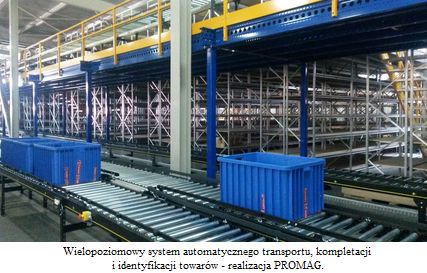 this area. And this makes decision-making difficult.
Polish warehouses, in order to successfully operate in the global market, must be competitive. And it is precisely competitiveness that is the superior value that automation brings. The question is, what does it mean in practice for a given enterprise?
First of all, thanks to modern warehouse automation solutions, we can significantly improve process efficiency, and consequently lower the unit cost of a product. A machine, unlike a human, can work all the time, practically 24 hours a day, and is able to perform significantly more operations in the same amount of time, which in turn helps to reduce labor costs, while also allowing for improved delivery quality, faster deadlines, etc. Thanks to automation, we can also eliminate potential errors in product picking almost to zero. Automation also means tangible operational savings. For example, racks with stacker cranes do not need light or heat, so they can work in an unlit and unheated warehouse. Thanks to automatic systems, we can fit significantly more goods in the same area – our warehouse can therefore be smaller, which reduces the costs of its construction, subsequent maintenance, but also taxes.
Racks, transport systems, and robots?
– Automation and the associated robotization of intralogistics processes is undoubtedly an inevitable and irreversible process. The sooner companies can create the right conditions for this type of investment and realize the benefits behind them, the more both they themselves and the entire Polish economy will benefit – says Karolina Tokarz, Vice President of the Board and Director of Sales and Marketing at PROMAG S.A. – We have noticed for a long time that the lack of courage among clients is largely a result of the lack of access to easily digestible knowledge in the field of new and constantly changing logistics solutions. As a result, it is difficult for us to convince a potential investor that this is the best possible solution for them. We have therefore decided to launch the PROMAG Warehouse Technology Center, where everyone will be able to see how such solutions work in practice. It is the first facility in Poland dedicated to the logistics industry, which will include not only an exhibition area but also a conference and training area. We hope that thanks to this, we will be able to interest the Polish logistics industry and encourage more serious discussions and decisions about automation.
According to a 2014 study of Polish Logistics Managers, Polish companies are currently interested primarily in investments in solutions such as: automatic AS/RS storage zones, automatic internal transport systems, and automatic order picking systems. This direction is also confirmed by Karolina Tokarz, according to whom the most common products currently offered by PROMAG S.A. include high-density storage racks with radio-controlled platforms, racks serviced by warehouse stacker cranes, vertical lift modules, carousel racks, multi-level transport and picking systems based on mezzanine structures, where picking paths are planned by individual algorithms, as well as palletizing systems using industrial robots, which are integrated with conveyors and packaging equipment.
Automation will become cheaper
Despite the positive changes that can be observed on the Polish market, the conviction still persists in many companies that automation is simply expensive, and even too expensive to be profitable. It is certainly true that it requires considerable initial financial outlays from every company. However, in the long term, it is the only way to reduce operating costs and thus 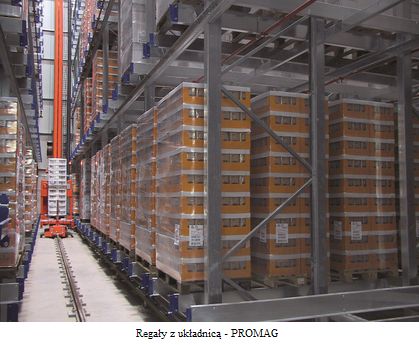 ensure further development. Besides, over the years, modern intralogistics solutions, along with their widespread adoption, are successively becoming cheaper, and as a result, they are already available to an increasingly wider group of clients (furthermore, funds for investment can be obtained, among other things, from EU funds). In this aspect, medium-sized Polish enterprises face a great opportunity, as they effectively lack any solutions in the field of warehouse automation, and all work rests in human hands.
Making the decision to carry out automation and robotization cannot be impulsive, however; it requires strategic thinking and must be supported by pre-implementation analysis. It is also worth entrusting the entire process to a company that has experience in this field, is not just a supplier of products, but possesses the appropriate design, engineering, and production facilities and is able to provide constant, comprehensive, substantive advice at every stage.
– For the entire automation process to bring about an improvement in efficiency, but on the other hand tangible savings in the shortest possible time, one must first adapt to the needs of a given enterprise, its specificity, scale of operation, and capabilities, and introduce flexible, modular solutions, i.e., those that can be developed in subsequent years – adds Karolina Tokarz. – Investment in automation is not just the construction of a completely new, fully automated warehouse area, but also the continuous modernization of the resources we already have. It can be the installation of new equipment handling one key process, the purchase of automatic racks, or investment in IT systems. And this is the direction in which Polish enterprises should head in the coming years.
Source: PROMAG