









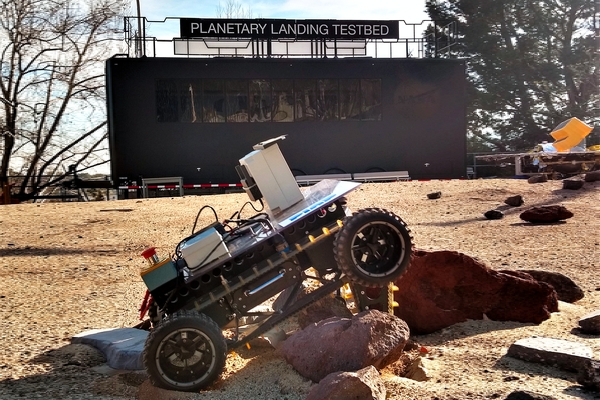
Poles have created a robot that cooperates with devices designed by the best engineers and scientists in the world. The robot, which is the result of cooperation between ŁUKASIEWICZ-PIAP and the California Institute of Technology, enables visual terrain reconnaissance. It will also take part in the prestigious DARPA Subterranean Challenge.
Polish engineers began cooperation with the California Institute of Technology (Caltech) in 2019 as part of the “Space Research Development” project, funded by the Polish National Agency for Academic Exchange (NAWA). As a result of this cooperation, one of the test robots produced at the ŁUKASIEWICZ-PIAP Institute was sent to the USA.
– Being present at the DARPA competition is an amazing experience. We can observe how robots perform in tasks related to searching underground areas. Such an application of robotics can be used in the area of security, and in the long term, perhaps, also in the exploration of the Solar System – explains Dr. hab. Eng. Piotr Szynkarczyk, Director of ŁUKASIEWICZ-PIAP.
So far, no Polish robot has participated in these competitions. In 2020, the competition focuses on the civilian aspects of using robots in rescue operations underground, including subway lines and mines.
Polish rover in the USA
The robot sent to the USA is a mobile platform weighing 27 kilograms, designed for visual terrain reconnaissance. The robot is equipped with specialized cameras and a tracked-wheeled drive system, ensuring increased mobility in difficult terrain conditions. Work preparing the rover for the DARPA competition took place in California during internship trips by Polish engineer Sławomir Kurdziel from ŁUKASIEWICZ-PIAP. Engineers from the Institute’s Warsaw headquarters also participated in the project remotely. The robot was subjected to processes of adaptation and testing of its suitability for the competition. In cooperation with scientists from the California Institute of Technology and NASA’s Jet Propulsion Laboratory (JPL), the robot was integrated with new software and sensors. This allowed for testing new methods of providing the robot with autonomy during mission execution. The cooperation of Łukasiewicz-PIAP specialists with engineers from the USA served to refine technologies that may find application during humanitarian and rescue work and perhaps – in space missions, such as exploring underground caves on the Moon.