








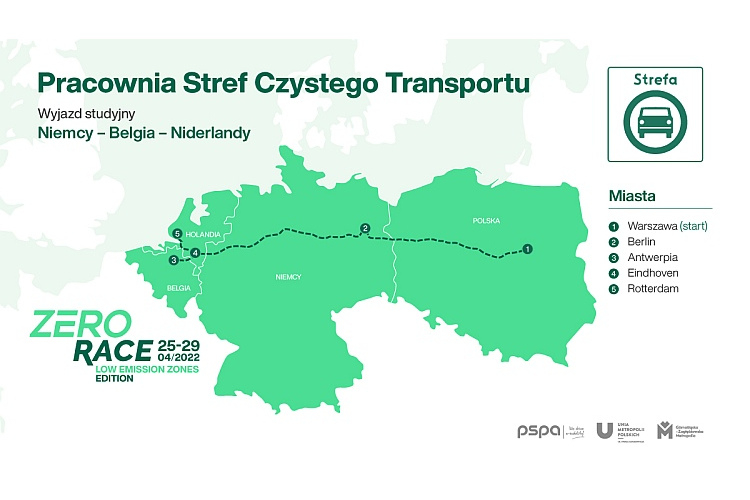
Clean Transport Zones are becoming a reality. Some cities in Poland have announced their implementation, while others are already conducting public consultations on the matter. PSPA, in cooperation with Polish local governments, wants to promote best practices for implementing these zones. Therefore, it is organizing a study trip for local government officials to cities in Europe where such zones are successfully operating.
On April 25th, representatives of local governments set off on a journey across Europe. The purpose of the trip is to familiarize officials with Clean Transport Zones (LEZ), which are successfully operating in nearly 300 cities in Western Europe. Participants will visit Berlin (Germany), Antwerp (Belgium), Rotterdam, and Eindhoven (the Netherlands), learning about the assumptions adopted when designing the zones, local conditions, the implementation process, and project evaluation. Local government officials will also have the opportunity to learn about the experiences resulting from the implementation of the Zones – their impact on air quality, public perception, and the structure of the vehicle fleet.
– The Union of Polish Metropolises (UMP) and the Polish Alternative Fuels Association (PSPA) see enormous potential in Clean Transport Zones (SCT), which are an effective tool for ensuring cleaner air, widely used in Western European countries. Properly directed actions taken by municipalities, supported by the knowledge and experience of domestic and foreign experts, have a chance to give Polish cities a second life, thereby positively influencing the health of residents – emphasizes Maciej Mazur, Managing Director of the Polish Alternative Fuels Association (PSPA).
Therefore, representatives of the Capital City of Warsaw, the City of Łódź Office, the Union of Polish Metropolises, the City of Wrocław Office, the Zabrze City Office, the Gdańsk City Office, the Metropolitan Office of the Upper Silesian-Zagłębie Metropolis, and the City of Kraków Office will embark on an educational journey aimed at building competence and knowledge among local governments in the area of Clean Transport Zones. By leveraging the experience of foreign experts, local government officials will gain a comprehensive range of knowledge and solutions regarding, among other things:
- factors determining the definition of the Zone’s boundaries in its current form,
- public information campaigns supporting the implementation of LEZs,
- the impact of implementing the Zones on the local community,
- changes in air quality within the Zone over the years,
- challenges during the preparation or implementation of the Zones,
- types of vehicles moving within the zone,
- the impact of implementing the Zones on pedestrians and cyclists.
– Implementing solutions aimed at improving the quality of life for city residents is extremely important. For this reason, we want to introduce them responsibly. To make this possible, we will hold substantive meetings with representatives of cities where Clean Transport Zones have already been introduced and have been operating for years. Thanks to these experiences, we will be able to introduce twin solutions in Poland with the appropriate know-how. We hope that thanks to this, we will be able to provide our residents with a better and healthier life while maintaining an appropriate level of traffic flow and transport in city centers – said Adam Wieczorek, Deputy Mayor of the City of Łódź, Union of Polish Metropolises.
To strengthen the educational message about the need for changes in mobility and simultaneously highlight the advantages of zero-emission transport, the local government officials will set off in electric vehicles. Among the cars that will tackle the route of over 3,000 kilometers are: Ford Mustang Mach-E, Mercedes-Benz EQV, Jaguar I-Pace, Kia EV6, and Hyundai Ioniq 5. The trip to cities in Germany, the Netherlands, and Belgium will also confirm that e-mobility is not just an eco-friendly trend, but a full-fledged and comfortable means of transport, even on long routes. During the trip, carbon dioxide (CO2) emissions will also be estimated and compared with data for conventional vehicles. The project partners also include infrastructure companies that will provide charging services to participants: Shell, Allego, and GreenWay Polska.
Where did the idea for the study visit come from? In the last decade alone, the number of vehicles in Poland has increased by as much as 40%, and transport is one of the main factors of smog in Polish cities. Therefore, the Polish Alternative Fuels Association (PSPA) – the country’s largest non-governmental industry organization promoting ecological and economically efficient energy technologies in transport, and the Union of Polish Metropolises – a leading local government organization in terms of commitment to the development of low- and zero-emission mobility, are jointly taking action to change legal regulations that will enable the socially acceptable and effective creation of Zones in Polish cities. To this end, PSPA has also established a highly specialized Local Government Committee, chaired by the City of Łódź, which is ultimately intended to bring together all Polish local governments active in the field of sustainable transport.