









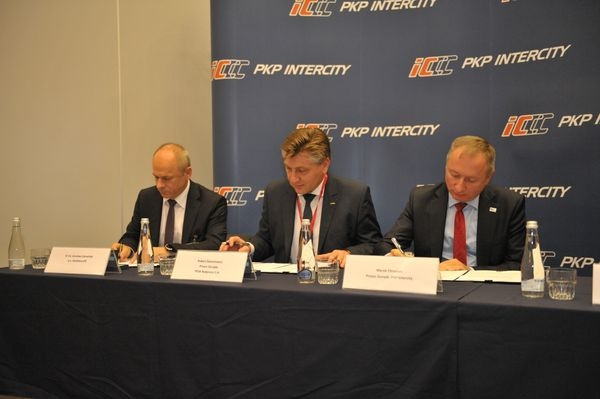
PKP Intercity SA, Pojazdy Szynowe PESA Bydgoszcz SA, and the Rail Vehicles Institute “Tabor” have signed a research and development cooperation agreement for the construction of a dual-mode locomotive. This will be the first Polish design of its kind.
Cooperation with PKP Intercity
The cooperation aims to create a new, TSI-compliant dual-mode diesel-electric locomotive, designed by the Bydgoszcz-based manufacturer. PESA will create it in cooperation with the Rail Vehicles Institute “Tabor” as a subcontractor and with PKP Intercity as a consultant and the entity conducting so-called supervised operation, i.e., tests for the first 12 months after its production.
– The experience of the Bydgoszcz company in building electric locomotives capable of shunting work on tracks without overhead lines, supported by PKP Intercity’s experience in operating many types of locomotives, creates an opportunity to implement a project that perfectly fits the assumptions of the Luxtorpeda 2.0 strategy. This would be the first completely Polish design of this type – says Marek Chraniuk, CEO of PKP Intercity.
– This type of vehicle will change the current traction service model – it will no longer be necessary to use an additional diesel shunting locomotive in the transport process. This joint venture between a Polish carrier and a manufacturer is fully in line with the Strategy for Responsible Development. So far, there have been no such activities, and we are pleased that it is PKP Intercity and PESA that are setting a new trend in manufacturer-carrier relations – notes Robert Świechowicz, CEO of PESA.
Savings through innovation
The entire work will be divided into four stages. They will include the preparation of a technical description of the designed locomotive and a work schedule, the research phase, the construction process, and locomotive testing. As part of the cooperation, a special committee will be formed, consisting of representatives of each of the parties involved in the project. They will approve and accept individual stages of the cooperation.
– This project is being created with the intention of implementing dual-mode vehicles into operation by PKP Intercity. Such a solution will enable, among other things, the operation of trains on various lines (electrified and non-electrified) without the need to change vehicles, and performing shunting with trains at terminal stations without the need to use diesel locomotives. This will allow for significant savings in time and money – says Jarosław Oniszczuk, member of the board of PKP Intercity.
– It is worth emphasizing that this type of locomotive is particularly useful in the implementation of intermodal transport, making it cheaper and faster. Taking into account the upward trends in intermodal transport, we expect a high demand for such vehicles – adds Andrzej Waszczuk, who oversees the dual-mode locomotive project at PESA.
The project assumes the construction of a vehicle with two power sources: from the overhead line and a power generator. The dual-mode locomotive will be a standard-gauge, four-axle vehicle with a maximum power, depending on the power source, of 2,800 kW (electric) or 1,800 kW (diesel). Thanks to the use of dual propulsion, the vehicle will be able to be used in long-distance passenger traffic, intermodal transport, and for all shunting work accompanying these transports.
Support from NCBR
The project to build a dual-mode locomotive, called “Platform of locomotives with advanced diesel-electric (multi-system) propulsion systems,” was submitted by PESA to the competition for funding innovative projects under the Innotabor program, announced by the National Centre for Research and Development, and received a positive assessment and a recommendation for funding. This was the basis for the signing of an agreement between PKP Intercity and the manufacturer.
The dual-mode locomotive built as part of the agreement will be the property of PESA. After the tests are completed, PKP Intercity will have the option to purchase the vehicle, provided that the manufacturer meets the appropriate conditions.
Modern technologies in the service of the railway
On October 6, 2016, representatives of PKP Intercity and PESA Bydgoszcz signed a letter of intent on developing cooperation. The companies declared to take action in the area of research and development work as part of the construction of new-generation rolling stock. According to the assumptions of the letter, the first joint project was to be the construction of a dual-mode electric-diesel locomotive. This year’s signing of the research and development cooperation agreement as part of the project is an important step towards the realization of the project.