








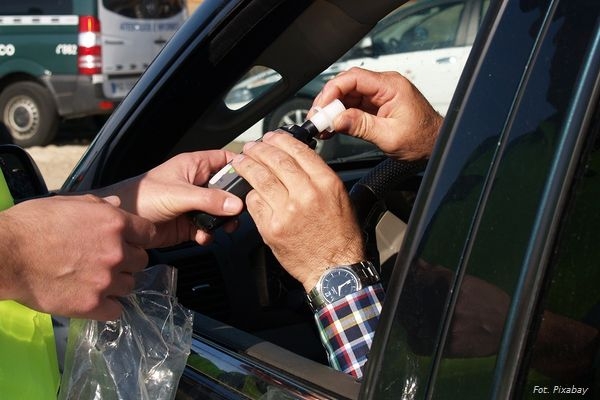
Compared to the European average, we blow into police breathalyzers exceptionally often. Despite this, half of Poles believe that the Police should check sobriety on the roads even more actively.
According to ETSC (European Transport Safety Council) data, Poland is among the European leaders in terms of the number of police sobriety checks1. Traffic police officers routinely reach for a breathalyzer during practically every traffic stop, and random testing as part of the “Sober Morning” campaign is often a Monday routine – especially in larger cities.
Police checks with strong support
Following the amendment to the Road Traffic Law in June 20172, a vehicle driver can no longer refuse to submit to a breath alcohol test when requested by an officer. One might expect that mandatory testing and the relatively high intensity of checks would be perceived by drivers as burdensome. It turns out, however, that the opposite is true. We expect even more activity from police officers because we treat drunk drivers as the number one threat on the roads3.
When asked about the frequency of checks in a study for AlcoSense Laboratories, the majority of Poles opted for greater involvement of the traffic police. Half of the respondents (50.5 percent) assessed that breathalyzer tests are too infrequent and would like to see more of them. One in three respondents (33.5 percent) was satisfied with the current number of checks, and only 13.6 percent of those surveyed stated that police officers reach for the breathalyzer too often.
– As the study results indicate, Police actions aimed at catching intoxicated drivers enjoy clear support. For example, sobriety check campaigns at motorway toll booths have met with a positive response. Due to the speeds developed, drivers under the influence pose an exceptionally high threat on express roads. A minimal mistake can lead to a tragedy. It is therefore worth it for the Police to intensify checks, including on motorways and at entrances to expressways. Especially since this is exactly what more than half of drivers expect – explains Hunter Abbot, a road safety expert from AlcoSense Laboratories.
Strong approval for new penalties
When asked about the introduction of new penalties for driving with more than 0.2 per mille of alcohol in the blood, the respondents indicated community service as the most desirable solution (supported by 82.3 percent of respondents). Similar support was also obtained for: suspension of a driving license for at least a year and mandatory installation of an alcohol interlock in the car. The vast majority (73.1 percent) also opted for a one-year ban on performing professions requiring driving. In turn, vehicle confiscation is the only penalty that the majority of respondents opposed (51.4 percent). However, almost half (48.6 percent) are still willing to accept it.
The SW Research study for AlcoSense Laboratories was conducted in May 2019 on a representative group of 1090 Polish drivers.
1 According to ETSC data, between 2010 and 2015, the frequency of sobriety checks conducted by the Polish Police increased fivefold. In 2010, there were on average 88 checks per 1000 inhabitants, and in 2015, it was already 466 checks per 1000 inhabitants. Only Estonians were checked more frequently – 677 checks per 1000 inhabitants in 2015.
Data comes from the ETSC report “How traffic law enforcement can contribute to safer roads”, page 25:
https://etsc.eu/how-traffic-law-enforcement-can-contribute-to-safer-roads-pin-flash-31/
2 Art. 129ja of the Act of June 20, 1997, Road Traffic Law (Journal of Laws of 2018, item 1990, as amended)
http://prawo.sejm.gov.pl/isap.nsf/download.xsp/WDU19970980602/U/D19970602Lj.pdf
3 The AlcoSense study from May 2019 indicated that 51.7% of respondents fear drunk drivers the most on the road. For comparison, 27.7% consider inexperience and recklessness on the road as the main threat.