









One of the largest Polish logistics operators, ROHLIG SUUS Logistics, decided to examine the habits and behaviors of Poles buying large household appliances online. The presented data indicates that we are buying more and more expensive equipment. Compared to last year, the average shopping cart value has increased by over 100 PLN. And although we are spending more and more online every year, a significant portion of customers is still attached to paying for purchases… in cash.
According to data from the Association of Household Appliance Employers APPLiA Polska, the first quarter of this year was very good for household appliance manufacturers. Compared to the same period last year, companies 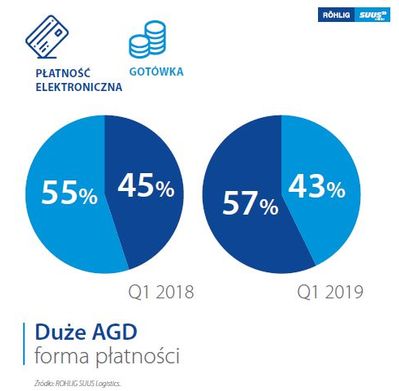 sold 6 percent more large household appliances for distribution, and their value was as much as 9 percent higher.
E-commerce on the rise
According to experts at ROHLIG SUUS Logistics, a leader among companies delivering household appliances in Poland, the driving force of the market is the increasing popularity of online sales.
– The value of the e-commerce market is growing dynamically. This year it is expected to reach 50 billion PLN. Interestingly, Poles are eager to buy not only clothing, books, or cinema tickets online, but also more expensive products, such as household appliances. This is visible in the number of equipment deliveries we carry out, which is systematically increasing – says Sławomir Wujek, Director of Domestic Distribution Product at ROHLIG SUUS Logistics.
Data from ROHLIG SUUS Logistics also shows that despite the digitalization of trade and the increasing prevalence of mobile payments, customers are still attached to cash. And although the share of online payments is noticeably increasing (in Q1 2018 it was 45 percent, in Q1 2019 it was already 57 percent), almost every second delivery is still paid for upon receipt.
– Online stores today offer various forms of electronic payments – from instant transfers, through card payments, to systems like PayPal or BLIK. Despite this, customers are still eager to use the payment on delivery option. When deciding on an expense of several thousand zlotys, they often want to see the product first, assess whether it is consistent with the order, and whether it has any defects. Especially since they can simply refuse to accept such goods without any consequences – adds Sławomir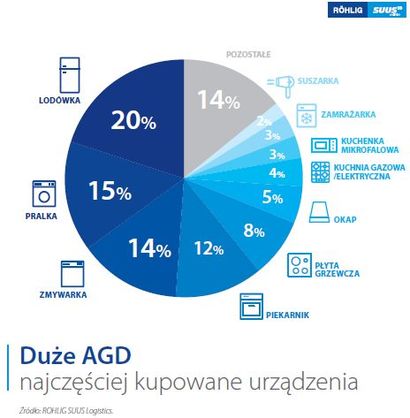 Wujek.
We are spending more and more
It is also worth noting that we are buying increasingly expensive household appliances. This is evidenced by the growing average order value, which in the first quarter of last year was 1884 PLN, while in the same period of this year it reached the level of 1990 PLN. As Sławomir Wujek emphasizes, a significant role here is played by the change in habits and the financial capabilities of customers.
– Poles are paying more and more attention to energy efficiency, choosing devices that consume less electricity or water. They also like technological novelties – once the ability to control a washing machine via a smartphone was considered a manufacturer’s whim, today it is almost a standard. Equipment is becoming “smart”, and consequently – more expensive. However, along with the country’s economic development, the earnings of Poles are also growing, and they can simply afford such equipment. Therefore, we can expect that the value of the shopping cart will systematically increase – says the ROHLIG SUUS Logistics expert.
Refrigerators for the holidays
What large household appliances do Poles buy most often online? As much as 20 percent of all delivered goods 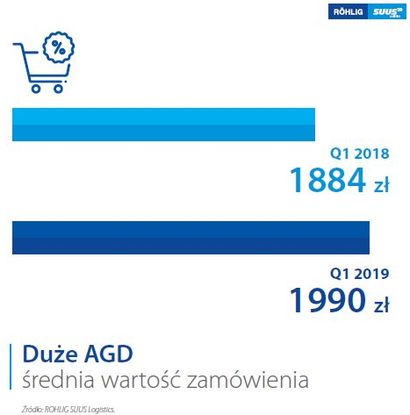 are refrigerators. Next are washing machines (15 percent), dishwashers (14 percent), and ovens (12 percent). We make purchases most often during the holiday season (July – September) and before Christmas (November – December). Interestingly, those buying online and choosing equipment delivery are most often residents of villages and towns with fewer than 100,000 people. In the first quarter of this year, they accounted for as much as 74 percent of all e-market customers. For comparison, deliveries in cities with 100,000 to 500,000 inhabitants account for 17 percent, and those over 500,000 – 9 percent of all deliveries.
The presented data was developed based on over 50,000 deliveries of large household appliances carried out by ROHLIG SUUS Logistics. The analysis covered deliveries of orders from distribution centers of electronic stores, carried out throughout the country. ROHLIG SUUS Logistics SA is the national leader among companies delivering household appliances purchased online.