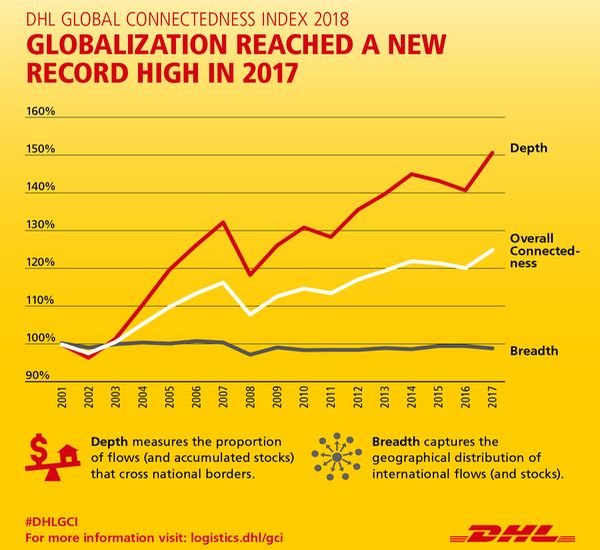
Data from the “Global Connectedness Index” – a detailed analysis of the degree of globalization prepared by DHL – measured by international trade, capital, information, and personal flows, shows that the level of globalization in Poland has remained at the same level (compared to the 2015 report).
In terms of international flows, Poles are most strongly connected with Europe. Of the 10 countries with the largest international connections with Poland, 8 are European countries. Germany is in first place, accounting for as much as 34 percent of Poland’s international flows. This is also a better result than that achieved by the next 7 countries combined (the second, the United Kingdom, reached a level of 8 percent).
Europe at the forefront of globalization
Despite growing anti-globalization tensions in many countries, international connections reached a record level in 2017, as cross-border trade, capital, information, and human flows intensified significantly for the first time since 2007. Strong economic growth has stimulated international flows, and key policy changes, such as tariff increases in the US, have not yet been implemented.
8 of the 10 countries with the most international connections are in Europe, making it the most globalized region in the world, particularly in terms of trade and the movement of people. North America, the leader in capital and information flows, took second place, followed by the Middle East and North Africa. The five most globally connected countries in the world are: the Netherlands, Singapore, Switzerland, Belgium, and the United Arab Emirates.
– It is surprising that even after the recent benefits of globalization, the world is still less connected than most people think – commented GCI report co-author Steven A. Altman, a senior research scholar at the NYU Stern School of Business and executive director of NYU Stern’s Center for the Globalization of Education and Management. – This is very important because when people overestimate international flows, they usually worry about them more. The information in our report can help calm these concerns and focus attention on current proposals for solutions to social problems associated with globalization.
At the global level, the GCI report shows, for example, that only about 20 percent of the world’s economic output is exported, about 7 percent of telephone call minutes (including internet calls) are international calls, and only 3 percent of people live outside the borders of the countries where they were born. The report also debunks the belief that distance is slowly becoming irrelevant. Most countries are much more connected to their neighbors than to distant nations.
– Even if the world continues to globalize, there is still huge potential. The GCI shows that currently, most of the movements and exchanges we observe are domestic, not international. However, we know that globalization is a decisive factor for growth and prosperity – says John Pearson, CEO of DHL Express.
Emerging economies remain less connected than developed economies
The GCI also reveals huge differences between the levels of globalization in developed and emerging economies. Emerging economies trade almost as intensively as developed ones, but developed ones are more than three times more integrated into international capital flows, five times more in terms of human flows, and almost nine times more in terms of information flows. Furthermore, while leaders from large emerging markets have become major drivers of globalization on the world stage, the progress of emerging economies in catching up in terms of global connections has stalled.
The GCI report provides the first comprehensive assessment of the development of globalization in 169 countries and territories since the Brexit referendum in the UK and the presidential elections in the United States in 2016.