








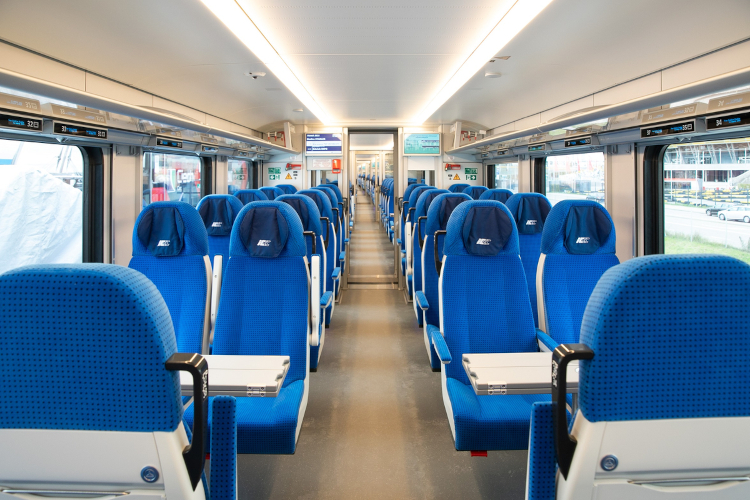
PKP Intercity has taken delivery of 6 out of 12 FLIRT-type electric multiple units, manufactured at the Stadler Polska factory in Siedlce. The remaining trainsets are expected to join the carrier’s rolling stock fleet by the end of the fourth quarter of 2023. The contract, worth over one billion PLN, will enable an increase in the number of connections on the most popular routes.
The modern vehicles delivered as part of the order worth 1.015 billion PLN gross are part of the largest investment program in the company’s history, “PKP Intercity – Railway of Large Investments”. The contract for the production of 12 electric multiple units was signed between PKP Intercity and Stadler Polska in 2019. The signed contract includes technical maintenance of the new fleet for a period of 15 years.
Fast, comfortable, and eco-friendly FLIRT trains
The modern electric multiple units will be adapted for speeds of 160 km/h, which will allow for efficient use of modernized railway lines. As a result, travel with PKP Intercity will significantly speed up. In the final configuration, the new vehicles from Stadler Polska will operate across Poland and supplement the offer on routes including:
- Szczecin – Poznań – Łódź – Lublin;
- Szczecin – Poznań – Łódź – Kraków;
- Gdynia – Bydgoszcz – Łódź – Kraków;
- Gdynia – Bydgoszcz – Łódź – Katowice;
- Olsztyn – Warszawa – Kraków;
- Olsztyn/Białystok – Warszawa – Częstochowa – Bielsko Biała/Racibórz.
Every investment by PKP Intercity is carried out with our passengers in mind, whom we always put first. Modern vehicles, like those just received from Stadler Polska, are a tangible proof of the positive change in Polish railways. More and more connections are being served by new or modernized rolling stock, making rail an increasingly preferred means of transport for passengers – says Jarosław Oniszczuk, member of the management board of PKP Intercity.
In the new multiple units, passengers will benefit from numerous amenities, including air conditioning, power outlets, GSM/LTE signal boosters, wireless internet, and dedicated space for bicycle transport. During the journey, PKP Intercity will be able to offer a selection of hot and cold dishes and drinks, served both to the passenger’s seat and in the catering area. Furthermore, the vehicles are adapted to the needs of people with disabilities. The new units are monitored, and the passenger space offers 294 seats in 2nd class and 60 seats in 1st class.
It is also worth emphasizing that the currently delivered FLIRT vehicles are compatible with the FLIRT vehicles handed over by Stadler Polska to PKP Intercity in 2015. This means that units from 2015 can be coupled with vehicles from the latest series. Such capability gives the carrier great operational flexibility. Additionally, the investment will allow for greater standardization of the company’s rolling stock.
I am convinced that the vehicles produced by Stadler Polska will serve the carrier very well, but above all, the passengers. These are the next trainsets of this type that we are delivering to PKP Intercity, which is proof of trust in our work and confirmation of the high quality of vehicles from our Siedlce factory – says Tomasz Prejs, CEO of Stadler Polska.
The vehicles produced by Stadler Polska were designed with environmental protection in mind. Their lightweight, aluminum construction guarantees lower energy consumption. They are built, among other things, from eco-friendly materials that are recyclable. Additionally, they are equipped with an energy recovery system, allowing them to return energy generated during braking to the overhead line. Greater travel comfort will be provided by acoustic insulation, which will result in lower noise emissions inside the trainsets.
Billion-PLN investments by PKP Intercity
As part of the “PKP Intercity – Railway of Large Investments” rolling stock strategy, the national carrier will invest 27 billion PLN by 2030 in modern rolling stock and eco-friendly maintenance depots. As a result, the carrier plans to run about twice as many trains in 2030 and offer passengers a high standard of travel. Travel at speeds of 160-250 km/h will become the norm, which will shorten travel times. Higher comfort and functionality will be provided by a new design of the interior space of the trains, the concepts for which are currently being worked on. The new vehicles will be adapted to the needs of various groups of travelers, e.g., people with disabilities or families with children. By 2030, the entire rolling stock of the carrier will be new or modernized, which will ensure a high level of travel safety and convenience. Massive investments in modern trains will drive the further development of rail as the most eco-friendly means of public transport, in line with the assumptions of the European Green Deal. PKP Intercity plans to become the first Polish passenger carrier whose operations will be climate neutral.