








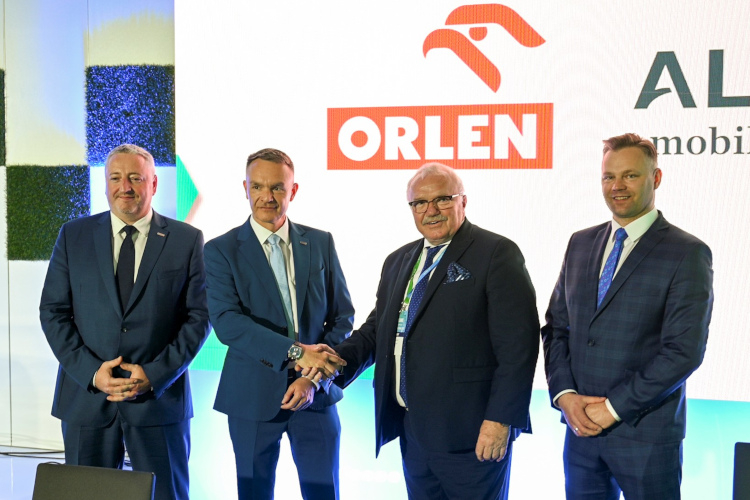
PKN ORLEN has signed a strategic cooperation agreement with Alstom for the supply of emission-free, eco-friendly trains and hydrogen fuel for public rail transport. The company, which is consistently implementing the hydrogen strategy announced this year, will provide refueling infrastructure for the trains produced by Alstom. The first hydrogen vehicles have the potential to enter regional lines within two years.
– We are effectively implementing our hydrogen strategy, which supports our pursuit of achieving emission neutrality. By 2030, we intend to allocate approximately PLN 7.5 billion for investments, thanks to which nearly half of the hydrogen produced in the ORLEN Group will be low- and zero-emission. This, in turn, will translate into a reduction of 1.6 million tons of CO2 emissions and, above all, will contribute to increasing Poland’s energy security. Cooperation with Alstom is another important step that will strengthen our position as a regional leader in hydrogen technologies – says Daniel Obajtek, CEO of PKN ORLEN.
Under the agreement, Alstom will cooperate with PKN ORLEN in participating in tenders organized by public rail transport operators. Alstom will be responsible for the supply of emission-free trains powered by hydrogen fuel cells. In turn, PKN ORLEN will be responsible for the distribution, storage, and supply of hydrogen fuel for these trains.
– We are consistently developing alternative energy sources, including hydrogen. It is the fuel of the future that will drive the energy transition in the long term. We have significant expertise in this area, backed by experience. Establishing cooperation with Alstom will enable us to implement pilot hydrogen projects in public rail transport and will translate into strengthening our position in Poland and the entire Central European region – says Józef Węgrecki, Member of the PKN ORLEN Management Board for Operations.
– One of the key elements of Alstom’s strategy is a positive impact on the climate and the environment. We have been using hydrogen technology in rail transport for years, and we are the first company in the world to have launched commercial passenger transport with hydrogen trains, which are completely emission-free and, importantly, partially produced in Poland. We were the first to introduce high-speed trains to Poland – 20 Pendolino trainsets. I hope that Alstom will also be the first to introduce hydrogen trains to Poland. Signing today’s agreement with PKN ORLEN is another step towards the transformation of Polish railways using the most modern global technologies – says Sławomir Cyza, CEO and Managing Director of Alstom in Poland, Ukraine, and the Baltic States.
– Alstom is a pioneer in developing hydrogen technologies in rail transport. In 2018, as the first manufacturer in the world, we put the Coradia iLint hydrogen train into commercial use. Cooperation with PKN ORLEN will allow us to more effectively realize our ambition of being a technological leader in rail transport, as well as Poland’s ambition as one of the key countries where hydrogen technologies are developed and implemented. The main motivation for working on hydrogen technologies is the need to seek emission-free energy sources, including in transport. Increasing zero-emission traffic on the rails means less pollution and lower CO2 emissions – says Artur Fryczkowski, Vice President and Sales and Business Development Director of Alstom in Poland, Ukraine, and the Baltic States.
In response to the challenges related to the energy transition, the ORLEN Group has prepared a hydrogen strategy until 2030, integrated with the ORLEN2030 business strategy. The document defines the company’s goals until the end of the decade and long-term ambitions in four key areas: mobility, refining and petrochemistry, industry and energy, and research and development.
The hydrogen strategy assumes the use of hydrogen in urban public transport and rail. To this end, PKN ORLEN has already signed letters of intent for cooperation with over 20 Polish cities and companies that are potential hydrogen recipients.
In 2021, an analytical laboratory for hydrogen testing and the first hydrogen hub were put into operation in Trzebinia, which currently produces grey hydrogen for transport, while ultimately it will produce low-emission hydrogen derived from renewable energy sources. By the end of this decade, 10 hydrogen hubs are expected to be operational, including in Włocławek and Płock.
Furthermore, by 2025, a hydrogen laboratory will be established at the Research and Development Center in Płock. It will conduct tests and research on installations regarding hydrogen production, its quality and purification, as well as storage and transport.
PKN ORLEN is also the leader of the Masovian Hydrogen Valley, within which it cooperates with 36 entities in the field of production, storage, and use of zero- and low-emission hydrogen, including in transport, energy, municipal services, and agriculture.
Read also:
– Safe and ecological railway – a good time for changes
– Masovian Hydrogen Valley established
– First hydrogen buses for Poznań