Nestlé Polska and PepsiCo Polska are launching the first project in Poland aimed at increasing the collection and recycling of packaging waste from flexible multi-material and plastic packaging. The essence of the project is to increase the volume of packaging waste from flexible packaging, such as crisp or breakfast cereal bags, sorted by municipal facilities. The “ReFlex” project, funded by both companies, will allow for an increase in the recycling levels of this waste in our country, which will contribute to the further development of a circular economy, and thus protect the planet against climate change.
Every year, Poles use approximately 650,000 tons of plastic packaging1. Less than 5% of this mass consists of flexible plastic packaging and multi-material packaging with a predominance of plastics2 – these include, for example, bags for crisps and other snacks, packaging for breakfast cereals, sweets, spices, or instant meals. Too little of this type of packaging is still being sent for recycling, mainly due to its small size, which makes it difficult to separate this type of waste during sorting in municipal facilities. Meanwhile, the plastics used to produce the packaging are fully recyclable. When properly collected and sorted, they can be given a second life to be used in the construction, transport, or furniture industries in the form of, for example, insulation boards, soundproofing mats, or structural furniture components.
The essence of the project is to increase the volume of packaging waste from flexible packaging sorted by municipal facilities. Thanks to the financial resources of Nestlé and PepsiCo, on one hand, residents will be educated about the need for more accurate waste segregation at home so that flexible packaging waste does not end up in mixed waste, and on the other hand, facilities will be able to sort more of such waste from the proverbial yellow bin for recycling plants.
– We strive to ensure that none of our product packaging ends up in landfills or the natural environment. In many areas, we are accelerating actions and increasing investments in this direction. In Poland, we decided to become leaders of change, which is why we took on a challenge that many considered impossible to achieve. By participating in the ReFlex project, we want to show that we can meet it. Every flexible package contains a valuable raw material that should be reused. We want to close the loop in every possible area and show how to do it. We are confident that together with our partners, we will achieve the goals we have set for ourselves – says Artur Jankowski, President of Nestlé Polska.
– ReFlex is an excellent example of implementing Extended Producer Responsibility. It is proof that producers want to and are able to carry out important projects on their own initiative that increase the level of recycling beyond their legal obligations. Thanks to such projects, everyone benefits, and most of all the environment, which we should all care about the most – said Michał Jaszczyk, President of the Management Board, CEO of PepsiCo Polska.
The technical implementation of the project, i.e., cooperation with entities collecting waste from residents, municipal facilities, and recycling plants, has been entrusted by the project partners to the company Eco Solutions.
– The ReFlex project is an innovative undertaking on an EU-wide scale. We are recovering packaging waste that, due to its small size and weight, was previously perceived negatively and did not end up where it should, i.e., in recycling. We decided to change that! – emphasized Tadeusz Pokrywka, Eco Solutions.
The coordinator of the entire undertaking is the Association of Employers of the Packaging Industry and Packaged Products EKO-PAK.
– As part of the pilot, together with Eco Solutions, we conducted tests on the possibilities of recycling and using secondary raw materials from this packaging, and we also analyzed their purity and physico-chemical properties. The effects of these actions led us to satisfactory results. Everything was therefore prepared to launch the project on an industrial scale today – added Magdalena Dziczek, Director of the EKO-PAK Association of Employers office.
Both Nestlé and PepsiCo have been taking action for many years to reduce the impact of packaging, including plastic, on the environment. Both companies are working intensively on building a future without waste and creating a world where plastic never becomes waste. The partners are members of international projects and coalitions aimed at implementing circular economy solutions, and as a result, reducing emissions and stopping climate change.
1 Source: Rekopol Packaging Recovery Organization SA
2 Source: National Chamber of Food and Packaging Industry
Source: Newseria
Read also about other ecological initiatives:
– Brambles achieves sustainability goals
– Polish industry to benefit from the development of offshore wind farms
– 4,000 photovoltaic panels on the roof of the LPP distribution center
– GLS focuses on renewable energy sources
– Kuehne+Nagel and IAG Cargo carry out carbon-neutral charter flights
– The world’s first passenger hydrogen train may be produced in Poland
– PKP Intercity informs passengers about their carbon footprint
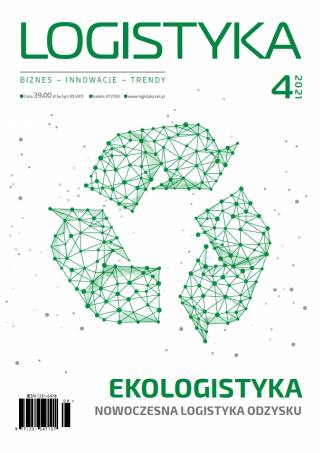
More articles on ecological solutions can be found in the magazine LOGISTYKA 4/2021.
The e-edition of the magazine is available in our offer!
Stay up to date, subscribe to the LOGISTYKA magazine!