








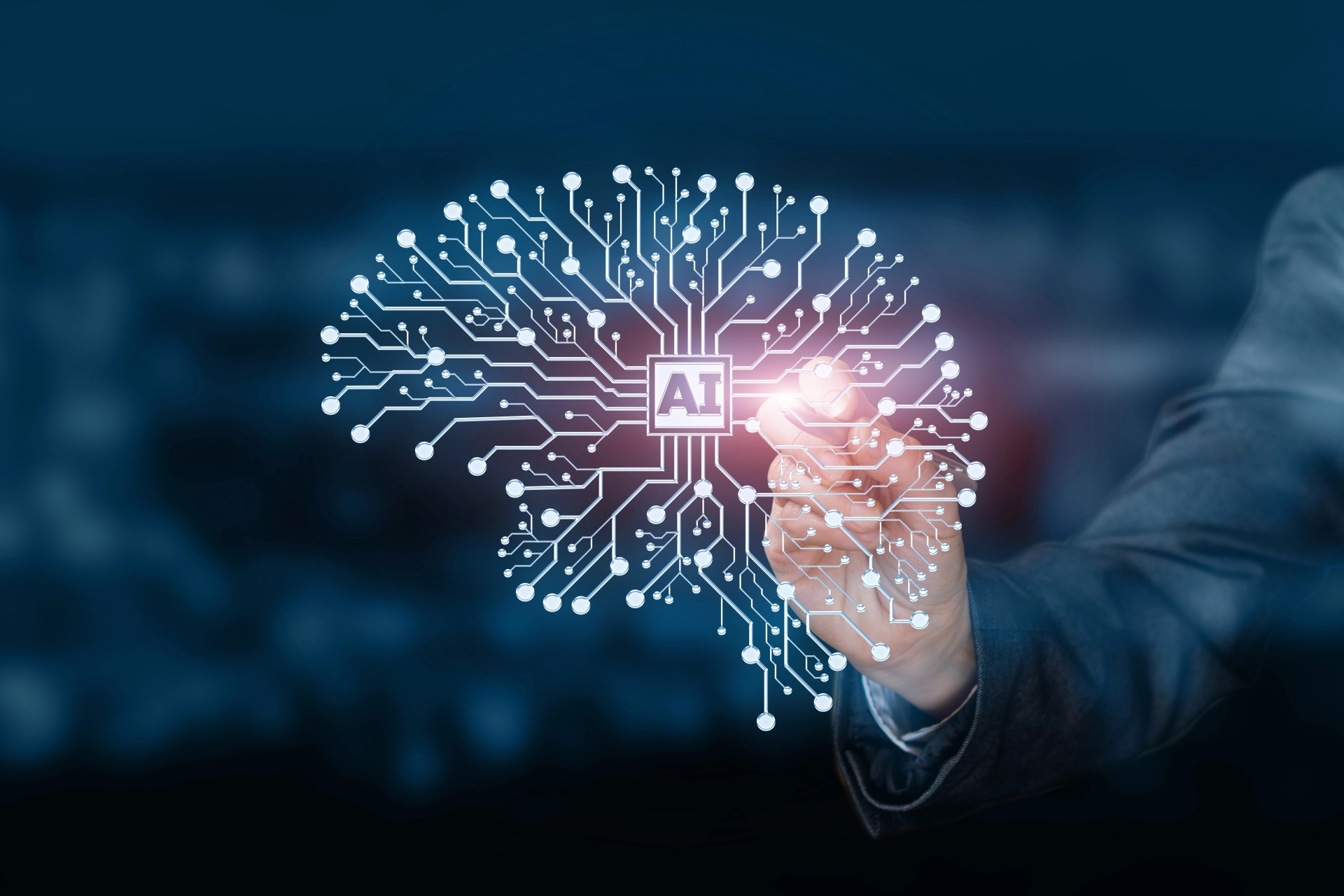
Artificial intelligence has become an integral part of many applications. Scientists and developers are working hard to find ever better ways to apply it.
Is artificial intelligence (AI) a technology of the distant future? The answer is both “yes” and “no.” No, because AI applications have long been a part of our daily lives. Take, for example, facial recognition, which many people use to unlock their smartphones. Or translation programs, which now excel at accurately translating sentences, and even entire documents, in many different languages in just a few seconds. There are also chatbot systems, such as ChatGPT and Copilot, that help today’s pupils and students write their papers.
These are three examples of IT applications that do not rely on traditional “if-then” programming. Instead, they use vast amounts of training data, advanced learning methods such as supervised or reinforcement learning, and algorithms that often utilize very complex neural networks. An artificial intelligence algorithm will never give a result of “0” or “1.” Instead, AI always provides the probability of the correctness of a mathematically calculated prediction, which will never be 100%. Artificial intelligence claims are always at least slightly inaccurate. And it is precisely this feature that makes it necessary to check results carefully, although this in no way negates the enormous potential of this technology. Indeed, artificial intelligence is the only way to calculate practical solutions for the most complex correlations. AI applications are more like an intelligent colleague who is very knowledgeable but sometimes makes mistakes.
Artificial intelligence has also reached the world of logistics. More than six years ago, the DACHSER Enterprise Lab team at Fraunhofer IML began developing algorithms to forecast tonnage volumes for the DACHSER groupage network 25 weeks in advance. They also developed an image recognition solution to identify, locate, and measure shipments in groupage warehouses in real time. For several years, the cornerstone of DACHSER’s AI implementation strategy has been the collaboration of logistics specialists and process experts with mathematicians and developers.
New, unexpected possibilities
Nevertheless, artificial intelligence can still be considered a technology of the future. New models continue to open up unexpected possibilities. Coming to the fore here are generative artificial intelligence models, which use advanced algorithms, trained on masses of data taken from the Internet, to understand and create texts and images. ChatGPT and other large language models (LLMs) in particular give the impression of possessing “intelligence.” However, this is actually based only on a mathematical function that predicts a coherent sequence of words.

Foundation models in artificial intelligence: In the field of artificial intelligence (AI), a foundation model is a large, pre-trained model based on extensive datasets that is compatible with a wide range of applications. There are various types of foundation models, including large language models (LLMs) and visual processing models. LLMs, such as OpenAI’s GPT-4, Google’s Gemini (formerly “Bard”) and Bert, and Meta’s Llama3, specialize in understanding and generating natural language. Visual models, such as OpenAI’s Sora and DALL-E, are designed to generate videos and images using any text (prompts). As the name suggests, foundation models often serve as the basis for specialized applications, for which they are customized to incorporate specific tasks or datasets.
Their enormous potential has only just begun to be tapped. For example, in the robotics industry, experts are experimenting with foundation models as a way to communicate with and control autonomous vehicles. This would increase the ability of robots to perform complex tasks, such as natural language processing, image and object recognition, and autonomous navigation. These models allow robots to learn from vast amounts of data and adapt to new environments and tasks, meaning they offer greater flexibility and a wider range of applications. We will soon see whether autonomous vehicles used in warehouses can be controlled more intuitively and efficiently. Intensive research is being conducted all over the world.
RAG: A better foundation for AI-assisted research
Many developments in the field of artificial intelligence are focusing on Retrieval-Augmented Generation (RAG), which promises to improve the quality of results generated by large foundation models. Essentially, RAG provides the LLM with higher-quality data and knowledge sources for a given use case. This prevents the LLM from fabricating results if it is unable to find a solution that is highly likely to be correct. Such improper behavior of LLM tools is referred to as “hallucination” and can often undermine user trust in artificial intelligence.
Further research into artificial intelligence will bring a whole new range of potential applications. Companies like DACHSER must strike a balance between using standard AI applications and internal development. Artificial intelligence models must be trained based on specific internal company data, especially for special logistics processes and solutions. General information available on the Internet is not a sufficient basis for training. At the same time, costs must be taken into account, especially for AI models that require significant computing power, as well as compliance with the new EU legal framework for AI applications, as set out in the AI Act. Both industry and society are only just beginning to delve into the use of artificial intelligence – a journey that will certainly bring quite a few challenges.
Source: Dachser