










The coronavirus pandemic is spreading rapidly. There are no vaccines, no cures. Specialists from the World Health Organization recommend that everyone minimize leaving their homes. In times of high activity and mobility, this is not an easy task. The Big Data company, Cloud Technologies, checked how Europe approached the matter.
Cloud Technologies, a Warsaw-based Big Data company specializing in data analytics and digital marketing, has prepared another report on mobility. The study aimed to check whether Europeans took the WHO recommendations seriously and whether they submitted to quarantine. Experts looked at the behaviors of: Poles, French, Spaniards, Germans, Italians, and the English. It turns out that Poles are very disciplined.
The time when the world stopped
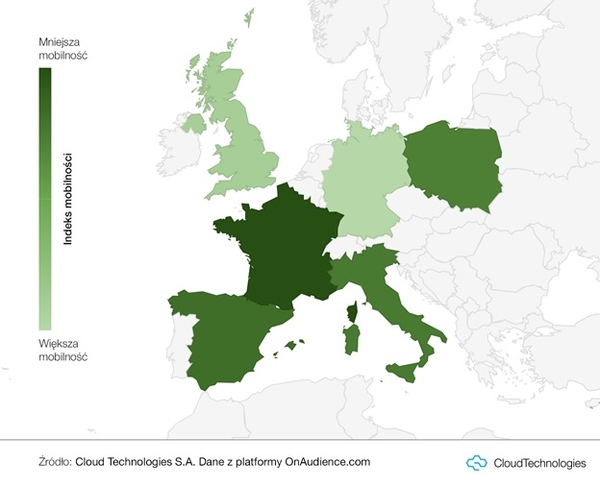
The Cloud Technologies report includes data collected from the network between February 25 and March 29, 2020. The charts included in it show the mobility of citizens of individual countries. Measuring such activity was possible thanks to mobile devices, especially the geolocation of mobile phones connected to the Internet and the use of GPS technology. Currently, 824 million devices connected to the Internet are being analyzed in the markets of France, Spain, Germany, Poland, Great Britain, and Italy. The data used were normalized to allow for the comparison of individual markets.
– We use the same methods in our daily work, helping companies from all over the world to precisely reach their audience. Over the years, marketing technology has evolved; today it is the main center of innovation. Big Data and artificial intelligence algorithms are our everyday life – says Piotr Prajsnar, CEO of Cloud Technologies.
The 100% value defines the average daily distance traveled by citizens in the period before the study. The colored line indicates the current measurement, which represents the average distance that residents of a given country traveled each day. Thanks to this, it is easy to compare the level of activity before and during the study, i.e., between February 25 and March 29.
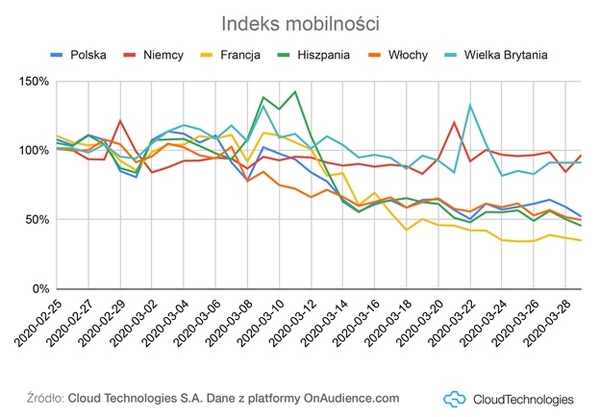
– The mobility index in practically all analyzed areas shows a downward trend over the perspective of the entire study, however, we can notice a large irregularity in the trend and sudden changes – says the CEO of Cloud Technologies. – Political, social, and economic events strongly influence our mobility, which is why we must interpret the situation of each country individually and with consideration for certain key issues and dates.
Isolation as a recipe for Europe
Residents of France, Spain, Poland, and Italy have limited their mobility much more than the Germans and the British. The decline in movement in France, Spain, and Poland occurred from the moment the pandemic state was announced by the WHO, regardless of the development of infections, which was very low, especially in Poland.
In Italy, despite the rapid increase in infections and the difficult situation in the healthcare system, the mobility coefficient remained at a high level until March 7, i.e., until the moment significant restrictions were introduced in that country.
According to the analysis, the French reduced the average distance traveled in one day the most, but they needed a lot of time for specific actions. Italians and Spaniards limited mobility only when the number of confirmed cases of infection was alarmingly high. Great Britain, on the other hand, was the last to introduce restrictions on the movement of people.
Conclusions and assessment of maturity
The global pandemic is still ongoing and it is unknown when it will end. However, the Cloud Technologies study can already be used today to assess the behavior of European governments and societies of individual countries towards the coronavirus.
The only recipe for limiting the spread of the COVID-19 virus is limiting mobility and isolation. This is a huge challenge for many, but only solidarity in action gives a chance for success in this difficult fight.
– This method of fighting the virus refers to the way of creating a physical distance barrier between two or more people to prevent or stop the transmission of the virus – says Arindam Basu, professor of epidemiology and environmental health at the University of Canterbury in New Zealand. – At the moment, we do not know of a safe and effective vaccine, nor do we know if a safe and effective drug will work after the symptoms of COVID-19 have already appeared. Therefore, the best we can bet on today is preventive measures against the spread.
Source: Cloud Technologies