









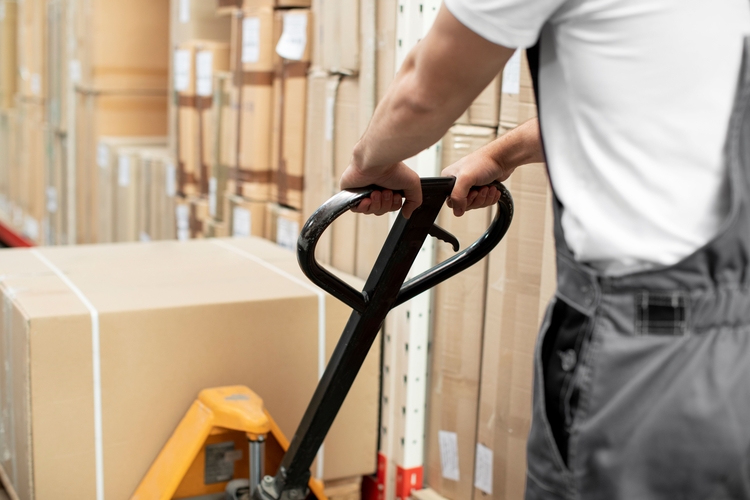
Weighing a pallet means a forced break from work. The operator must interrupt transport, drive to the scale, wait their turn, and return. With 30 pallets a day, that is up to an hour lost on a single truck. People rarely think about it this way, but the truth is that the weighing point very often becomes a warehouse bottleneck when queues start to form.
A pallet truck with a scale puts an end to this problem. Strain gauge sensors built into the frame weigh the goods during transport – without extra steps, without downtime. You lift the pallet, the display shows the weight, and you keep moving.
How does a pallet truck with a scale affect warehouse logistics optimization?
Imagine a hall where 5 trucks drive up to a single stationary scale throughout the day. Queues during peak hours, empty runs, the operator standing and waiting. That is a real 3-4 hours wasted per week on each piece of equipment.
A truck with a scale eliminates this chaos. The operator removes the goods from the trailer and immediately sees the weight – checking compliance with documents in the same second. Zero extra trips, zero queues.
You also gain space. A stationary scale takes up several square meters in a traffic lane – often at the most critical point of the hall. Removing it gives you freedom in space arrangement and improves safety.
Concrete benefits you see from the first day:
- Delivery control in the unloading zone – you check the weight of the goods before they disappear into the depths of the warehouse
- Automatic piece counting – if you know the unit weight, the system will count how many items are on the pallet itself
- Batch summing – you instantly calculate the total weight of the transport without multiple trips
- Faster inventory – you weigh stock levels without reorganizing the entire hall
- Error-free picking – the operator immediately knows if they have picked the correct amount of goods
With intensive work, such an investment pays for itself in 3-4 months. You simply stop wasting time that is currently consumed by unnecessary maneuvers.
Types of pallet trucks with scales and their industrial applications
Small hall, short distances, budget under control? Manual pallet trucks with scales are your solution. Load capacity up to 2.5 tons, marginal battery operating costs, zero UDT (Office of Technical Inspection) requirements. Simple, reliable, sufficient for most typical operations.
Electric pallet trucks with built-in scales
Large distribution and hundreds of pallets a day require power. An electric pallet truck with a lithium-ion battery works the entire shift without a drop in performance. You charge it after work and during the operator’s lunch break – 15 minutes is enough for several more hours of work. In case of intensive use, you have the option of quickly replacing the battery.
Pallet trucks with scales for special tasks
Specific work environments need dedicated equipment:
- Stainless steel trucks (INOX) – food and chemical industry, where ordinary steel is not enough
- Galvanized trucks – damp halls, cold stores, environments exposed to corrosion
- Stacker trucks – safe pallet stacking without additional equipment
- Scissor lift trucks – ergonomic workstations eliminating the need for the operator to bend down
- Low-profile trucks – non-standard carriers with minimal clearance
Each of these variants can have a built-in weighing system. You do not need a separate scale – transport and measurement are one operation.
When is legal verification of a pallet truck scale a legal requirement?
If the weight of the load affects the price or fee in settlement with a contractor – legal verification of a pallet truck scale is mandatory. End of discussion. Do you sell by weight? Do you settle customs duties? Do contractual penalties depend on weight? You must have a certificate of verification and OIML markings.
The Office of Measures checks whether your scale meets metrological standards. In the food, chemical, or pharmaceutical industry, this is an absolute standard – one measurement error can cost you a contract or a fine of up to 5000 PLN.
What you need:
- Device certification for commercial settlements
- UDT qualifications only for those lifting to a height of over 1.6m
- Re-verification every 2 years from purchase
Important: if you use the truck only for internal stock control, no additional documents are required. Legal verification applies only to commercial trade.
What technical parameters should you pay attention to when choosing a pallet truck with a scale?
Load capacity is the zero point. The standard is 2000 kg or 2500 kg – choose a variant matched to your heaviest pallets with a safety margin. A high-grade steel frame will not deform under load and will survive years of intensive operation.
The measuring system determines the reliability of the data. Choose systems with 4 strain gauge sensors – they eliminate errors resulting from uneven load distribution. The weighing terminal should have:
- Tare function (deducting pallet weight with one button)
- Backlit LCD display (reading in darker parts of the hall)
- Summing of consecutive weighings (total batch weight without a calculator)
- IP65 protection rating (dustproof and moisture resistant)
Hydraulics are the mechanical heart of the truck. Good hydraulic components will allow for reliable work with lifting and lowering loads for thousands of cycles.
Tires affect comfort and floor durability:
- Polyurethane wheels – durable, quiet, universal on various surfaces
- Nylon wheels – low rolling resistance on smooth concrete, maximum efficiency
- Rubber wheels – best cushioning on old, uneven surfaces
An optional printer in the set allows you to immediately generate weighing reports. The operator does not have to rewrite data manually – you eliminate a source of errors and speed up dispatch.
If you want to know what elements to pay attention to when choosing a manual pallet truck without a scale, you can read about it in another article: https://www.biznesradar.pl/a/133266,jaki-wozek-paletowy-wybrac-do-magazynu-na-co-zwrocic-uwage
How to take care of a truck with a weighing system and when to perform re-calibration?
Hydraulic oil is the blood of your truck. Check it regularly – if you feel resistance when lifting, bleed the system. Lifting empty forks several times solves the problem and stabilizes readings.
Pressure sensors are precise devices that do not tolerate dirt. Dust and vibrations destroy measurement accuracy. Regular cleaning of the sensor area and battery checks (in electric models) eliminate 90% of failures.
Remember: legal verification for commercial purposes is a separate procedure, mandatory every 2 years. Scale service will not replace legal verification, but it will ensure that the device is ready for the procedure.
Rules for operators that extend the life of the equipment:
- Weighing only on a flat surface (unevenness falsifies results)
- Checking tandem rollers before every shift
- Smooth load pickup without hitting the forks
- Adhering to the permissible load capacity (exceeding it destroys the sensors)
One damaged sensor costs several hundred zlotys and machine downtime. Prevention is cheaper than repair.