









The Polish packaging production sector will have to face several challenges in the near future. Rising energy and raw material prices, as well as their reduced availability caused by the war in Ukraine, are translating into even higher costs and significant price pressure. According to forecasts by Santander Bank Polska analysts, presented in the report “The Packaging Industry in 2022. Condition, Prospects, and the Impact of War,” the Polish packaging sector will be worth approximately PLN 60 billion this year, although a slowdown in its growth rate is expected despite the increase.
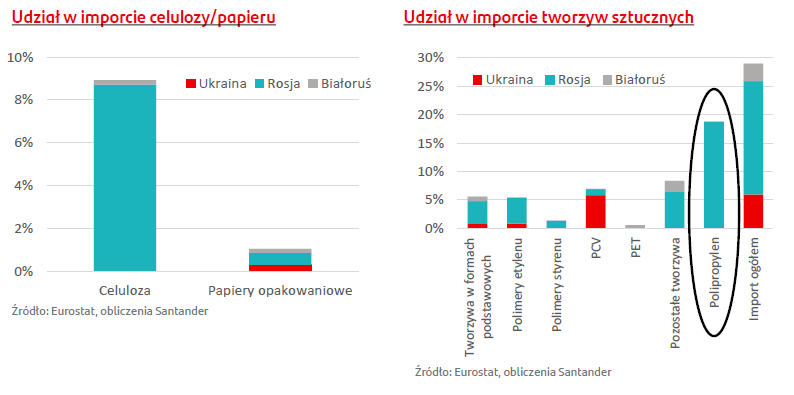
Russian aggression against Ukraine has been a source of increased uncertainty for domestic companies, which can be observed through the deteriorating business sentiment in March economic surveys. From the perspective of packaging manufacturers, the greatest deterioration in sentiment was recorded in the paper sector. This was likely influenced by concerns about rising gas prices, but also by a decline in the availability of cellulose imported from Russia (which accounted for nearly 9% of foreign supplies last year). In the plastic packaging segment, the biggest concerns relate to polypropylene, for which imports from Russia accounted for almost 20% of foreign supplies to our market in 2021. Conversely, manufacturers of pallets and glass bottles should experience increased demand due to the decline in supplies of these packages from the East.
– The structure of import exposure for packaging from the markets of Ukraine, Russia, and Belarus is similar for Poland as it is for the EU average. In terms of supply share, wooden packaging (mainly pallets) and glass packaging dominated. In the case of Poland, nearly 30% of pallets imported in 2021 came from the Ukrainian market, and another approximately 15% from the Belarusian market. This may translate into a decrease in the availability of pallets for the transport sector. A similar scenario is already unfolding in the German market, where, due to the embargo on Russian steel, there is a shortage of nails for assembling pallets – explains Maciej Nałęcz, sector analyst at Santander Bank Polska.
Price pressure continues to rise
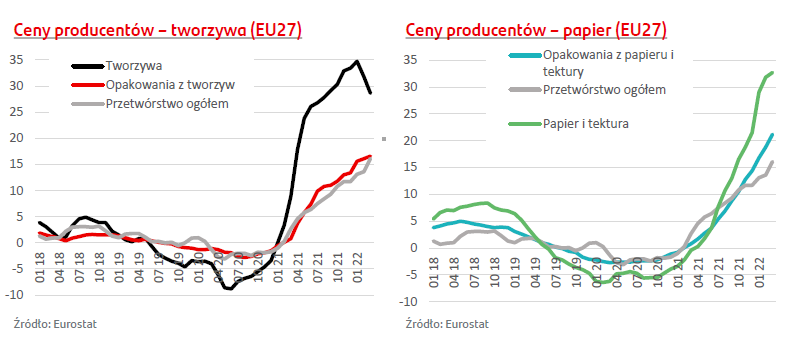
At the level of public statistics, producer price index dynamics are hitting new records, and in nominal terms, they have surpassed previous ones from the turn of the 3rd and 4th quarters of 2021. This means that raw material prices and, consequently, the prices of finished goods are the highest in the history of the survey. As emphasized by Santander Bank Polska experts, cost-side price pressure is constantly intensifying. Both in the case of plastics and cellulose, the dynamics in March (at the EU level) were not as high as in February, but this does not mean that these raw materials are starting to become cheaper. The growth rate is slowing down because, with each passing month, we are entering a period of an increasingly higher base from the previous year. In nominal terms, prices in March were still climbing.
– We are seeing record-high cost pressure; prices of raw materials for packaging production hit record levels in March, causing packaging producer price indices in the EU to grow faster than the average for the broad manufacturing sector. This effect is also visible in the price expectations of processors, especially in the plastics segment, which is sensitive to oil prices. Nevertheless, after the initial shock in March, economic sentiment indices showed a return of optimism in order book assessments in April – explains Maciej Nałęcz, sector analyst at Santander Bank Polska.
Glass packaging is the only segment of the industry where, according to Eurostat, prices grew more slowly in March than in the entire manufacturing sector (11% y/y vs 16.1% y/y). In the case of plastic packaging, prices are growing only slightly faster than the average – by 16.6% y/y, paper and cardboard packaging became more expensive by about 21.2% y/y, light metal packaging by 21.8% y/y, while the highest growth dynamics concerned wooden packaging, at as much as 38.9% y/y.
In Poland, price expectations measured at the level of broad paper, chemical, and plastic and rubber product industry indices peaked in January of this year. Only in the case of plastic products did April bring a new record, with about 46% of companies declaring price increases. For paper and paper product manufacturers, price expectations in April were comparable to the level from the 2nd quarter of 2021 (43% of companies declaring increases compared to 59% in January). In March, order book assessment indices showed some weakness, but the April economic reading indicates a return of optimism among companies, despite record costs.
Will a slowdown not bypass the packaging industry?
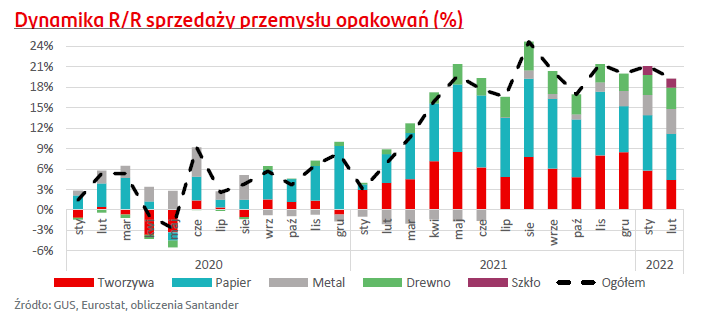
At the beginning of 2022, the packaging industry was growing at a rate of nearly 20% per year. However, in volume terms, the growth dynamics of production will be at a single-digit level, partly due to the very high base from the previous year. This means that price increases are currently the predominant driver of company turnover growth. In value terms, the largest increases are recorded in the wooden packaging segment (40% y/y), which may be linked to the decline in imports from Ukraine and Belarus. There is also high growth momentum in the glass bottle (approx. 16% y/y) and metal (approx. 14% y/y) segments – this is likely an effect of stockpiling due to the war in Ukraine.
Santander Bank Polska analysts estimate that the sold production of the domestic packaging industry grew by about 13-18% y/y last year, to a level of nearly PLN 52 billion.
– In 2022, the packaging industry will maintain a growth trend, but its structure will change, and it will likely be lower growth than last year. We currently expect sold production dynamics to be around 12-16% y/y, i.e., about PLN 60 billion. However, taking into account the record-high raw material prices, we see a high risk of revising our forecast upwards, especially since cost inflation will likely be the main channel for transmitting the war in Ukraine to the situation of the domestic packaging industry – comments Maciej Nałęcz, sector analyst at Santander Bank Polska.
Poland is the leader in packaging export growth for another year
Santander Bank Polska analysts estimate that the share of exports in the sold production of the Polish packaging sector may have increased slightly in 2021. In total, the weight dynamics of packaging delivered to foreign markets increased by about 10%. This trend is most visible in wooden, paper and cardboard, and steel packaging.
In terms of packaging export growth, Poland is systematically strengthening its position in the European market. In the case of paper and cardboard packaging, domestic producers took second place in the EU in terms of growth, which translates into 3rd place in terms of total export value (behind Germany and the Netherlands). While Dutch exports in this segment grew significantly faster than domestic ones, compared to the leader, Germany, we are observing a gradual catch-up. In 2020, domestic exports of paper and cardboard packaging accounted for about 40% of German exports, while in 2021 it was already 44%.
In the case of plastic packaging, domestic producers took a leading position in the European Union in terms of export volume growth, which translated into a growth dynamic of about 6.6%. As a result, exports in this segment accounted for 55% of German exports in 2021. Meanwhile, in the metal packaging segment, Poland took 7th place in terms of growth, and we maintained our position as the leader in the export of wooden packaging, both in terms of total export value and its growth. In turn, in the glass packaging segment, thanks to an 8% y/y increase in foreign deliveries, domestic producers took 10th place in terms of growth, while holding 6th place in the EU in terms of total production value.
Market regulations are an important factor for the future
The sector is also facing important changes in the regulatory field, which are intended to introduce major modifications in Poland regarding recycling requirements, financing of the waste management system, and promoting eco-design. The level of the extended producer responsibility fee for plastic packaging proposed in the draft amendment, at approximately EUR 200/t, given the current record-high level of plastic prices for the packaging industry, could translate into an increase in producer prices of 5-5.5 percentage points.
The financing of the Plastic Tax in the long term remains a question mark, which would be a strong incentive for changes in consumer purchasing behavior if plastic processors had to cover it. At the same time, it is precisely in the plastic packaging segment that the greatest potential for benefits from an effective EPR system reform lies, due to its size, relatively low recycling rate, and deep trade deficit in raw materials. Currently, the Ministry of Climate and Environment is still working on the act, which was supposed to enter into force from January 2023, but this deadline seems unrealistic. The other two acts from the prepared package (on the deposit system and SUP) may be adopted faster because they do not translate directly into consumer product prices. According to estimates by Santander Bank Polska analysts, the SUP directive could cover up to about 10% of the packaging production volume, mainly small and medium-sized companies with a narrow product portfolio.
More about the planned regulatory changes and changes in the packaging industry will be available during the 14th International Packaging Trade Fair, Packaging Innovations. The agenda of presentations prepared by the fair includes substantive and inspiring lectures, not only about the packaging industry itself but also, among others, about e-commerce in the B2B formula. Registration for the fair is possible at the link https://packaging2022.exposupport.pl/visitor/register.