








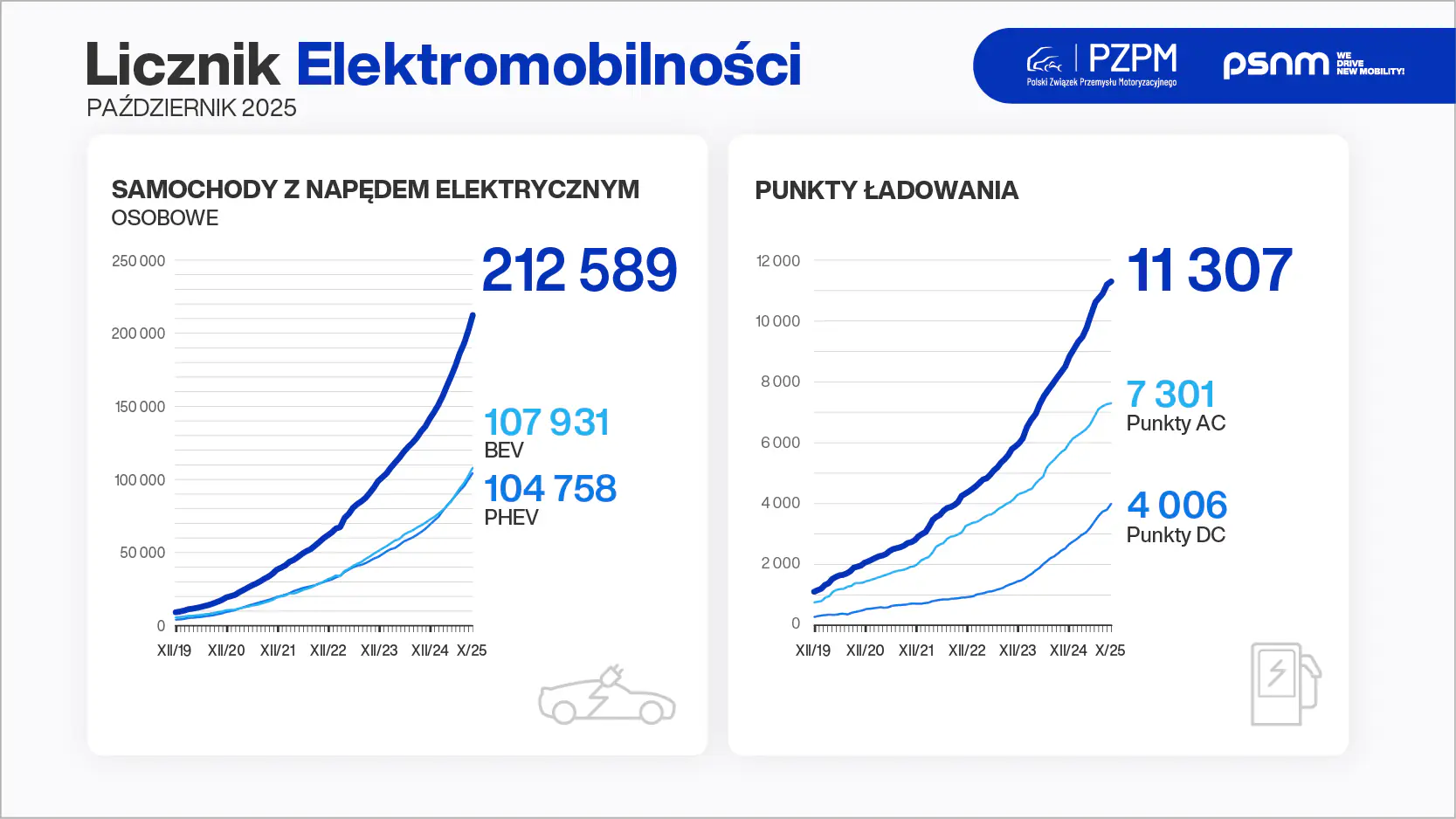
According to data from the end of October 2025, a total of 118,208 passenger and commercial fully electric vehicles (BEVs) were registered in Poland. In the first ten months of this year, their number increased by 38,287 units, which is 94% more than in the same period of 2024, according to the Electromobility Meter launched by PZPM and PSNM.
At the end of October 2025, there were 212,689 electric passenger cars on Polish roads. The fleet of fully electric passenger cars (BEVs) numbered 107,931 units, and the fleet of plug-in hybrids (PHEVs) totaled 104,758 units. The number of electric delivery and heavy-duty vehicles amounted to 10,613 units. The fleet of electric mopeds and motorcycles is constantly growing, consisting of 27,507 units at the end of October, as is the number of hybrid passenger and delivery vehicles, which increased to 1,221,096 units. By the end of last month, the zero-emission bus fleet in Poland grew to 1,691 units (of which 1,569 were fully electric vehicles and 122 were hydrogen-powered).
Parallel to the fleet of electric vehicles, charging infrastructure is also developing. At the end of October 2025, there were 11,307 publicly accessible electric vehicle charging points in Poland. 35% of them (4,006) were fast direct current (DC) charging points, and 65% were slow alternating current (AC) points with a power of 22 kW or less.
We already know that 2025 will be the best year yet for the Polish e-mobility market. We will close it with a result of approximately 1,500 newly launched, publicly accessible DC charging points. The share of BEVs in the new passenger vehicle sector may exceed 6.5%. That is more than twice as much as in 2024. In this respect, we have already overtaken not only a number of countries in the CEE region (including the Czech Republic and Slovakia) but also Greece and Italy. We are catching up with Hungary and Spain. However, repeating such a result in 2026 will be very difficult, primarily due to the shrinking budget of the “NaszEauto” program, which will likely be exhausted within the next three months.
– says Jan Wiśniewski, Director of the PSNM Research and Analysis Center.
We are very pleased with the result of zero-emission vehicle registrations in Poland in 2025, which turned out to be the best result in history. Over 100% more plug-in hybrids were registered than last year. The subsidy program for heavy-duty vehicles and their infrastructure is developing – the number of public chargers is growing dynamically. The most important factor for growth – both in terms of vehicle registrations and infrastructure – is subsidy programs. Unfortunately, according to preliminary information, the NaszEauto program will be the last subsidy program for the purchase of zero-emission passenger and delivery vehicles, which is why we are already working on solutions that, despite the lack of subsidies, could contribute to curbing the decline in their registration numbers.
– says Jakub Faryś, President of PZPM.
Source: Polish Alternative Fuels Association (PSNM)