








The Kalisz Cooperative Group of Milk Producers (OSM Kalisz) implemented a comprehensive transport, palletizing, packaging, and storage system at the beginning of this year. It is currently one of the most modern solutions of this type in the entire dairy industry in Poland. The project was carried out by PROMAG S.A., one of the largest manufacturers and suppliers of warehouse equipment in Poland.
The company from Kalisz allocated several dozen million zlotys for investments in improving production and warehouse processes, with more than half coming from subsidies. The investments covered the areas of raw material storage, production, packaging, and the finished goods warehouse.
– The installation of vertical and horizontal transport systems integrated with robots, carried out at our company by PROMAG S.A., has provided us with a significant increase in work efficiency in the area of palletizing and transport. Meanwhile, the storage systems have allowed us to maximize the use of available space in the warehouse. I can confidently say that we currently possess one of the most modern solutions of this type in the industry –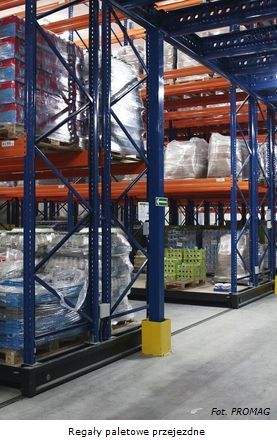 says Kazimierz Gęsicki, President of the Management Board at the Kalisz Cooperative Group of Milk Producers.
The project was completed and fully implemented just six months after PROMAG and OSM Kalisz began discussions regarding technical solutions.
– The project implementation time had to be very short due to the investor’s need to settle EU funds, which co-financed it. This was certainly a very important mobilizing and motivational factor for our design engineers, designers, automation specialists, and the entire project team we assembled. Because of this, we started design work in the areas of mechanics and automation simultaneously. The main challenge we had to face was the issue of space availability, as the production hall operated 24 hours a day, seven days a week, and additionally, we were dealing with an aggressive working environment. Despite this, all goals were 100 percent achieved – says Karolina Tokarz, Vice President of the Management Board, Director of Trade and Marketing at PROMAG S.A.
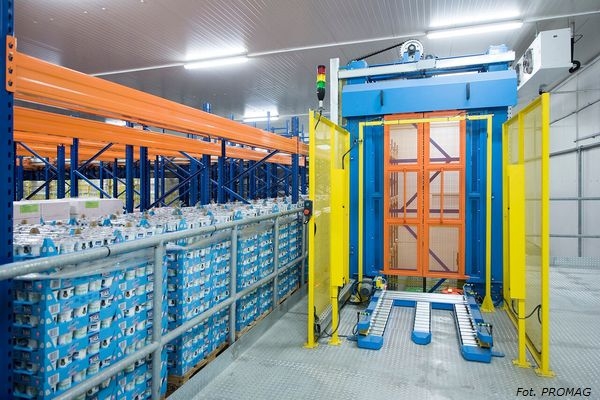
Seven production lines served by seven integrated product transport lines operate daily at OSM Kalisz. Thanks to the investment, all of them work with completely new final product transport lines. Each conveyor transfer line has been adapted to the requirements of the given production device and fully integrated with the automation and safety system. Due to the limited production space, products are 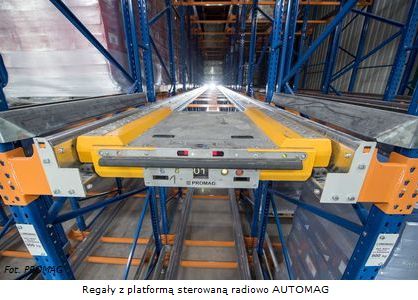 transported at a height of several meters using special vertical conveyors.
– Due to the prevailing conditions, it was not possible to use inclined conveyors, so we decided on vertical conveyors that pick up each small pallet or bucket individually, lift them to the set height, and continuously transfer the product for further transport. Throughout the zone, we used modular conveyors made of steel that meets the high requirements of the food industry, while we replaced transport belts with polyacetal slat chains – says Marek Łabęda, Technical Director at PROMAG S.A.
Palletizing using robots
The palletizing zone at OSM Kalisz is located in a separate hall, where three independent robot cells have been separated. It is to these that the transport lines deliver the small pallets and buckets. To ensure efficient communication and line operation, PROMAG S.A. designed a staircase passage along with a mezzanine placed above the transfer lines. This place is an excellent observation point for people supervising the work of the entire zone.
In the small space of each robot cell, the following were installed:
• continuation conveyors
• pallet stacking devices
• three-section roller conveyors
• spacer magazines
• PAL 180 type robots.
Furthermore, the palletizing zone was also equipped with an integrated pallet exchange system. It allows for the loading of 45 EUR pallets transferred to the appropriate loading point via a system of transfers and conveyors. Pallet exchange at each station occurs automatically.
Reduction of heat loss in the blast tunnel
All pallets, after being loaded, are transported directly to the collection point or to the so-called blast tunnel. Passage through the blast tunnel takes place continuously at a low speed, which can be adjusted to the needs and requirements of the cooling technology for a given load. To minimize unwanted heat exchange between rooms, the high-speed gates installed in the cooling tunnel were integrated with the operation of the transport system.
Efficient packaging and labeling
Ultimately, the transport system directs the pallets to a wrapper, from which the load is then transferred for marking – the application of transport labels. The automatic marking device was placed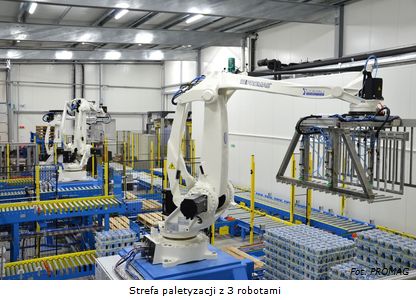 next to the pallet turntable, thanks to which it perfectly meets logistical requirements and, in a double cycle, can place a label on both sides of the load. The pallets leave the palletizing zone and are transferred to the next room, which is the cold storage warehouse. It is here that the forklift operator picks up the load and transfers it to the appropriate storage system.
Two racking systems
The finished goods warehouse at OSM Kalisz was equipped by PROMAG S.A. with two racking systems. The first consists of mobile pallet racks. They are an excellent solution for companies that want to maximize storage space (e.g., when it is relatively small) while also wanting access to every load unit. All racks were mounted on special carriages moving on rails, which allows for opening any aisle between racks and enables the retrieval of the required pallet. In the case of KSGMP, such a solution allowed for 100% more pallet spaces compared to the possibilities offered by a system of traditional row racks.
The second warehouse system consists of high-density pallet racks with the semi-automatic AUTOMAG satellite. These are devices that work perfectly in cold storage warehouses because they do not require the use of complex automation and control cabinets. Loading, unloading, and moving load units take place in specially constructed channels using a radio-controlled platform. The system allows for a very high coefficient of warehouse volume utilization, which translates into a significant reduction in the average cost of storing one pallet. This is an excellent solution, among other things, when it is required to maintain effective rotation in the FIFO system.
The finished goods warehouse was also equipped with a storage platform – an additional storage space supporting the investor in the cheese ripening process. The platform is supplied with pallets via a vertical conveyor system along with a loading and unloading device. These three integrated devices are operated from the platform level using manual pallet trucks.