








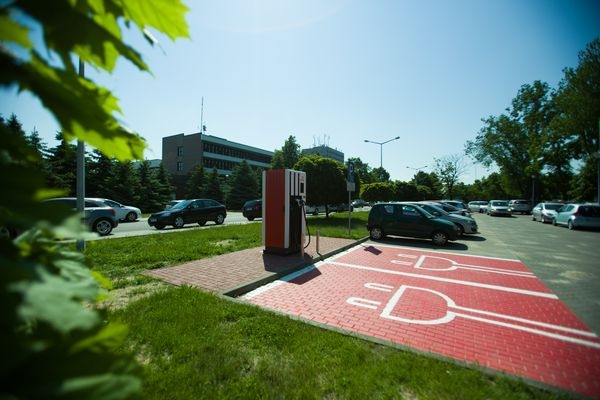
Thanks to investments in electromobility, PKN ORLEN can cover the costs of the emission fee without passing them on to its customers. The concern is expanding its program for building electric vehicle charging stations. To this end, PKN ORLEN has selected a total of 150 service stations, located both in cities and along transit routes. In the first stage of the pilot, by the end of 2019, approximately 50 fast charging points will be launched.
– We see electromobility as a significant development opportunity for our concern. We are a significant energy producer, and we also possess a modern petrochemical segment, whose products will be essential in automotive transport based on alternative fuels. On top of this, there are regulatory issues. An example is the emission fee, designed as support for electromobility, which we treat as our investment in the development of the alternative fuels market. It is an incentive to invest more strongly in this market segment, which in the future will bring us measurable business benefits, and partly thanks to this, we will not pass the costs of the emission fee on to customers – said Daniel Obajtek, President of the Management Board of PKN ORLEN.
By engaging in the development of electromobility, PKN ORLEN intends to maximize the business opportunities provided by the biofuels act. In accordance with earlier declarations, PKN ORLEN will not pass the costs of the emission fee on to drivers and treats it as an investment supporting the construction of the alternative fuels market. We see new business opportunities for a concern that possesses an extensive energy segment and modern petrochemistry, which constitutes a significant source of products for vehicles with alternative drives.
– We are perfectly aware of the changes taking place in the global market and the growing popularity of alternative drives. New technologies and everything associated with building innovative energy infrastructure is a very promising business. For us, it is particularly important to take a strong position in this area from the beginning, which is why we decided to expand the pilot program and nearly double the number of planned stations. This is not our final word, however, as we are analyzing the development of the market in this area and, in the longer term, we see opportunities for even more intensive involvement in the development of electromobility. We are convinced that these actions allow us not only to respond to new customer expectations but also align with the development plans of the Polish economy – added Daniel Obajtek, President of the Management Board of PKN ORLEN.
The pilot program is part of the concern’s strategy to adapt its retail network for the distribution of alternative fuels. As part of the project being implemented, by 2019, electric vehicle drivers will have the opportunity to travel across Poland along main communication routes, charging their vehicles at ORLEN stations. Fast charging stations with a power of 50 and 100 kW will be built by companies selected in the tender procedure currently being finalized. The planned charging points will serve all types of electric vehicles offered on the European market. All points will be equipped with two connectors for DC vehicle charging, with CHAdeMO and CCS plugs, as well as a Type 2 connector for AC vehicle charging. A fast charging station with a power of 50 kW on the DC side allows for charging an electric vehicle’s battery from 20% to 80% capacity in about 20-30 minutes. Specific locations will be announced in the further part of the investment program.
As part of the pilot program, the first charger has already been built in Płock near the Concern’s headquarters. The 50 kW charging station is intended for both electric vehicles (EV) and plug-in hybrids (PHEV) and provides the possibility of charging 4 vehicles simultaneously. Power for each of the stands is dynamically allocated by the station controller during vehicle charging, thanks to which it will be possible to significantly shorten the time. The modular design of the device allows for the potential expansion of the DC charging station up to 150 kW within the same housing. Currently, the investment is in the testing phase; in the near future, solutions in the IT area, station functionality, its maintenance, and ongoing operation will be checked, among other things. In the third quarter of this year, the station will be made available to drivers, who, in the first stage of the pilot conducted by the concern, will be able to charge their cars for free. The contractor for the charging station is the company ORLEN Serwis.
Among other projects related to alternative fuels, electric vehicle charging points are already operating at ORLEN Group stations: Tesla in Poland at the ORLEN station in Kostomłoty, Katowice, and Ciechocinek, and in Germany – in the towns of Grimmen in Mecklenburg-Western Pomerania and Uckerfelde in Brandenburg. In the Czech Republic, the Concern also plans to develop a network of charging points available at Benzina stations. Currently, one point is operating there, located in the city of Vrchlabi.
Other alternative fuels are also available at stations belonging to the ORLEN Group. Last year, the first pilot point for hydrogen-powered cars was launched at the concern’s German station operating under the star brand in the town of Mülheim; further actions in this area are planned for this year. CNG can also be refueled at 35 of the concern’s stations located in the Czech Republic.