








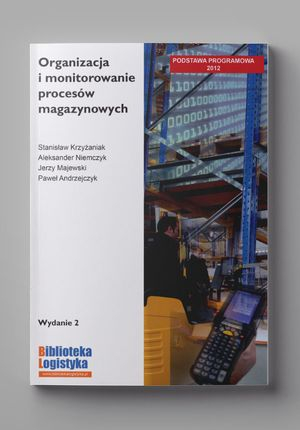
Authors: St. Krzyżaniak, A. Niemczyk, J. Majewski, P. Andrzejczyk
Price: 79.00 PLN
Description:
The warehouse is an essential element of the logistics system. Without the proper functioning of warehouses, it is difficult to imagine the efficient flow of goods in supply chains from producers to final recipients. Such an approach requires the use of appropriate technology as well as efficient organization and monitoring of warehousing processes. The textbook has been developed in accordance with the assumptions of the new core curriculum for the logistics technician profession and contains a systematic presentation of thematically related learning outcomes, described in the qualification part A.30 “Organization and monitoring of the flow of resources and information in production, distribution, and warehousing processes”. In the textbook, the reader will find, among other things:
– over 70 examples illustrating the described theoretical issues,
– as many as 180 test questions to check skills and knowledge,
– a glossary of key terms in English and German.
Year of publication: 2014
ISBN: 978-83-63186-76-0
Volume: 506 pages
Approval number: 85/2013
Table of contents:
Preface
1.1. Warehouse and warehousing
1.1.1. Warehouse and warehousing – basic information
1.1.2. Functions and tasks of warehouses
1.1.3. Types of warehouses
1.1.4. Types of inventory
1.1.5. Storage conditions
1.1.6. Load units
1.1.7. Warehousing program
1.1.8. Warehouse supervision
1.1.9. Responsibility in the warehouse
1.1.10. Skills and knowledge test
1.2. Warehouse management
1.2.1. Division of the warehouse into zones
1.2.2. Technological layouts of warehouses
1.2.3. Row storage
1.2.4. Block storage
1.2.5. Arrangement and stacking of load units
1.2.6. Warehouse modules
1.2.7. Warehouse space management
1.2.8. Skills and knowledge test
1.3. Warehouse processes
1.3.1. Warehouse processes
1.3.2. Receiving
1.3.3. Storage
1.3.4. Picking
1.3.5. Dispatch
1.3.6. ABC analysis in warehousing
1.3.7. Inventory placement
1.3.8. Picking methods
1.3.9. Flow of goods
1.3.10. Skills and knowledge test
1.4. Indicator and process evaluation of warehouse work
1.4.1. Warehousing costs and prices of warehouse services
1.4.2. Definitions of indicators and metrics
1.4.3. Indicators and metrics in warehousing
1.4.3. Skills and knowledge test
1.5. Warehouse equipment
1.5.1. Storage equipment
1.5.1. Fixed racks
1.5.2. Loading docks
1.5.3. Auxiliary equipment
1.5.4. Skills and knowledge test
1.6. Internal transport means
1.6.1. Division of internal transport infrastructure
1.6.2. Transport trucks
1.6.3. Other internal transport equipment
1.6.4. Skills and knowledge test
1.7. Warehouse documentation
1.7.1. Warehouse documentation – introduction
1.7.2. Warehouse manual
1.7.3. OHS manual for warehousing and material storage
1.7.4. Scope of employee duties
1.7.5. Warehouse turnover documents
1.7.6. Examples of bad practices in filling out warehouse documentation
1.7.7. VAT invoice
1.7.8. Skills and knowledge test
2.1. Basic information regarding inventory
2.1.1. The role of demand in inventory management
2.1.2. Types of demand changes
2.1.3. Decoupling point and its importance in inventory management
2.1.4. Independent demand
2.1.5. Dependent demand
2.1.6. Types of inventory classification
2.1.7. General division of enterprise inventory in quantitative and value terms
2.1.8. Structure of cyclically renewed inventory: cycle stock, safety stock, and excess stock
2.1.9. Inventory level indicators
2.1.10. Responsibility for inventory in the enterprise
2.1.11. Skills and knowledge test
2.2. Costs in inventory management
2.2.1. Fixed costs related to inventory
2.2.2. Variable costs related to inventory
2.2.3. Inventory replenishment costs
2.2.4. Inventory holding costs
2.2.5. Stockout costs
2.2.6. Costs of periodic excess inventory
2.2.7. Skills and knowledge test
2.3. Demand analysis
2.3.1. ABC analysis and classification
2.3.2. XYZ analysis and classification
2.3.3. ABC/XYZ classification
2.3.4. History – analysis of demand changes over time
2.3.5. Stationary demand
2.3.6. Demand trends
2.3.7. Seasonal demand
2.3.8. Random demand changes
2.3.9. Demand anomalies
2.3.10. Skills and knowledge test
2.4. Demand forecasting
2.4.1. Basic concepts related to forecasting
2.4.2. Time series – starting point for quantitative forecasting
2.4.3. Forecasting methods
2.4.4. Naive model
2.4.5. Arithmetic mean models
2.4.6. Exponential smoothing – simple Brown model
2.4.7. Trend forecasting – Holt model
2.4.8. Linear regression based on the least squares method as an example of an analytical model used to forecast demand changes related to the occurrence of a trend
2.4.9. Forecasting seasonal demand changes
2.4.10. Econometric models – causal-descriptive
2.4.11. Evaluation of forecast quality
2.4.12. Skills and knowledge test
2.5. Demand profile – frequency distributions
2.5.1. Demand as a random variable
2.5.2. Creating a demand profile
2.5.3. Different forms of demand profile
2.5.4. What does the demand profile tell us?
2.5.5. How to describe a demand profile – mean value and standard deviation
2.5.6. Theoretical frequency distributions of demand
2.5.7. Normal distribution
2.5.8. Poisson distribution
2.5.9. Why is it important for the profile to include only random changes?
2.5.10. What practical applications can be derived from knowing the demand frequency distribution?
2.5.11. Skills and knowledge test
2.6. Inventory replenishment cycle
2.6.1. How to determine the duration of the replenishment cycle
2.6.2. Demand in the replenishment cycle
2.6.3. Skills and knowledge test
2.7. Service level vs. safety stock
2.7.1. Customer service level – starting point for determining safety stock
2.7.2. Customer service level – as the probability of no stockout
2.7.4. Safety stock – what does it depend on and how to calculate it?
2.7.5. Safety stock in case of inventory dispersion
2.7.6. How can the safety stock level be reduced?
2.7.7. Skills and knowledge test
2.8. Cycle stock optimization
2.8.1. Once again about where cycle stock comes from
2.8.2. Selected criteria and methods for determining delivery sizes
2.8.3. Economic order quantity
2.8.4. Skills and knowledge test
2.9. Inventory control systems
2.9.1. Inventory renewal in a system based on an information level
2.9.2. System based on periodic review
2.9.3. Other inventory renewal systems
2.9.4. Inventory renewal of slow-moving items
2.9.5. Skills and knowledge test
2.10. Inventory in selected logistics strategies
2.10.1. Material Requirement Planning – MRP
2.10.2. Just-in-Time – JiT
2.10.3. Quick Response – QR
2.10.4. Efficient Consumer Response – ECR
2.10.5. Vendor Managed Inventory – VMI
2.10.6. Co-managed Inventory – CMI
2.10.7. Collaborative Planning, Forecasting and Replenishment – CPFR
2.10.8. Selected logistics strategies and inventory shaping – summary
2.10.9. Logistics outsourcing
2.10.10. Skills and knowledge test
3.1. Supporting warehouse processes using IT systems
3.1.1 Information flow in the warehouse
3.1.2. Barcodes and their types
3.1.3. Use of GS1 barcodes
3.1.4. Automatic data identification system
3.1.5. Equipment for automatic identification
3.1.6. IT solutions supporting data acquisition
3.1.7. Warehouse management systems
3.1.8. Skills and knowledge test
Key formulas
Auxiliary tables for calculation tasks
Glossary of basic terms in Polish, English, and German
List of English abbreviations and acronyms
Bibliography