








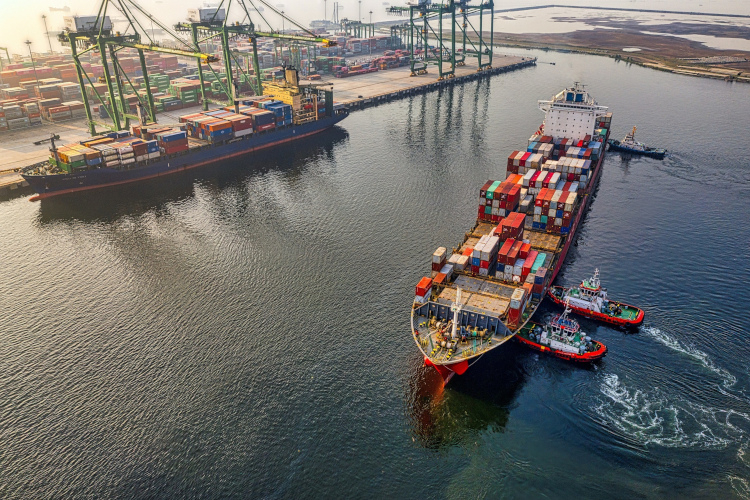
September marks the beginning of increased cargo movement related to pre-holiday deliveries for the beverage and alcohol industry, imported from various corners of the world. Sea transport is most commonly used for their shipment, and refrigerated containers are used for transporting temperature-sensitive goods. In an era of high freight prices, besides choosing the type of container, it is also worth considering load optimization. What is this about? Hillebrand Gori, a global logistics operator for the beverage industry, explains.
Refrigerated containers, also known as reefers, are steel boxes equipped with a refrigeration unit managed by a control panel. They are equipped with fans, ventilation openings, and a condenser that maintains the required temperature and air humidity. Cool air circulates in these types of containers, maintaining a constant temperature, just like in a standard refrigerator. The refrigeration unit is usually connected to the ship’s power grid. Alternatively, a power generator (or genset) can be installed in the unit, thus providing emergency power.
Most refrigerated containers are capable of maintaining temperatures in the range of -30°C to +30°C, while maintaining low humidity levels. The required temperature and humidity are maintained through airflow through and around the transported goods.
Refrigerated container in the transport of sensitive goods
Due to their design, this type of container is considered the best option for transporting temperature-sensitive goods, which include certain types of wines and beer. The use of refrigerated containers in their transport is a necessity, as if transported in standard containers, they could spoil in the event of high temperatures and humidity.
Optimization – how many pallets of wine will fit in a refrigerated container?
Refrigerated containers are available in various capacities, depending on the year of manufacture and the manufacturer. Load optimization is important here, which is worth considering when planning deliveries. The most popular are 20′ and 40′ containers. In a 20-foot container, you can place 9 standard pallets (1m x 1.2m) or 10 EURO pallets (0.8m x 1.2m). In contrast, a 40-foot container can be loaded with 20 standard pallets (1m x 1.2m) or 23 EURO pallets (0.8m x 1.2m). The capacity of refrigerated containers is smaller than that of standard or insulated ones.
Refrigerated containers with the unit turned off are also used in transport, serving as standard ones. This is the so-called non-operating reefer (NOR). Insulated walls provide limited maintenance of a stable temperature, but due to the specific design, there is less storage space here than in the case of a standard or insulated container. The most cost-effective way to use a NOR is to use it for return shipments. Other types of goods can be loaded into already empty containers, and this will optimize the costs of the entire delivery.
Electricity increases costs and carbon footprint
A reefer that uses electricity for cooling or heating is a more expensive solution than a standard or insulated container. Electricity consumption also contributes to increasing its carbon footprint. This is shown by data from the Hillebrand emissions calculator. For example, in door-to-door transport of 20-foot containers from Chile to the UK, the carbon footprint of a refrigerated container is 2,510 kgCO2e, while for a standard and insulated one it is 1,930 kgCO2e.
Limited availability of refrigerated containers
When planning shipments using refrigerated containers, one must take into account limitations in their availability, which is related to supply problems in sea transport. For example, the Covid-19 pandemic contributed to the creation of a bottleneck in North America, where empty containers piled up. As a result of subsequent lockdowns in many countries, factories were closed and production was halted, and the number of ships at sea also decreased. Despite the resumption of exports by China, it still takes time for the supply and distribution of containers to return to normal. As a result, disruptions remain at a very high level, with varied regional demand and uneven transport capacity. The situation remains uncertain, and it is exacerbated by the war in Ukraine, which leads to delays in bookings and an increase in rates.
Source: Hillebrand Gori