








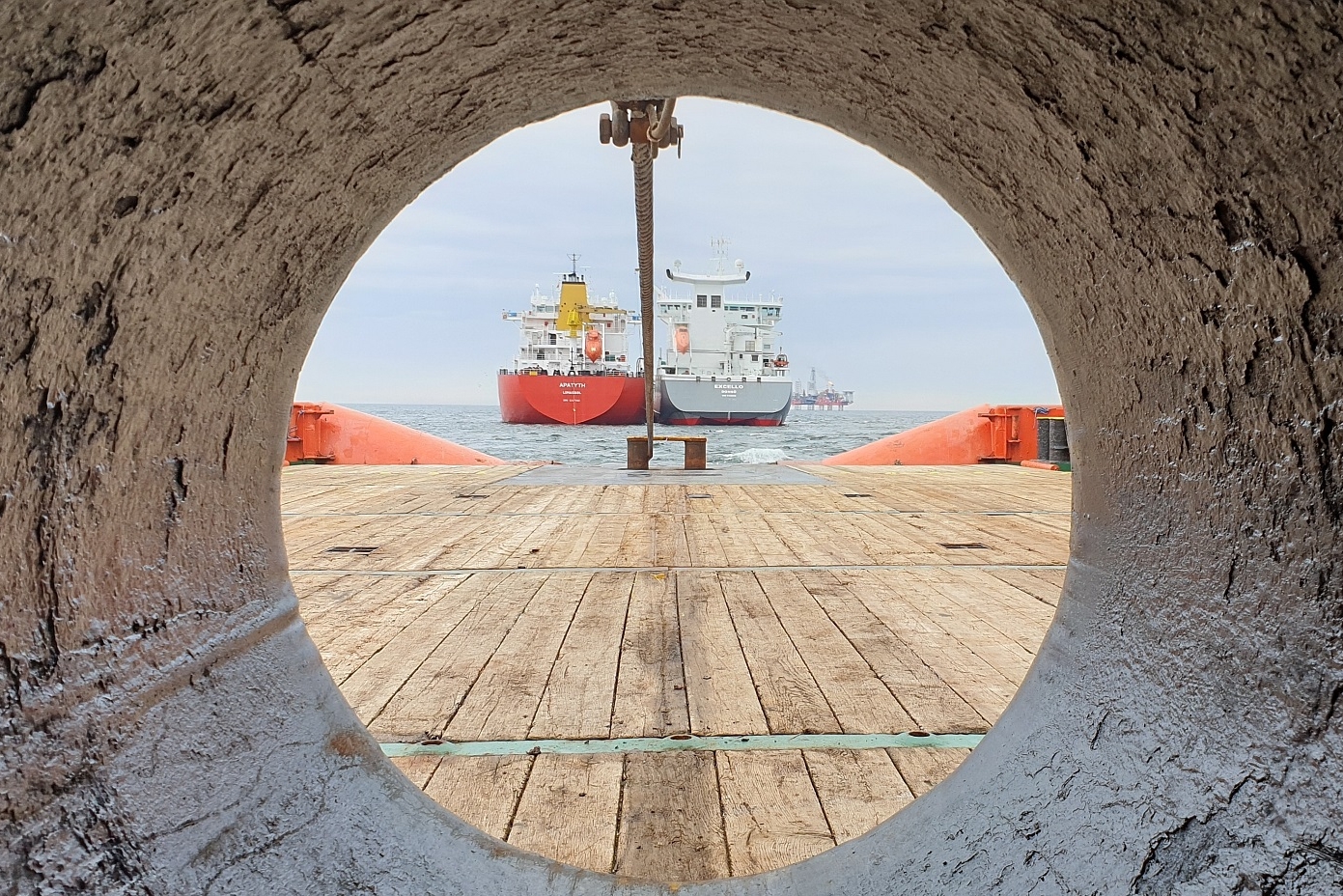
Thanks to the actions taken by the logistics and dispatch office of ORLEN Petrobaltic, it is possible to optimize STS (Ship To Ship Transfer) operations by combining oil collection from the B3 and B8 fields. This optimization brought the company 969,000 PLN in savings in 2024.
Within the ORLEN Petrobaltic Group, crude oil extraction in the Baltic Sea takes place from the B3 and B8 fields. The extracted raw material is transported via pipelines to tankers that are permanently stationed at the fields and serve as “storage” facilities where oil is collected. After being pumped onto an external tanker, the oil is transported to the Naftoport in Gdańsk.
– STS operations have been performed at ORLEN Petrobaltic since 2014. Previously, every disconnection of a tanker after it was filled, followed by the transport of oil to the port, involved halting production – sometimes for up to two days. Currently, this method of unloading is used only during maintenance breaks on the platforms. Thanks to STS transshipment, we do not have to stop production, and we also avoid a drop in efficiency and the difficult process of restarting the field – says Piotr Wierzbicki, head of the logistics and dispatch office at ORLEN Petrobaltic.
For about 10 years, there has been no need to halt production on the platforms each time. The oil collected on the tankers is transported to the refinery using STS operations. The conditions for carrying this out include waves of up to 2 meters, wind speeds of up to 10 m/s, as well as time discipline, good organization, and coordination of the activities of the platforms, ships, and Naftoport.
Complicated oil deliveries
– Oil deliveries after transshipment on the open sea are among the more complicated compared to deliveries of oil loaded in ports. This is because more aspects must be coordinated with each other. In addition to contracting a tanker that meets technical requirements, favorable weather conditions must also occur to carry out the STS operation – explains Marta Kudła, senior trader in the oil trading department at ORLEN.
– Such an operation, despite the fact that it may carry the risk of the ship standing by while waiting for suitable weather conditions, which may result in an additional fee for the shipowner, the so-called demurrage fee, still brings a cost reduction on the combined STS operation compared to the double mobilization cost that the shipowner would charge for chartering each tanker separately – argues Andrzej Nowotnik, manager of the operational and economic department at Technical Ship Management sp. z o.o.
Thanks to the actions taken by the logistics and dispatch office of ORLEN Petrobaltic in cooperation with the company Technical Ship Management and the ORLEN oil trading department, it is possible to optimize the STS process, which consists of combining oil collection from both “storage” tankers. To achieve this, two full STS operations (with oil unloading in the port) must be performed under a single contract for an external vessel. In such a situation, the shipowners from whom external ships are chartered include in the price of the service only one mobilization of the ship, which most often arrives from the North Sea. This translates into a reduction in the final price.
The organization of STS operations is possible thanks to proper planning and scheduling, taking into account the current state of production at both fields. Cooperation between companies and units within the ORLEN Group is also an essential element.
Source: ORLEN