Each of us is aware of how rapidly e-commerce is developing. Countless scientific and industry articles, as well as reports, provide new knowledge and information about the value of this growth. And these are truly impressive: In 2020, global e-commerce sales reached $4.28 trillion, an increase of 27.6% compared to the previous year. E-commerce accounts for approximately 19% of global retail sales. In 2020, Poles made online purchases worth over EUR 15.3 billion, which means an increase of about 32% compared to 2019. Currently, about 150,000 Polish companies sell their products and services online.
The aforementioned, very dynamic growth of online retail is vividly illustrated by the graphic below (Fig. 1).
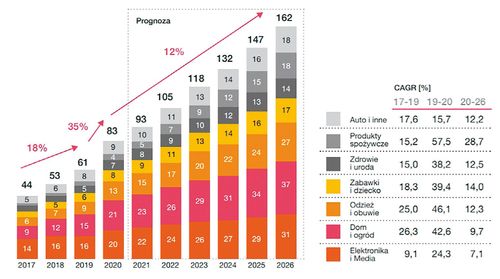
Fig. 1. PwC market model – gross value of online goods sales in Poland, 2017-2026 [PLN billion]
Source: PwC report “Winning Strategies. E-commerce leaders on the development of digital trade”
The forecasts for online sales value in Poland presented in the chart not only show very clear and large increases (an average of 12% annually), but may also prove to be underestimated even today (with a fair degree of probability). The pandemic caused very significant changes in the shopping habits of Poles, which influenced the growth of volumes and the value of online trade to a much greater extent than initially expected.
Such dynamic e-commerce growth is both a consequence and a determinant of the growing requirements of recipients. As customers, we not only want to buy more online, but we also have increasingly high expectations regarding the delivery of ordered goods. These needs are usually related to the type of goods we buy. However, the “fast and cheap” principle applies to most industries. The most specific area, associated with the highest customer requirements in terms of delivery speed, is so-called “groceries” and ready-made meals ordered from restaurants. It is these areas of e-commerce sales that have developed most dynamically in recent months, mainly due to the pandemic. During lockdowns and numerous quarantine cases, home deliveries of both groceries and ready-made food became significantly more common than before the pandemic. E-grocery skyrocketed, exceeding the wildest growth expectations. It is estimated that with the current growth dynamics of e-grocery, by 2022 the share of online sales in total FMCG sales may reach as much as 5%, whereas the current value only recently exceeded 1%. For comparison, the share of this channel in the British market is about 6% and is the highest in Europe.
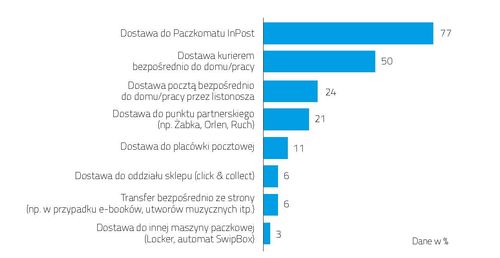
Fig. 2. Forms of purchasing goods most often chosen during online shopping
Source: Gemius report “E-commerce in Poland 2021”
E-commerce customers receive a wide range of delivery options, from “doorstep” delivery, through delivery to designated collection points, to the extremely popular parcel lockers offered by an increasingly wide spectrum of operators. While deliveries to parcel lockers and collection points are very popular, when it comes to fast or express delivery, the most frequently used form of delivery is definitely delivery to the customer’s home. According to data from the Gemius report, as many as 50% of Poles use the option of online shopping with home delivery (Fig. 2). In this situation, quality requirements for CEP (Courier, Express, Parcel) operators are being pushed quite high. These requirements particularly concern delivery time, and time counts most in the delivery of food and ready-made meals. We are able to wait for shoes, a washing machine, or books (though even that time is getting shorter), but we want our dinner or a missing kitchen product “right now.” This fact has become a premise for the development of quick commerce – the concept of delivering online purchases as quickly as possible. Q-commerce is considered the third generation of trade, after trade based on stationary stores and online trade (e-commerce), which is very interestingly illustrated by the DeliveryHero graphic (Fig. 3). The emergence and intensive development of q-commerce is the basis for many changes in the online delivery logistics market and sets the bar very high for suppliers and couriers.
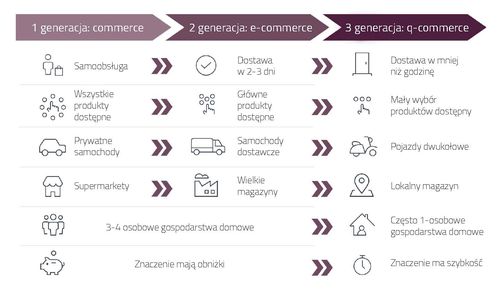
Fig. 3. Three generations of trade
The five main players in food and grocery delivery are currently Pyszne.pl, Uber Eats, Wolt, Glovo, and Bolt Food. The number of products in the baskets of customers ordering goods with fast delivery is growing very rapidly. The value of this basket is also growing. On the Polish market, new business relationships are increasingly being established to meet the needs of customers related to express delivery. Key examples in this regard are:
– Biedronka – Glovo → from October 15, 2021, Biedronka customers will be able to order products from the online store via the Glovo application and choose a new delivery option: Biedronka Express BIEK; this form of product delivery is carried out within 15 minutes of placing the order; the service is to be available in 6 cities in Poland (Warsaw, Poznań, Łódź, Wrocław, Kraków, Gdańsk).
– Spar – Wolt → Spar chain grocery products can be purchased online using delivery provided by the company Wolt; the companies established cooperation in September 2020, offering the possibility of purchasing from Monday to Friday, between 10:00 AM and 6:00 PM, and delivery in 35 minutes. The service is available in Warsaw; Spar and Wolt declare that it will be developed, i.e., both delivery hours and the assortment will be expanded.
– Żabka – Uber Eats → products from the Żabka offer can be purchased via the Uber Eats platform since August 2020; at the time of launch, the offer included about 660 products, and the delivery time was about 30 minutes; the service is available in Warsaw and Poznań.
– Makro – InPost → Makro and InPost have embarked on the path towards building the largest food marketplace in Poland. The service, launched in July 2021, makes it possible to order groceries via the InPost Fresh application. Using the application, you can choose from an assortment of over 10,000 products for same-day and next-day delivery; the fastest delivery model offered as part of the Makro and InPost cooperation is Express delivery with arrival in as little as 60 minutes. The service test was launched in Warsaw.
Fast deliveries in the above-mentioned cases are carried out using bicycles, scooters, and cars. Fast delivery services are available – for now – only in large cities, and sometimes only in Warsaw. However, it can be assumed that the high demand for this type of service will cause strong competition and will strengthen existing and launch new business relationships, which will translate into an increase in service quality, i.e., an increasingly wide spectrum of goods available in express delivery, shorter delivery times, and greater availability of the service (i.e., entry into subsequent cities).
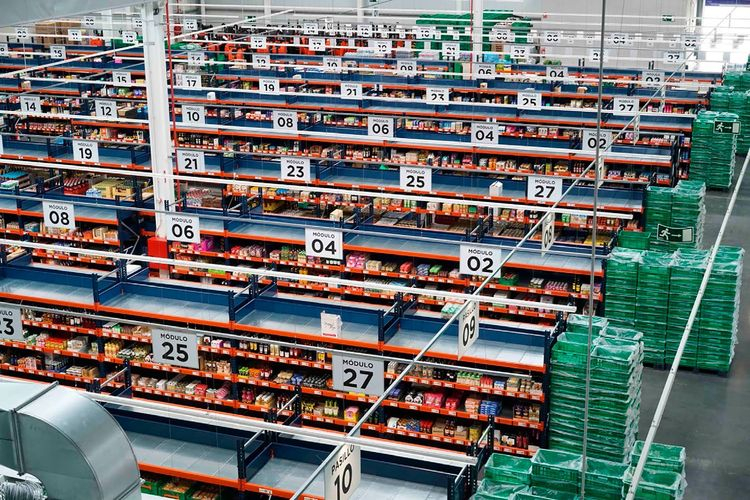
The development of mobile platforms for ordering ready-made food, groceries, and other purchases, combined with customer expectations regarding a wide range of goods available via mobile and express delivery time, has also become the basis for the development of new logistics models and new warehouse formats dedicated to q-commerce operations. The flagship showcase of q-commerce logistics are dark stores and dark kitchens. A dark store is a type of warehouse adapted to handle only orders placed online; walk-in customers are not allowed there. The absence of customers in the store means that the employed staff is able to complete online orders faster and hand them over to the courier for delivery. The organization and technology of these types of warehouses are appropriately selected: aisles and product placement locations are numbered, these warehouses are often equipped with advanced warehouse automation solutions, and the application suggests to the employee which aisles to follow to complete the order as quickly as possible. Dark stores are usually located in cities, and even in strict city centers, close to large residential clusters or right next to communication routes. This is intended to ensure the fastest possible delivery and is the realization of the “as close to the customer as possible” concept.
When discussing the q-commerce concept, it is impossible not to mention the intensive development of entities specializing in express deliveries and using dark stores. Among such entities operating on the Polish market are both domestic startups and large global players entering the Polish market. It is worth mentioning:
– Swyft – the Swyft platform has been operating in Poland since July 2021, the company has its own product assortment and logistics facilities, and uses its own dark stores. Swyft fulfills orders 7 days a week, from 7:30 AM to 10:30 PM, the delivery time is max. 15 minutes; the service currently operates in the Śródmieście district of Warsaw.
– Lisek – a Polish startup that has been operating in Warsaw since 2018, currently also carries out deliveries in Piaseczno, Wrocław, and Kraków. The Lisek dark store operates in Warsaw’s Wilanów district, Lisek fulfills orders daily from 8:00 AM to 11:00 PM, the delivery time is as little as 10 minutes;
– Jokr – the Jokr platform entered the Warsaw market in June 2021. It is an international startup, operating in Mexico, Lima, Bogota, or New York, among others. In Poland, Jokr services are available in Warsaw, where the company has 7 hubs, i.e., micro-warehouses with an area of 200-250 sq m, from which deliveries are carried out daily from 7:30 AM to 11:30 PM, and the delivery time is 15 minutes.
Quick commerce and dark stores are concepts that will increasingly determine the development of online retail and logistics delivery services. Forecasts indicate that new entities will enter the Polish market (e.g., the planned entry of Gorillas), and fast deliveries will cover new groups of goods (90-minute deliveries of CCC products in cooperation with Xpress Delivery). It is worth following the development of these trends, both from the perspective of the customer and the logistician.
The article comes from the magazine LOGISTYKA 5/2021.
The e-edition of the magazine is available in our offer!
Stay up to date, subscribe to the LOGISTYKA magazine!