









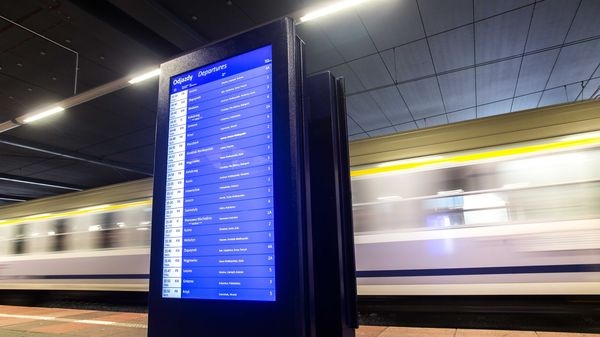
The new passenger information system in the capital of Greater Poland has passed tests and handled 20,000 trains.
The new dynamic passenger information system installed on the modernized platforms of Poznań Główny station has completed its trial operation period. Since December 2013, the system has handled 20,000 trains. The system was manufactured and installed by the PKP Informatyka Group on behalf of PKP Polskie Linie Kolejowe SA.
The system consists of ninety-four platform screens, collective screens, and information kiosks. A novelty for passengers is the PKP PLK relational timetable available on a scrolling touchscreen LCD. The system, produced by PKP Informatyka and Kolejowe Zakłady Łączności, is much more advanced than its predecessor. On the modernized platforms, the number of screens is almost twice as high as before. The system presents information according to a common standard used throughout Poland, agreed upon with carriers and meeting European Union requirements.
The new information system screens show a greater range of intermediate station trains. The data displayed on them is much clearer and has higher contrast. The displays can also convey additional data for each train as requested by the carrier. The system has been designed to be easily expandable with additional information media, and its operation is handled through a more user-friendly interface than before. The LCD screens at the Poznań station are ready for continuous operation. They can operate in temperatures ranging from -30 to +40 degrees Celsius.
– Production of the system and devices for the Poznań Główny station began in September 2013, and installation was completed in December. The short duration of this project was the biggest challenge – says Marcin Iwaszkiewicz, President of the Management Board of Kolejowe Zakłady Łączności. – Typically, such projects take about a year. We did it three times faster – he adds.
The system handles approximately 300 trains every day from three railway carriers: PKP Intercity, Przewozy Regionalne, and Koleje Wielkopolskie. Throughout the year, it is used by approximately 120,000 trains and fifteen million passengers.