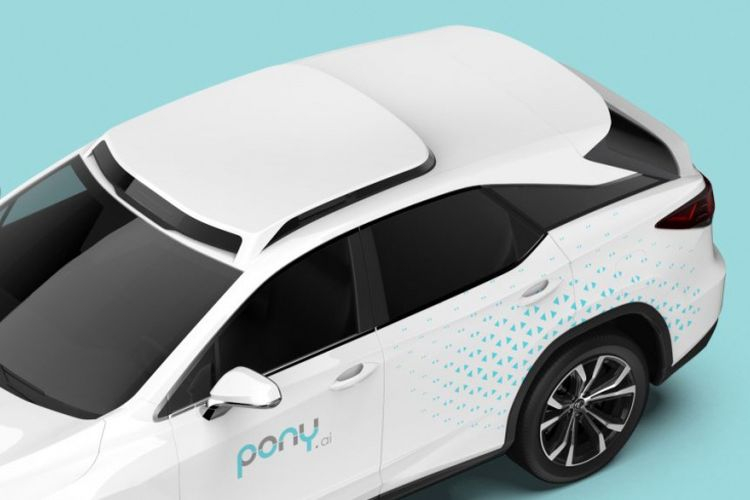
A breakthrough in the evolution of autonomous vehicle design is coming. LiDAR technology, a laser sensor that sends out millions of points per second and measures the time it takes to bounce off an obstacle, is crucial for the development of autonomous driving.
Recently, Pony.ai announced that it will deploy fully autonomous robotaxi fleets in 2023, which, thanks to a new generation of lidar technology, will not differ much from traditional cars. Helicopter manufacturers and the Volvo brand in its new SUV also want to take advantage of 3D mapping capabilities.
The Chinese autonomous vehicle start-up Pony.ai, in collaboration with Luminar Technologies, has just unveiled a newly designed laser sensor platform. LiDAR sends millions of laser points per second and measures the time it takes to bounce off an obstacle. The technology is crucial in autonomous driving. Pony.ai will use four Luminar Iris sensors in its cars, two on the roof and two on each side of the vehicle, to generate a high-resolution image. In 2023, the entire fleet of robotaxis is expected to be equipped with the new generation sensors.
– We are building a next-generation platform and preparing for large-scale mass production, and the collaboration with Luminar is key to this – points out James Peng, CEO and founder of Pony.ai. – Luminar is in a league of its own when it comes to lidar technology. Furthermore, they share our belief that delivering autonomous mobility globally will ensure a safe and sustainable future.
The Chinese start-up has already launched a Robotaxi service in five cities in China and the USA (the company recently received permission to test its fully autonomous vehicles on public roads in California). It is the only company that provides cars on such a large scale and has a fleet of over 200 autonomous vehicles.
– Pony.ai’s vision of creating a dynamic, vehicle-independent autonomous driving system is impressive. They have already proven that they are a leader in the development of robotaxis both in China and beyond – argues Austin Russell, founder and CEO of Luminar.
Pony.ai is changing the face of the roofline for its next generation of autonomous taxis. As part of the partnership with Luminar, the robotaxis will be equipped with a flat roof with the necessary cameras, radar, and LiDAR sensors, which use light to measure the distance between objects so that the car can “see” for itself.
– We are leveraging the full range of technology and our existing years of product development, implementing them directly into the Pony.ai platform and fleet. Our collaboration is a milestone towards realizing safe, autonomous robotaxi services in the coming years – emphasizes Austin Russell.
Typical LiDAR sensors, such as Velodyne, Intel’s Mobileye, or Waymo’s Laser Bear Honeycomb, are mainly cone-shaped to help get a full 360-degree view from above and around the car. The Iris LiDAR system relies on multiple sensors to capture the same 360-degree vantage point. The thinner sensor system “sees” 500 m ahead and displays an image with a resolution close to that of a camera. The entire roof unit is only about 10 cm high and is integrated into the car. Pony.ai will begin testing with Iris sensors next year.
– Today, we are finally seeing the blurring of the line between the design of a beautiful consumer car and the look of a robotaxi – points out Jason Wojack, Vice President of Product Development at Luminar. – This is a real breakthrough in the evolution of vehicle design and innovation.
The new generation Iris LiDAR laser sensors will find application not only in autonomous taxis. Airbus wants to use 3D mapping capabilities in helicopters. Luminar’s collaboration with Airbus will fall under two of the aircraft manufacturer’s innovative projects: UpNext and Flightlab, where new concepts are being tested. Introducing sensors to helicopters is intended to help reduce the number of accidents, which has been systematically increasing for several years.
It is also known that Volvo will introduce Iris LiDAR sensors to its cars. The company announces the introduction of the Highway Pilot autonomous driving feature as part of the next major update to the Scalable Product Architecture (SPA2) platform. This will appear with the new generation of the XC90 SUV in 2022.
Source: Newseria
Read more about autonomous vehicles:
– Toyota E-Palette will soon appear on the streets of Japan
– An autonomous tram has appeared in Krakow – without a driver
– UPS and Waymo are testing autonomous vans
We write more about the transport of the future in the magazine Logistyka 4/2020.
The e-edition of the magazine is available in our offer!