








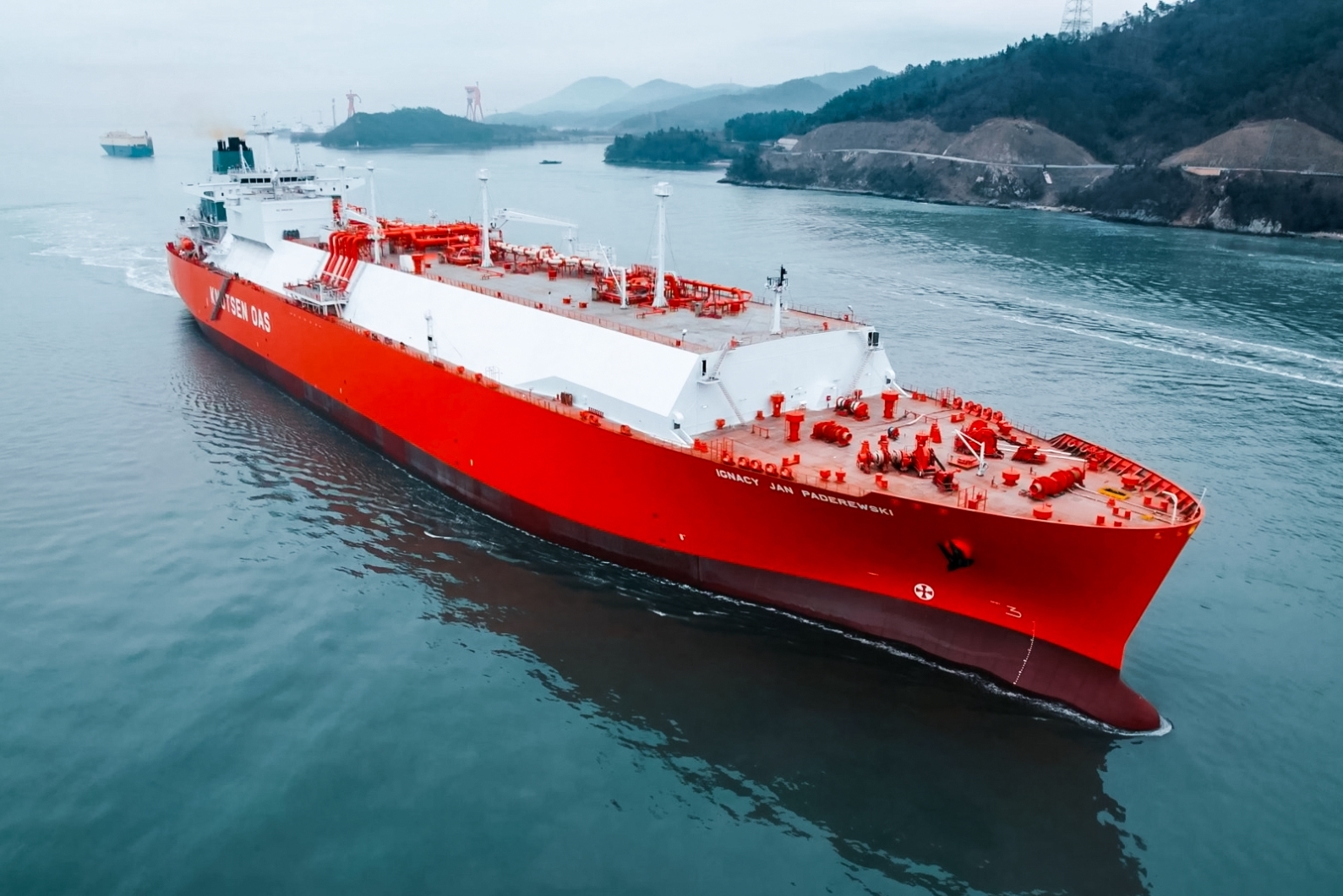
Up to two million Polish households could be powered by the gas delivered to the country by each of ORLEN’s new tankers. A naming ceremony for two new liquefied natural gas (LNG) carriers, built for the ORLEN Group, took place at the Hyundai Samho Heavy Industries shipyard in Mokpo, Korea. The godmothers of the “Józef Piłsudski” and “Ignacy Paderewski” were Anita Włodarczyk and Natalia Partyka.
The share of liquefied natural gas delivered by sea in Poland’s natural gas imports is systematically growing. In 2024, LNG accounted for nearly half of the gas imported into the country, with the entire volume of 70.22 TWh imported by the ORLEN Group. The new gas carriers will provide the company with greater flexibility in securing supplies in the coming years.
The new gas carriers are named after the architects of Polish independence: Józef Piłsudski and Ignacy Jan Paderewski. The godmothers of the vessels are decorated athletes: Anita Włodarczyk, an Olympic champion in athletics, and Natalia Partyka, a Paralympic champion in table tennis. Both ships are among the most modern vessels of this type in the world. They were built by Hyundai Heavy Industries, a company that is one of the leaders in the global shipbuilding industry.
The charter period covers 10 years with an option to extend. Each vessel can transport approximately 70,000 tons of LNG, which corresponds to about 100 million cubic meters of natural gas in its gaseous state. This is equivalent to the average weekly consumption of all households in Poland. The size of the ordered ships ensures their versatility and the ability to receive and deliver gas at almost all LNG terminals worldwide.
We are building Poland’s energy security and independence. We have adopted and are implementing a strategy of diversifying supply routes, in which we will use our own fleet of gas carriers. By next year, it will grow to eight vessels, and the portfolio of long-term contracts with American suppliers that we are building strengthens our position and guarantees the stability of raw material supplies. As a result, we can provide Polish customers with reliable sources of supply and also offer it on neighboring markets, including the Ukrainian one, strengthening the energy security of the region
– says Ireneusz Fąfara, CEO of ORLEN.
The construction of the ships utilized the most advanced technical solutions to increase their operational economy. These include integrated electricity consumption management and a reliquefaction system, which allows for the recovery of gas that naturally evaporates during transport. Furthermore, the gas carriers’ engines can use both diesel fuel and natural gas, which will ensure their compliance with environmental standards for maritime transport in the future as well.
The key role of a transition fuel
According to ORLEN’s strategy until 2035, natural gas will play a key role as a transition fuel in the energy transformation of Poland and the region, and its consumption will grow in the coming years, reaching 27 billion cubic meters within a decade. In response to these challenges, the company is implementing an ambitious investment program that will allow it to fully meet the national demand for this raw material. One of its key elements is securing LNG supplies.
The company receives LNG primarily at the Terminal in Świnoujście. So far, 347 deliveries with a volume of 27 million tons of LNG have been completed. Most of the cargoes arrived from Qatar (154) and the USA (167). Deliveries to Poland also arrived from Norway (16), Nigeria (3), Trinidad and Tobago (4), Egypt (2), and Equatorial Guinea (1). In the first quarter of this year, the company plans to receive 20 LNG deliveries at this terminal, 9 more than in the same period last year.
ORLEN also utilizes capacity reserved at the FSRU terminal in Klaipėda, Lithuania, where it has so far received 11 cargoes with a total volume of nearly 740,000 tons of liquefied natural gas. After regasification, the raw material is sent to Poland via the Poland-Lithuania gas pipeline. Part of the fuel is also directed to the markets of the Baltic states.
ORLEN is also expanding its capacity to receive liquefied gas at domestic terminals. The company has reserved the entire regasification capacity of 6.1 billion cubic meters at the floating LNG terminal being built in the Gulf of Gdańsk. The development of infrastructure will allow the Group to increase the number of liquefied natural gas deliveries received by up to 58 per year.
Source: ORLEN