








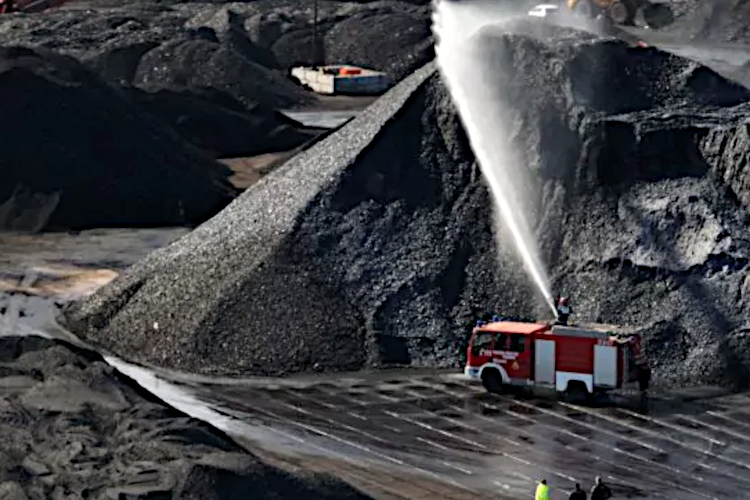
To reduce the number of handling operations, the company Port Gdański Eksploatacja has purchased new handling equipment that is significantly more efficient than what was used previously. Some of it is already operating on the quays, along with water curtains and cannons that generate mist to reduce dust.
Soon, two Liebherr LHM 550 mobile cranes will be delivered to the Dworzec Drzewny Quay. The first one in the second half of June 2023, and the second one at the end of the year. The cranes are equipped with grabs for coal and ore, as well as a universal container spreader, allowing for more coal to be handled in the same amount of time with fewer operations. In December of this year, two new Liebherr LHM 280 mobile cranes will be delivered to the Szczecińskie Quay. They are equipped for handling bulk cargo such as coal and grain, as well as sheet metal in coils (c-hooks), and have one universal container spreader. Contracts have been signed for all these cranes, and payments are being made according to the schedule included in the agreements.
– PG Eksploatacja has also purchased a closed-circuit wheel and chassis wash for trucks, and its installation is nearing completion. It is fully mobile and operates in a closed cycle, meaning it does not release any pollutants outside the facility. Ultimately, it will be operational in the coming days in the area of the Mining Basin (Basen Górniczy), in the part of the newly paved yard between the F1 security post and the truck scales. It is a mobile device with automatic scraper conveyors for removing contaminants – announces Łukasz Malinowski, President of the Port of Gdańsk Authority.
Furthermore, PGE has organized and purchased approximately 70 water curtains and cannons that produce water mist, and is carrying out recommendations to water the storage yards in the Mining Basin area. Similar solutions are also being used by other operators. In addition, the yards are being cleaned using wet methods, and the collected material is transported to designated waste disposal sites. The port also cooperates with firefighters, utilizing their expertise. In the event of strong winds, when the Port Master’s Office suspends work on the quays, operators are also required to suspend handling operations; they are also prohibited from loading coal onto trucks from a great height to limit dust. Most of the coal is intended to leave the port area by rail, which uses conveyor belts and loaders to handle the raw material. The conveyor belts must also be watered.
Street cleaning and pile management
The Port of Gdańsk and all operators working there clean communication routes, i.e., roads, sidewalks, parking lots, and mooring paths located on land properties under the management of the Port of Gdańsk Authority. Furthermore, in accordance with arrangements with the public road manager, the port cleans roads belonging to the city. The current campaign will be conducted until July 15, and if the need persists, it will be continued. Currently, the streets being cleaned are Ku Ujściu, Trasa Sucharskiego, Przetoczna, the tunnel under the Martwa Wisła, and the beginning of Płażyńskiego Street. In total, this covers over 287,000 square meters of surface area.
At the same time, companies involved in coal handling are sprinkling the piles according to weather conditions. To counteract dust, communication routes and storage yards are cleaned and swept using wet methods with equipment dedicated to such work, and the products collected in this way are transported to waste disposal sites. A cellulose and polymer preparation is used on the piles to reduce dust, and in the case of piles that begin to steam and smoke due to the large amount of water poured onto them, they must be compacted to cut off the oxygen supply to the smoldering spots. This may generate smoke and water vapor, which will cease once such a pile stabilizes. Compaction is carried out according to technology implemented from companies that deal with coal storage on a daily basis. Raw material stored for longer periods is laminated, which causes it to bind on the surface and become significantly more resistant to the influence of wind.
Coal and grain handling
In the port area in Gdańsk during the summer, operators will continue to handle coal with an intensity allowed by the transport organized by the recipients of this raw material in the country. It will be and is dependent on the space in coal depots at the locations of coal recipients. As autumn approaches, the collection and handling of coal for the next heating season will also take place again.
– The raw material is not imported only for the needs of households, but also for combined heat and power plants to secure heat and electricity for entire cities. Logistics companies employed by, among others, combined heat and power plants will distribute the coal to the final destinations, adhering to guidelines regarding transport speed and covering loads with tarpaulins. Most of the cargo, about 80 percent, leaves the port by rail – announces Kamil Tarczewski, Vice President of the Port of Gdańsk Authority.
In the case of road transport, if carriers do not comply with the procedures, the Port will cooperate with the Police to enforce the rules regarding moving with heavy loads on public roads.
The companies handling coal in the port area in Gdańsk are: Port Gdański Eksploatacja, Przedsiębiorstwo Przeładunkowo-Składowe Port Północny, Rudoport, J&S Energy, Przedsiębiorstwo Przeładunkowo-Składowe Siark-Port, Speed, Węglobud and Węglokoks, Handel i Minerały Nowak, and Polcopper. Since the beginning of the increased coal handling at the Port of Gdańsk, the port authority has been in dialogue with operators to maximize the reduction of the negative effects of handling in the form of excessive dust. Port operators assure that they are doing everything in their power to limit these effects on an ongoing basis. Port representatives also remain in contact with them daily and react to situations in the yards on an ongoing basis. Coal from the area leased by Siark-Port is to be removed by the end of May.
Less pollution, more parking spaces and sensors
In order to relieve potential congestion caused by trucks, the Port of Gdańsk Authority has allocated land for the organization of buffer points for semi-trucks. The so-called staging areas are located at: Budowniczych Portu Płn. St. (150 parking spaces), Ku Ujściu St. (80 spaces), Załogowa St. (currently approx. 50 spaces with the possibility of increasing to 300), and Śnieżna – Handlowa St. (170 spaces). Buffer parking lots are also planned at Kontenerowa St. (for 600 vehicles) and Budowniczych Portu Płn. St. (for 150 spaces). Currently, it is also seeking permission from the City of Gdańsk for additional parking spaces for vehicles in the vicinity of the Port, in connection with the possible increase in the number of grain transports from warehouses throughout Poland to the Port and further by ships to destination countries.
Furthermore, an application has been placed on the website www.portgdansk.pl that allows for viewing historical data regarding air quality for all sensors located in the port area. Thanks to it, one can find out what the air quality is on a given day in a given place, but also how it has changed over the last few days. Four new charts include data in the form of hourly averages for 3 days back and daily averages for 7 days back. Sensors monitoring air quality, the so-called YetiBoxes, are located in seven locations: in the Free Customs Zone, at the Szczecińskie, Oliwskie, and Krakowskie quays, at the Zakręt Pięciu Gwizdków, on Marynarki Polskiej Street, and in the Outer Port. Air quality data is also provided on Radio Gdańsk. The Port of Gdańsk also plans to install another, even more sensitive sensor in a location to be indicated by the Nowy Port District Council.
The Port of Gdańsk Authority, together with representatives of the Nowy Port district, is working to obtain the consent of the manager of municipal lands for new plantings in the Nowy Port area and is talking to other districts to plant more trees there as well. Currently, the port wants to plant 4,000 trees, for which it needs formal consent from the manager of the municipal lands. In Nowy Port, the planting project would take place along Oliwska Street.