









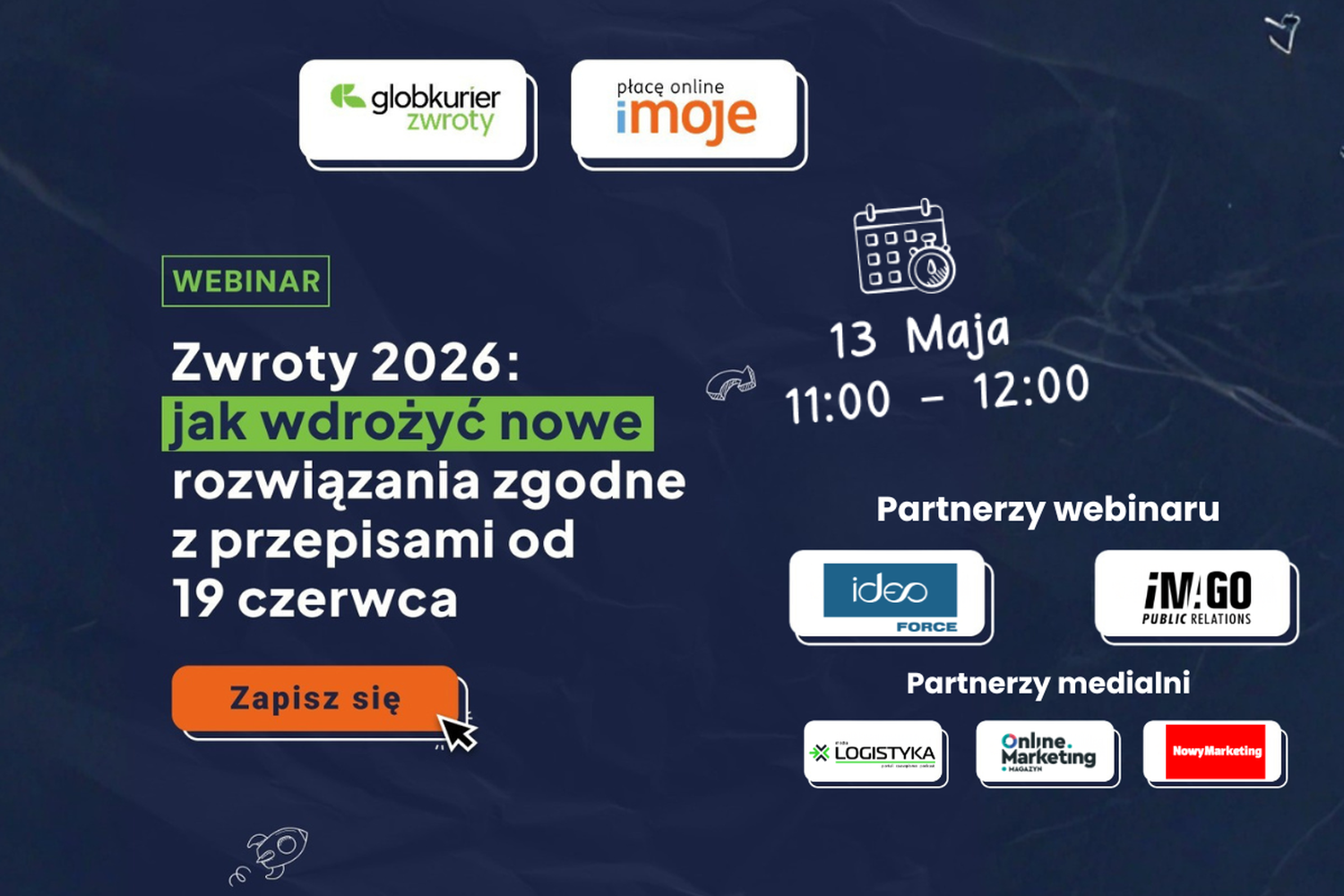
From June 19, 2026, online stores will be required to provide customers with a simple path for online contract withdrawal. For the e-commerce industry, this means not only a change visible on the store’s website, but also the necessity to organize the entire back-end of the process: from the customer’s decision, through the logistics of the return shipment, to the refund. Experts from GlobKurier and imoje will talk about the practical preparation of companies for the new requirements during the webinar “Returns 2026: how to implement new regulations in 1 day” (Wednesday, May 13).
In many stores, product returns still start with a message to customer service, a PDF form, or manual confirmation of the request. Only later does the separate organization of the shipment appear, followed by the next stage, which is the refund. With a small number of orders, such a model is often sufficient. However, at a larger scale, it begins to burden support, increases the risk of errors, and hinders ongoing control over the status of the case. The new rules, resulting from EU Directive 2023/2673 coming into force on June 19 this year, are intended to make it easier for consumers to withdraw from a contract. For sellers, this means providing an unambiguous online mechanism, such as a button or an appropriate function in the store.
Returns must be designed as a single path
However, from the sellers’ perspective, the mechanism itself is only the first step. After the customer clicks, the subsequent stages of the process will follow as before: receiving the request, choosing the return method, shipping the package, informing about the status, and transferring money to the customer. According to experts, the notification of contract withdrawal, handling the return shipment, and the refund should not function in isolation from each other, as this creates problems that grow with the scale of operations.
The less manual transfer of data between tools and teams, the easier it is to limit errors, shorten handling time, and maintain control over the customer experience. In this situation, the key question is: how to adapt the store to the new reality without rebuilding the entire e-commerce? During the webinar, we will cover this important topic and point out solutions that will help streamline the key element of the purchasing and sales process – says Agata Kędzierska-Zawisza, Head of Marketing & E-commerce at GlobKurier. – Importantly, we will focus on a practical discussion of the new obligations, without legal jargon and using examples showing the return as one, coherent process, not a collection of independent activities. Process efficiency based on available tools allows for the completion of a return in an average of just 120 seconds – adds the webinar co-host.
***
“Returns 2026: how to implement new regulations in 1 day” – Wednesday, May 13, 11:00 AM, duration 60 minutes.
Additional information and registration: globkurier.clickmeeting.com/zwroty-2026-jak-wdrozyc-nowe-przepisy-w-1-dzien
Organizers: GlobKurier, a technological logistics partner supporting e-commerce and business in domestic and international shipping; imoje, an e-commerce payment gateway belonging to ING Bank Śląski.
The webinar is aimed at online store owners, e-commerce managers, and people responsible for logistics, payments, customer service, and online sales development. It may be particularly useful for companies that want to prepare for changes in advance, reduce manual return handling, and use a ready-made solution instead of creating the entire process from scratch.
***
About Globkurier
Globkurier is a technological logistics partner for companies, comprehensively supporting e-commerce and business in organizing the flow of goods in domestic and international deliveries. The company’s competencies combine logistics experience with consulting and technology.
Globkurier cooperates with over 100 courier and transport companies, enabling the shipment of packages, pallets, and international freight to 192 countries. In this way, it effectively helps Polish enterprises open up to foreign markets. It serves both the SME sector and large organizations, offering comprehensive solutions including logistics planning, integration with sales platforms, and support in customs procedures.
Thanks to proprietary IT tools and a team of experts, Globkurier supports companies in building efficient, scalable, and global-ready logistics that keep up with their ambitions. The company has been recognized in the prestigious Financial Times FT1000 ranking, a list of the fastest-growing companies in Europe (link).