










Nagel-Group has introduced a pilot project aimed at optimizing task execution time and ensuring employee health. The study tracked 580 routes of 37 employees across 48 warehouse areas, allowing for the collection of 3.3 billion relevant data points.
The goal set by Nagel-Group was to eliminate non-ergonomic working positions, excessively long walking paths, and unnecessary employee activities, as these factors impact the maintenance of the highest safety standards and employee health. The results of the study conducted at the warehouse in Komorniki near Poznań allowed for important conclusions to be drawn and a new work system to be developed.
Motion-Mining®
The management of Nagel-Group, together with the German company MotionMiners, decided to implement a unique research program analyzing efficiency and ergonomics for process optimization. The main premise of the program was detailed monitoring of employee movement throughout their working hours—the distance covered in the warehouse, time spent in specific areas, and body positions during task execution. First, cameras were used for several hours to observe activities in all studied areas.
– Each employee wore wristbands and a belt with sensors, and devices installed in various locations (exactly 97 beacons) collected signals from employees via Bluetooth, then transmitted them to the cloud, where they were stored and analyzed. Of course, before we carried out the entire process, we prepared our employees for it. We informed them precisely about the purpose of the activities and what they could expect from the research team – says Mateusz Sikorski, Operations Director at Nagel-Group.
As many as 3.3 billion data points
The study lasted two weeks, during which exactly 3.3 billion data points collected from 580 routes covered by 37 employees in 48 areas were analyzed. A total of 74,000 working hours of all employees were examined. 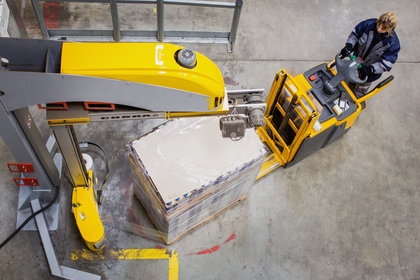 The processes of pallet picking and preparation for shipment were examined in detail. The conclusions from the study showed which areas required improvement and how significant the benefits of optimization could be.
Conclusions and new actions
– We were aware that we needed changes. The study confirmed our assumptions, and the hard data collected in the reports motivated us to make the right decisions – adds Mateusz Sikorski.
The conclusions from the study allowed for the optimization of routes taken by employees, the reduction of waiting times in various areas (e.g., at equipment), and the reduction of queues during picking and completion.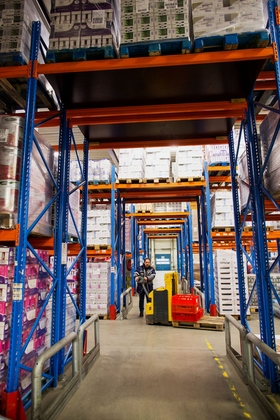 Changing roles (e.g., dedicated employees for pallet wrapping), using auxiliary equipment, and correcting the locations of printers or the positions of wrapping stations are further examples of time optimization for subsequent tasks. Additionally, it was possible to reduce the number of stops for pickers who were waiting for the opportunity to approach pallets from which goods were being picked.
– The study allowed us not only to save time but also to look in detail at work ergonomics, and thus reduce the number of situations where employees are in an uncomfortable position, e.g., bending, which accounted for 17% of working time. The study also showed that our employees covered as much as 8 km during a shift. These figures were reduced thanks to the conclusions from the study and the implemented optimizations. Furthermore, to take even better care of warehouse employees’ health and prevent injuries resulting from the nature of the work, the Komorniki branch is planning training sessions led by a physiotherapist and the installation of drawers for pallet racks. Thanks to this, working conditions in our warehouses are constantly improving – adds Agnieszka Talarczyk, HR & Marketing Manager at Nagel-Group.
Source: Nagel-Group