









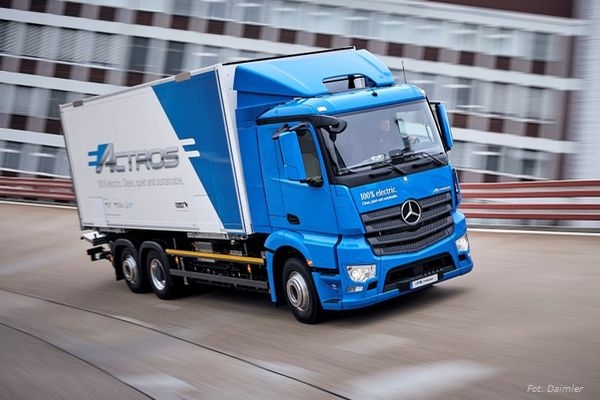
In many European cities, there is an increasing number of electric trucks being delivered by various manufacturers. An example of good practice is the implementation of a zero-emission freight transport strategy by the Daimler Group. The prototype of the world’s first electric truck premiered in 2016 at the IAA Commercial Vehicles show in Hanover. The implementation phase of the electric version of the popular Actros by Daimler began in the second half of 2018.
The first user of the eActros was the EDEKA retail chain, which has been testing the first unit on the streets of Berlin since September 2018. As part of the “innovation fleet” program, these innovative Actros trucks are joining the fleets of leading logistics operators. At the end of 2018, Dachser purchased its first truck to service a general cargo line between a micro-hub in Kornwestheim and the center of Stuttgart.
In July of this year, the Nagel Group put into operation an electric Actros with a gross vehicle weight (GVW) of 25 tons, which is used for transporting goods requiring controlled temperatures. This implementation specifically involves deliveries to customers, most often grocery stores located in the city center. As part of the cooperation between the Nagel Group and Schmitz Cargobull, the supplier’s refrigerated semi-trailers are used, equipped with a cooling unit that is also powered by electricity.
Under the aforementioned “innovation fleet” project, electric Actros trucks are being tested by customers from several industries who are shippers of various types of cargo (from food products to building materials). The vehicle tests are conducted under the same conditions as those in which diesel-powered Actros trucks are operated. In the tractor unit version operated by EDEKA, lithium-ion batteries with a capacity of 240 kW are used. Depending on the load, a full battery charge takes just 2 hours, and the vehicle’s performance is comparable to that of a conventional truck. The range of the eActros on a single charge is between 150 and 300 km. Battery charging takes place at night, after the truck has finished its route.
The development of the concept and the testing of heavy-duty trucks in urban distribution transport is the result of the “EconceptELV2” project, which has been running since 2018. The project involves 8 companies from Germany (Edeka, Dachser, Hermes, Nagel, Ludwig Meyer, pfenning Logistics, TBS Rhein-Neckar, and Rigtering) and 2 from Switzerland (Camion Transport and Migros). The assumptions of the entire venture were developed by Daimler AG and RWTH Aachen University. The project involves testing the vehicles until mid-2020, with the aim of comparing various scenarios regarding the efficiency of electric vehicles (e.g., energy consumption, cost-effectiveness) in relation to diesel-powered tractor units used under different operating conditions.