








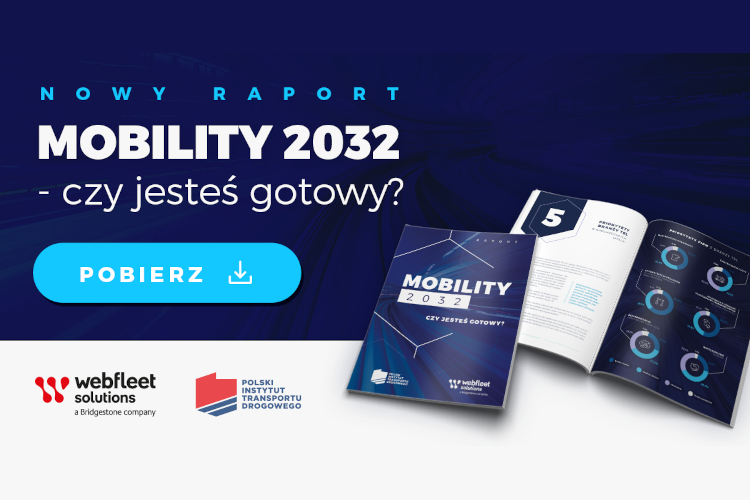
The report “Mobility 2032. Are you ready?” answers questions about what road transport will look like in 2032. It addresses technological challenges, climate policy goals regarding transport, and how a modern fleet influences the fight against CO2 emissions.
On April 26, 2022, an expert discussion took place regarding the challenges of the TSL industry in terms of mobility, as part of the Webfleet Mobility Conference. The conference was held under the slogan “Mobility 2032: Are you ready,” and this topic is being continued by Webfleet Solutions and the Polish Institute of Road Transport in the report Mobility 2032 Report: Are you ready?
The study was conducted among a group of 110 respondents, of which 52.8% were representatives of the transport industry, 31.5% were representatives of the forwarding and transport sector, and the remaining 15.7% were people from the trade, manufacturing, and courier services industries. Among them, the largest group consisted of companies employing up to 10 employees (37.1%) and companies where a fleet with a GVW of over 3.5t dominated – 82%.
– By 2050, European Union countries have committed to achieving climate neutrality, which also applies to transport, considered one of the main emitters of exhaust fumes. Poland has already declared that it will introduce a ban on the sale of new combustion engine cars from 2035. To check how Polish companies are prepared for this change, together with Webfleet Solutions, we have prepared a report that examines the main directions of transport and logistics companies for the next 10 years. Thanks to the research, we were able to obtain information on what the biggest trends in the TSL industry are, what is a priority for companies in the coming years, and what are the barriers to implementing new technologies – says Dr. Justyna Świeboda, President of the Polish Institute of Road Transport.
Modern fleet and the fight against CO2
In accordance with the COP26 declaration, Poland has committed to introducing a ban on the sale of new cars with combustion engines from 2035. Thanks to the report, it is possible to determine how companies fit into the trend of fighting the carbon footprint. The study shows that 3/5 of the respondents are aware of the upcoming legal changes. 32.4% of respondents plan to increase fuel efficiency by using less coal, oil, and gas. Nearly 1/4 of the respondents are focusing on renewable energy sources. Electric propulsion in long-haul transport is still a thing of the future. Only for 15% is it a very important issue, and only 10% intend to introduce EV vehicles into their fleet within 1-3 years.
Digital technologies in practical application
More than 2/3 of the respondents use or would like to use technologies dedicated to transport management, including electronic documents and fleet management systems. Only 1 in 10 respondents stated that they do not intend to implement them. Among the most popular solutions were telematics systems (including GPS monitoring), chosen by 20.6% of respondents. Similar interest is shown in: transport exchanges/logistics platforms (17.2%) and electronic documents (13.4%).
When it comes to the implementation of new tools, the most desired are systems enabling process automation and transport order handling (26.6%). There is a similar attitude towards using tools for analyzing and improving driver driving style (eco-driving); 25.4% declared such plans.
The speed and willingness to implement new technologies depend on many factors. The study and the Mobility 2032: Are you ready? report presented areas where the industry should encourage digitalization and education in this regard, as well as generating savings in companies. Lack of budget (25.5%) and high investment costs (25%) are the main reasons hindering the introduction of tools among the respondents. Next were lack of knowledge about technology (13%), unsatisfactory benefit-to-price ratio (10.9%), and employee fear of using new technologies (9.8%).
TSL industry priorities
The report showed that the priorities of companies’ operations are mainly issues directly related to operational activities. The most important issues are process automation, cybersecurity, trained personnel, and integration with exchanges and digital platforms. Of all the priorities assessed, more than half of the respondents considered them very important. According to the data obtained, goals related to climate policy and activities related to decarbonization turned out to be less important. The least important for respondents were: opening a company branch in another country (41.6%) and fleet electrification (40.4%).
Situation in the driver market
Staff shortages are currently one of the most pressing problems in the transport industry in Poland. This is a particularly important aspect for the surveyed companies, as as many as 84.3% employ drivers. 37.3% of companies observed significant staff turnover, and 46.7% believe that the situation will worsen in the next 1-3 months. To counteract the changes, respondents most often implement: training for employed drivers (18.4%), investments in a modern fleet (17.9%), and hiring drivers from other markets (17.3%). This problem is not helped by the introduction of the Mobility Package and the ongoing conflict in Ukraine. In addition, legal regulations and sanctions imposed in the East have caused 48% of respondents to withdraw from routes, mainly to Russia, Ukraine, and Belarus, in the last two months.
Key conclusions from the study:
- 32.4% of companies reduce carbon dioxide emissions by increasing fuel efficiency
- 20.6% use or would like to use telematics systems
- 26.6% of TSL industry representatives plan to implement process automation and transport order handling systems
- The most important priorities for TSL companies are process automation, cybersecurity, trained personnel, and integration with exchanges and digital platforms
- 40.4% of companies believe that fleet electrification is not a significant priority
- 46.7% of companies expect the situation in the driver market to worsen in the next 1-3 months
– The technological revolution is ongoing, and there is no doubt that the coming decade will change the face of transport and the way fleet companies operate beyond recognition. Currently, we are all more focused on neutralizing the changes and challenges that 2022 has brought us than on constructing long-term strategies, which is reflected in the results of this report – says Dariusz Terlecki, Regional Director Poland & EE at Webfleet Solutions. – It is gratifying that as many as 58% want to focus on process automation, nearly 43% intend to eliminate “paperwork” and want to digitize document flow, and over 50% see significant benefits in integration with transport exchanges and platforms.
Business mobility is changing, and technological progress and innovation will transform it exponentially. Transport companies wanting to continue to develop and build a competitive advantage must not only adapt quickly to these changes but also anticipate them.
What is blocking companies from the widespread implementation of green technologies? What can wider use of telematics give companies? How to prepare for the digital revolution? You will find answers to these and a number of other questions in the latest report: Mobility 2032. Are you ready?, which can be downloaded FOR FREE from the website: https://pitd.org.pl/mobility-raport/
The report was covered by media patronage by Media Logistyka.